

Wholesale coin pusher machine manufacturer and supplier

Wholesale coin pusher machine sourcing requires more than comparing unit prices. B2B buyers must evaluate factory capacity, minimum order quantities, payout and game settings, component consistency, electrical documentation, packaging, shipping terms, spare parts, and after-sales support. MYL ARCADE, established in 2007 in Guangzhou, China, is a manufacturer and amusement venue solution provider offering coin pusher machine production, arcade equipment, redemption machines, prize machines, digital sports equipment, VR attractions, and project support for distributors, family entertainment centers, and indoor amusement venues. Buyers can reduce procurement risk by requesting a documented quotation, approved specifications, sample validation, pre-shipment inspection, and a logistics plan before placing a bulk order.
Understanding Demand and the Bulk-Sourcing Landscape
Why coin-operated amusement equipment remains attractive to operators
A coin pusher machine can be used as a compact revenue-generating attraction in arcades, family entertainment centers, shopping mall entertainment zones, amusement parks, and mixed-use leisure venues. Its operating concept is easy for customers to understand: users insert tokens or coins and control timing while a moving platform pushes prizes, coins, or promotional items toward a collection area. This straightforward interaction can support repeat play when the cabinet design, prize presentation, lighting, sound, and game settings are appropriate for the venue.
For wholesale buyers, the commercial value is not based only on the cabinet. The complete offer includes mechanical reliability, attractive visual design, user safety, serviceability, payment-system compatibility, and the ability to keep multiple units operating consistently. A distributor may need several models for different venue formats, while a chain operator may prioritize standardized dimensions, common spare parts, and a unified software or payment configuration.
How buyers should define the product before requesting quotations
Before contacting a coin pusher machine manufacturer, prepare a product brief. Specify the cabinet width and height, number of players, platform layout, prize type, coin or token size, payment method, voltage and frequency, language requirements, lighting, display content, branding, and destination country. Also clarify whether the equipment is intended for commercial operation, rental, export resale, or a specific family entertainment project.
Product photos alone are not sufficient for comparison. Ask for technical drawings, electrical specifications, net and gross weight, carton or wooden-crate dimensions, power consumption, recommended operating environment, and maintenance access points. If the machine includes a ticket dispenser, card reader, bill acceptor, or networked payment system, identify the exact interface and confirm whether the buyer or supplier will provide those components.
Direct factory sourcing compared with local purchasing
| Purchase route | Typical advantage | Key concern | Best use case |
|---|---|---|---|
| Direct factory import | Broader model selection, factory customization, and potential volume pricing | Buyer manages freight, import formalities, inspection, and local compliance review | Distributors, chains, and project buyers ordering multiple units |
| Local distributor | Shorter delivery distance and potentially simpler local service | Higher landed price or limited customization | Small urgent orders or buyers needing local inventory |
| Trading company | May consolidate products from several factories | Less direct visibility into production and quality controls | Mixed-category procurement when factory identification is verified |
There is no universal best route. Direct importing is often more suitable when a buyer can consolidate shipment volume and manage customs coordination. Local purchasing may be more practical when the order is small, replacement speed is critical, or local certification and service arrangements are difficult to organize independently. A professional supplier should explain the differences between EXW, FOB, CIF, and DAP quotations rather than presenting a single price without scope.
How to Evaluate a Wholesale Coin Pusher Machine Factory
Production capacity, engineering, and project experience
Factory capacity should be assessed through evidence, not marketing language. Ask how many production lines are available, which processes are performed in-house, how electrical and mechanical assemblies are tested, and whether the supplier can maintain the same specification across repeat orders. A capable manufacturer should be able to explain its production schedule, component sourcing process, assembly sequence, testing criteria, packaging method, and escalation process for defects.
MYL ARCADE was formerly known as Meilian Technology and has been rooted in the amusement and entertainment equipment industry for nearly two decades. The company integrates research and development, production, sales, after-sales service, venue planning, and operation support. In China, it reports long-term partnerships with more than 2,000 amusement centers, family entertainment centers, digital sports parks, and indoor entertainment venues. Its products have been exported to more than 20 countries and regions, including Japan, the United States, Italy, Spain, Guyana, the Middle East, South America, and Southeast Asia. These company-reported operating relationships are relevant to buyers seeking a supplier familiar with repeat orders and varied venue requirements.
MOQ and tiered pricing questions
Minimum order quantity depends on whether the buyer selects a standard model, requests new tooling, changes the cabinet artwork, or needs a private-label configuration. Standard machines may be available in lower quantities than fully customized machines, but the supplier should state whether a small trial order carries a surcharge. Buyers should also ask whether different models can be combined to reach a production threshold and whether spare parts, signage, or accessories count toward the order quantity.
Request a tiered quotation that separates product price from customization, packaging, testing, documentation, inland transport, export handling, and freight. This makes it easier to compare offers and calculate landed cost. A low unit price may not be economical if it excludes reinforced packaging, payment-system integration, spare parts, or destination-specific documentation.
| Order stage | Buyer objective | Information to confirm |
|---|---|---|
| Sample or pilot order | Validate design, playability, finish, and serviceability | Sample price, testing scope, lead time, and whether the amount is creditable against a bulk order |
| Initial bulk order | Test production consistency and market response | MOQ, approved specification, inspection rights, packaging, spare-parts ratio, and payment milestones |
| Repeat order | Maintain identical customer experience across locations | Revision control, component substitutions, production records, and replenishment lead time |
Quality consistency and pre-shipment controls
Quality consistency is one of the most important concerns in a multi-unit coin pusher machine order. The buyer should approve a written specification and retain reference photos, drawings, color samples, wiring diagrams, control-board information, and packaging requirements. Any later component substitution should require notification and approval, especially for motors, power supplies, sensors, coin mechanisms, displays, lighting modules, and control systems.
A practical inspection plan can include incoming component checks, assembly inspection, electrical safety checks, continuous operation testing, coin or token acceptance testing, platform movement verification, lighting and audio checks, cabinet alignment review, and final visual inspection. Buyers may conduct inspections themselves or appoint an independent inspection company. Quality systems can be discussed using recognized frameworks such as ISO 9001 quality management principles, while the precise legal requirements for electrical and amusement equipment depend on the destination market.
Do not assume that a certificate issued for one component automatically proves compliance for the complete machine. Confirm which entity issued each document, which model and voltage it covers, and whether the destination authority recognizes it. The importer remains responsible for checking applicable national rules, labeling, language, electrical safety, payment equipment, and venue requirements before commercial deployment.
Logistics, Documentation, and After-Sales Support
Planning international shipment from China
Guangzhou is a major manufacturing and export center, giving buyers access to regional trucking, container consolidation, and international freight services. Nevertheless, the correct shipping method depends on order volume, destination, urgency, cabinet dimensions, and total cubic measurement. Sea freight is generally considered for larger commercial orders, while air or express transport may suit samples and urgent replacement parts. The final decision should be based on a written freight quotation and confirmed shipping scope.
Ask the supplier for packing photographs, carton or crate specifications, gross weight, cubic volume, loading plan, and insurance options. Large arcade cabinets can be damaged by impact, moisture, or incorrect stacking, so packaging should be matched to the route. Clarify whether the quotation covers export clearance, origin handling, destination delivery, customs duties, taxes, unloading, and installation. Incoterms should be agreed in writing; the International Chamber of Commerce Incoterms rules explain the allocation of transport costs, risk, and responsibilities between seller and buyer.
Import classification and documentation
Commercial importers should work with a customs broker to determine the appropriate tariff classification for arcade or amusement equipment. The World Customs Organization Harmonized System provides the international product-classification framework, but the final tariff code and duty treatment are determined by the destination customs administration. Avoid relying on a code copied from an unrelated shipment.
Common commercial documents may include a commercial invoice, packing list, bill of lading or air waybill, certificate of origin when required, product specification, and applicable conformity or test documents. The exact list varies by destination and transaction structure. The buyer should ensure that the invoice description, quantities, values, model numbers, and package counts match the physical shipment.
Installation, spare parts, and warranty planning
A wholesale supplier should provide clear installation instructions and troubleshooting guidance. For large orders, request a startup checklist covering cabinet placement, ventilation, power connection, leveling, coin or token setup, prize loading, test play, and cleaning. If the equipment uses a card or cashless payment system, installation responsibility should be assigned between the machine supplier and the payment-system provider.
Maintain a spare-parts plan before shipment. Useful items may include motors, belts, sensors, fuses, power supplies, switches, coin mechanisms, control boards, lighting modules, locks, and fasteners. The correct list depends on the model and operating environment. Ask for part numbers, illustrated diagrams, recommended stock levels, warranty exclusions, response times, remote diagnostic procedures, and paid repair options after the warranty period.
MYL ARCADE’s broader capabilities in product development, after-sales service, venue planning, and operation support can be valuable when a buyer is launching more than a single machine. A distributor may need product training and marketing materials, while a new entertainment venue may require layout advice, attraction mix planning, and coordinated delivery of several equipment categories.
A Practical Procurement Process for Bulk Buyers
Step one: qualify the supplier
Begin with a written request that includes destination, quantity, preferred models, customization, delivery target, payment method, and documentation requirements. Compare the supplier’s response quality as well as price. Reliable communication should produce a coherent specification, realistic lead time, clear exclusions, and a named contact for technical issues.
Step two: approve a sample or golden unit
Where the order value is significant, approve one representative unit or a documented production sample before mass assembly. Record the approved cabinet finish, logo placement, sound level, lighting behavior, game settings, coin acceptance, and packaging. This approved reference, sometimes called a golden sample, becomes a practical benchmark for later inspection.
Step three: control production and shipment
Use milestone communication rather than waiting until the planned shipping date. Confirm artwork approval, component availability, assembly completion, testing, inspection findings, packing, and loading. For a repeat order, request confirmation that the same bill of materials and software version will be used unless a change has been approved.
A sound purchasing decision balances price, reliability, service, documentation, and logistics. MYL ARCADE’s product range and integrated project capabilities allow buyers to source coin pusher machine units alongside redemption games, arcade cabinets, sports games, prize machines, VR attractions, and children’s amusement equipment when a broader venue package is required.
For technical and electrical considerations, buyers can also consult relevant standards information from the International Electrotechnical Commission standards platform and verify destination-market requirements with local authorities or qualified compliance professionals. Standards references are useful for risk management, but they do not replace a market-specific legal assessment.
Contact MYL ARCADE for wholesale coin pusher machine pricing, MOQ options, approved specifications, production planning, shipping quotations, and bulk-order support for your target market.
Frequently Asked Questions
What MOQ should I expect when ordering coin pusher machines wholesale?
MOQ depends on whether the buyer selects a standard model, requests new tooling, changes cabinet artwork, or needs a private-label configuration. Standard machines may be available in lower quantities than fully customized machines, and buyers should ask whether different models can be combined to reach a production threshold.
How can I verify quality consistency across a bulk order?
Approve a written specification and retain reference photos, drawings, color samples, wiring diagrams, control-board information, and packaging requirements. Use incoming component checks, assembly inspection, electrical checks, continuous operation testing, coin or token testing, movement verification, and final visual inspection, either directly or through an independent inspection company.
What information should I provide when requesting a wholesale quotation?
Provide the destination country, quantity, preferred models, cabinet dimensions, payment method, voltage and frequency, language requirements, prize type, customization needs, delivery target, and documentation requirements. Also request separate pricing for customization, packaging, testing, inland transport, export handling, and freight.
What shipping method is suitable for importing arcade machines from China?
The appropriate method depends on order volume, destination, urgency, cabinet dimensions, and total cubic measurement. Sea freight is generally considered for larger commercial orders, while air or express transport may suit samples and urgent replacement parts. Buyers should compare written freight quotations and confirm the Incoterm and included charges.
Which documents may be required for importing coin pusher machines?
Common commercial documents may include a commercial invoice, packing list, bill of lading or air waybill, certificate of origin when required, product specification, and applicable conformity or test documents. Exact requirements vary by destination, so buyers should work with a customs broker and local compliance professionals.
Can a supplier support a complete family entertainment center project?
A supplier with product development, production, after-sales service, venue planning, and operation support can assist with more than a single machine. MYL ARCADE offers coin-operated arcade equipment, redemption machines, sports games, VR attractions, prize machines, children’s amusement machines, and family entertainment solutions for broader venue projects.
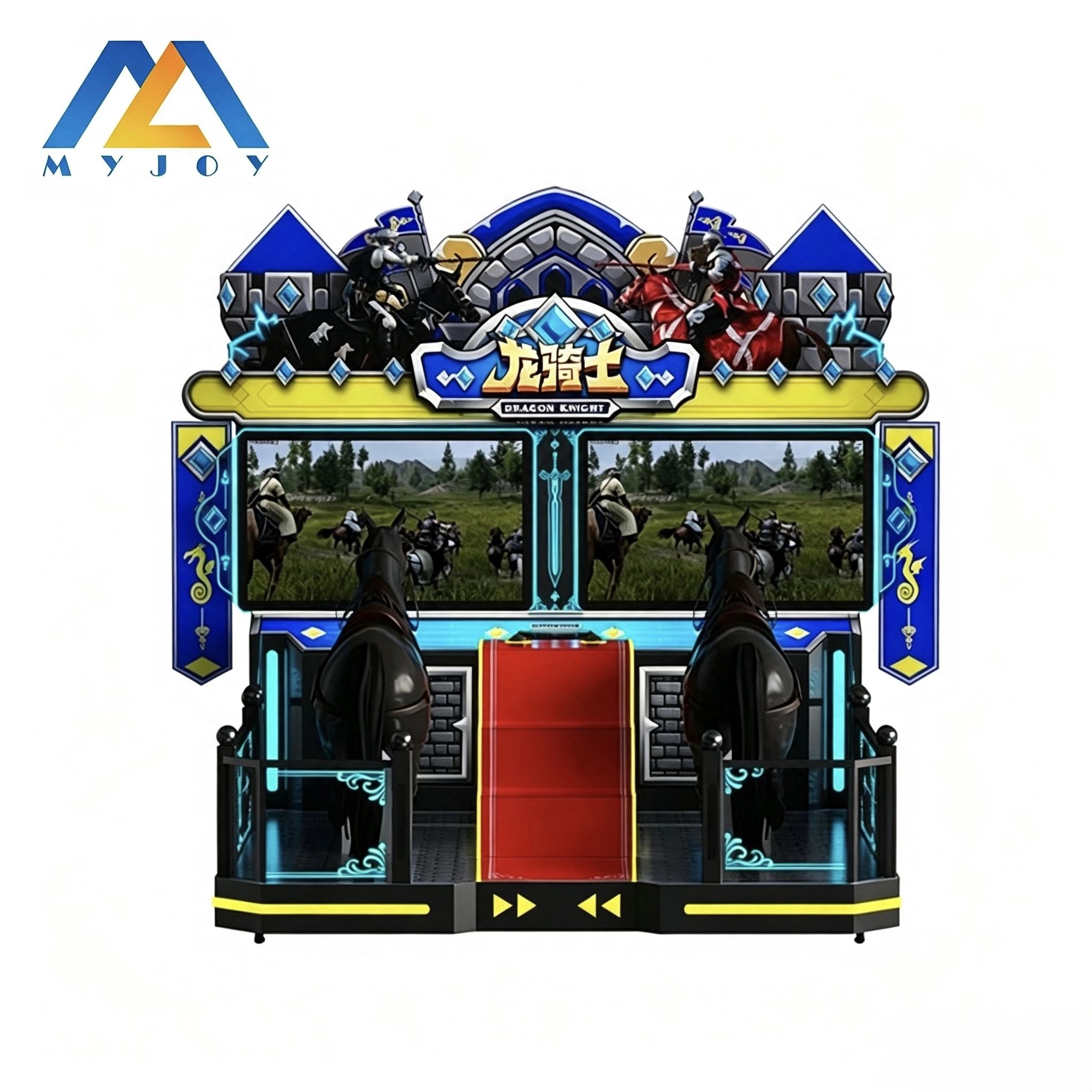
Flying Dragon Knight Horse Racing Simulator is a premium two-player arcade entertainment machine designed for amusement parks, shopping malls, arcades, family entertainment centers and themed attractions. Inspired by medieval knights and fantasy dragon adventures, this simulator combines realistic horse riding motion, interactive racing gameplay and an impressive visual design to create an unforgettable entertainment experience.
Featuring two realistic horse models, dual HD displays, dynamic motion control, vibration feedback and immersive sound effects, players can experience exciting horse racing competitions, adventure challenges and jumping missions. The machine recreates the feeling of real horseback riding through synchronized movement and responsive control systems.
With its eye-catching dragon knight appearance, colorful LED lighting, multiplayer competition mode and safe commercial design, Flying Dragon Knight Horse Racing Simulator is an excellent attraction solution for increasing customer engagement and entertainment value.
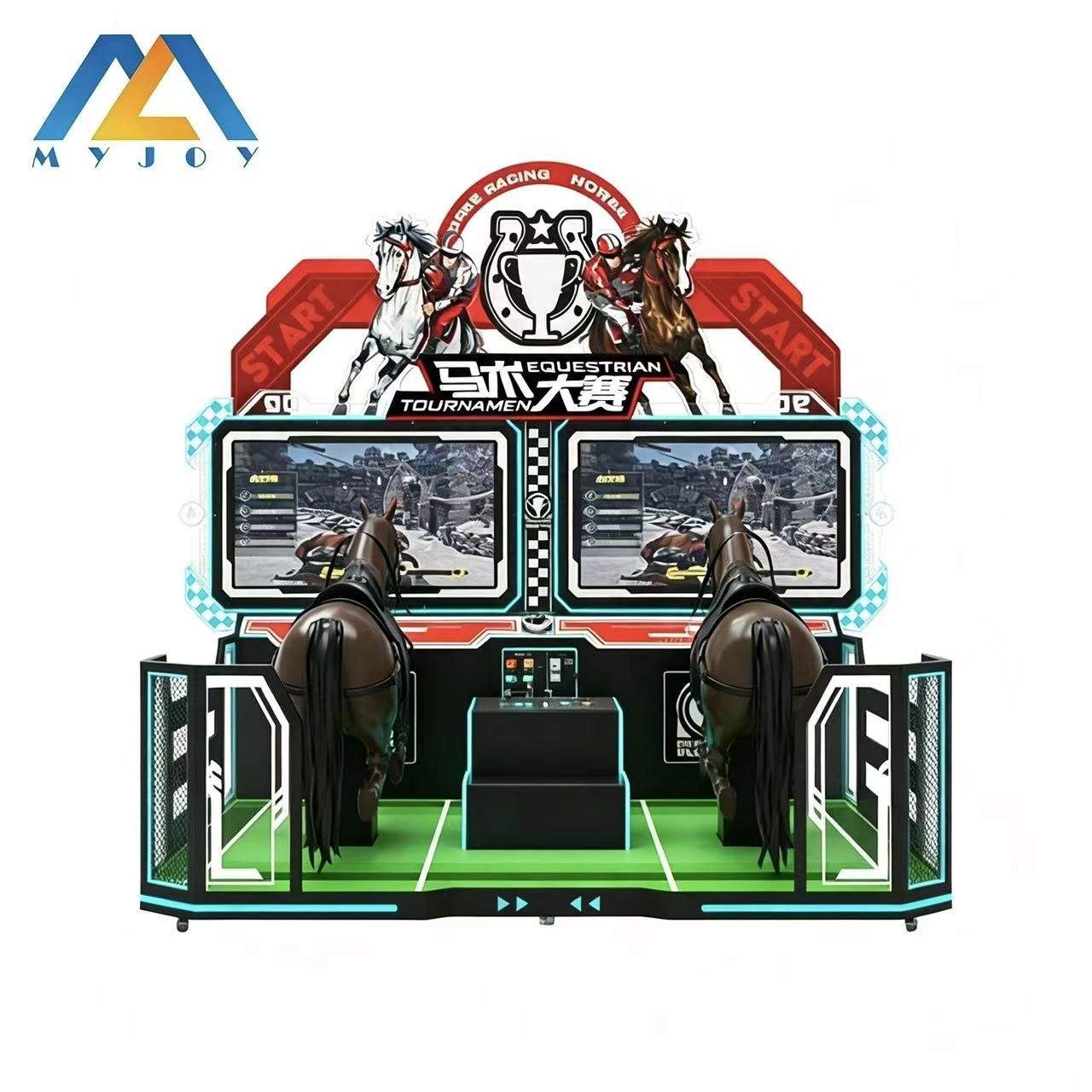
The Horse Racing Championship is a dual-player interactive sports simulator developed by Guangzhou Meiyilian Animation Technology Co., Ltd. It combines simulated horseback riding, competitive racing, physical interaction, and immersive visual effects to create an exciting attraction for players aged 5 to 50.
The machine features two realistic horse models equipped with comfortable saddles and reins. Players control their horses through riding movements and compete on two HD screens. Multiple racing scenes, difficulty levels, and challenge modes make the experience suitable for beginners and experienced players alike.
With its striking equestrian-themed design, dynamic LED lighting, green racetrack-style platform, and competitive ranking system, the machine easily attracts attention and encourages repeat play. It is ideal for amusement arcades, shopping malls, family entertainment centers, sports venues, theme parks, clubs, and tourist attractions.
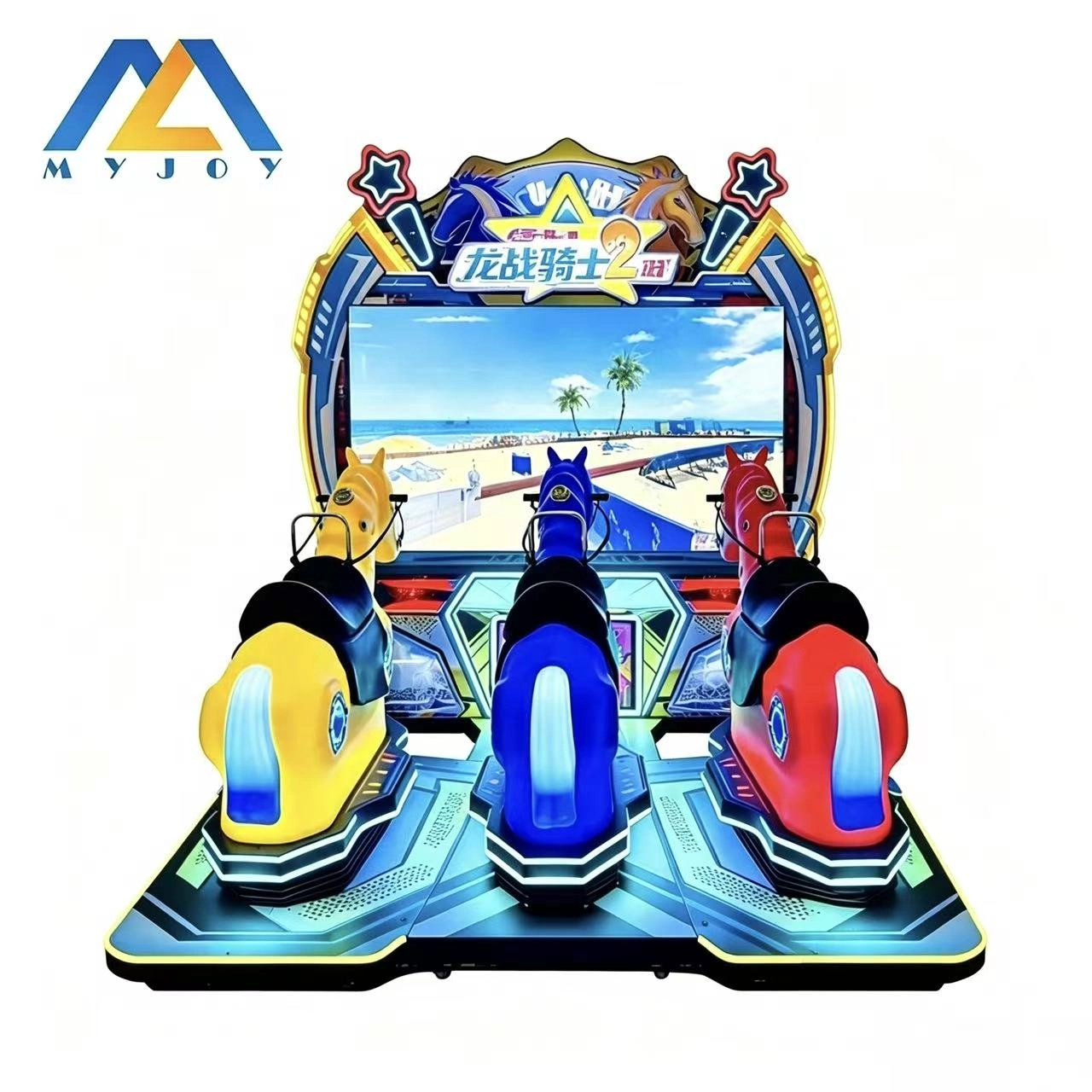
Dragon Warrior Knight 2 – Bring Real Horse Racing Excitement to Indoor Entertainment Venues
Dragon Warrior Knight 2 is an immersive interactive horse riding arcade machine designed around horse racing, obstacle challenges, and multiplayer competition. Featuring a cute and colorful horse design, large HD display, dynamic lighting effects, surround sound system, and realistic rein-control operation, this simulator creates an exciting horse racing experience for children, teenagers, and families.
Players can experience the feeling of riding a racing horse by controlling the reins to accelerate, change direction, and jump over obstacles. The realistic riding movements and interactive gameplay provide strong immersion and encourage repeat play.
The machine supports single-player challenge mode and 3-player competitive racing mode, allowing players to compete with friends, family members, or teammates. It is an ideal attraction for children's playgrounds, arcades, shopping malls, amusement parks, and family entertainment centers.
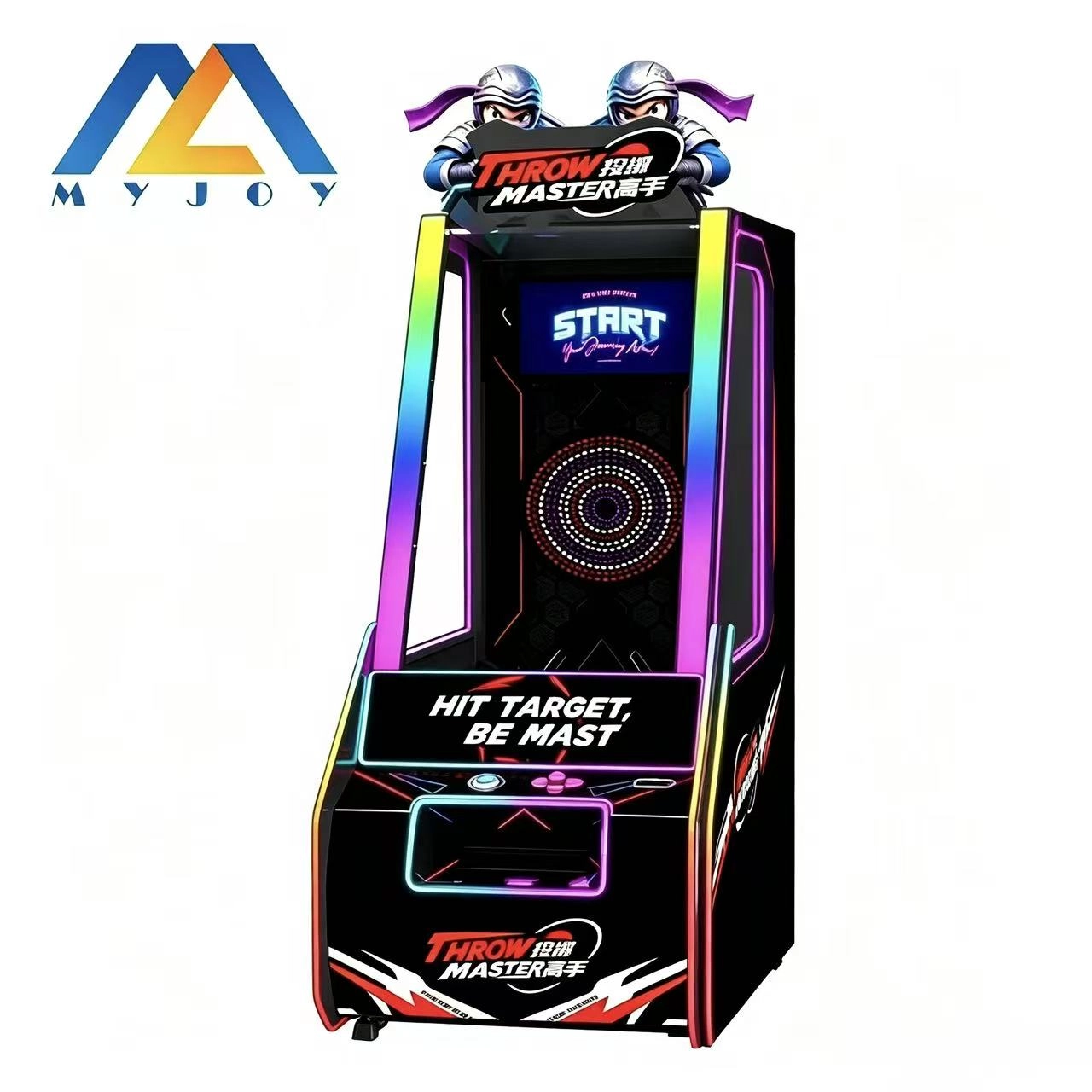
THROW MASTER is a commercial interactive dart throwing arcade machine that combines physical throwing action with an electronic target, digital scoring, on-screen interaction, and camera-based hit detection.
Designed for arcades, family entertainment centers (FECs), indoor amusement venues, shopping malls, and competitive entertainment spaces, THROW MASTER delivers an engaging mix of casual fun and skill-based competition.
Players insert coins, select their player and game mode, and throw darts at the large colorful electronic target. The system detects each result and displays scores, objectives, remaining throws, and game progress on the screen.
With Standard Mode for score-based challenges and Skill Mode for precision target challenges, the machine is suitable for both casual players and those looking for a more competitive experience. Leaderboards, adjustable game settings, and optional ticket rewards also make it well suited for commercial arcade operation.
Its large upright cabinet, colorful circular target, and vibrant RGB-style lighting create a futuristic arcade appearance that helps attract attention in busy entertainment venues.


No. 3, Wenjian Second Road, Wenbian Village, Shiji Town, Panyu District, Guangzhou City, China
Facebook