

Where to Buy coin operated games

For buyers sourcing coin operated games, the best purchasing channel depends on the destination country, delivery deadline, required game mix, and level of local service needed. Local distributors can offer faster delivery and nearby support, while direct-from-factory purchasing may provide broader customization and lower unit pricing for suitable wholesale orders. Compare total landed cost—not just the quoted machine price—and confirm applicable electrical safety, customs classification, import charges, warranty coverage, spare-parts availability, and shipping terms before placing an order. Because no target country or company profile has been provided, this guide explains how to evaluate options without assuming local regulations, supplier credentials, or market prices.
Understanding the buying landscape for arcade equipment
Local distributors and amusement-equipment dealers
A local distributor is often a practical starting point when a venue needs coin operated games quickly or requires installation and service from a nearby provider. Dealers may carry arcade cabinets, redemption machines, air hockey tables, kiddie rides, pool tables, or other coin- and payment-operated equipment. Buyers can sometimes inspect demonstration units, discuss venue layout in person, and obtain assistance with delivery, setup, and basic staff training. These benefits can be especially valuable for a first-time operator or a site with a fixed opening date.
Local availability does not automatically mean the overall purchase is less expensive or better supported. Ask whether the dealer is the manufacturer’s authorized representative, whether the quoted unit is new or refurbished, and which parts and labor are covered by the warranty. Confirm if the price includes freight, unloading, installation, payment-system configuration, and taxes. Obtain a written list of included accessories, software, coin mechanisms, and spare parts. For coin operated games, a low initial price can become a costly choice if the cabinet is difficult to maintain or essential components have long replenishment times.
Importers and regional trading companies
An importer or trading company may combine overseas purchasing with local invoicing, consolidated freight, and assistance with customs paperwork. This arrangement can reduce the number of suppliers a buyer must coordinate, and a regional intermediary may understand local delivery practices better than a factory selling internationally for the first time. However, intermediary margins, unclear warranty responsibility, and limited access to the original manufacturer can affect value. Buyers should establish which entity is responsible for technical support, replacement parts, product documentation, and claims if a shipment arrives damaged.
Before treating a trading company as the source, request the legal name of the manufacturer, the factory’s product documentation, and a clear description of the intermediary’s role. Confirm whether the seller will provide serial numbers, packing details, manuals, and a parts list before dispatch. These checks help operators compare like-for-like offers and reduce the risk of receiving a visually similar cabinet with different electronics, components, or software from the model evaluated.
Direct-from-factory purchasing
Buying directly from a manufacturer can suit operators, distributors, and multi-site businesses purchasing several machines or planning repeat orders. Direct sourcing may make it easier to discuss cabinet artwork, screen specifications, game libraries, payment interfaces, branding, and packaging with the production team. It can also provide direct access to technical documents and replacement-part identification. These advantages are not automatic: minimum order quantities, factory schedules, communication across time zones, and international freight can make a direct order less convenient for a single urgent replacement.
Assess a factory by reviewing its company identity, product range, written specifications, quality-control process, export experience, and ability to provide references or verifiable inspection evidence. A quality-management certificate can be one useful data point, but it does not prove that every machine meets the requirements of the destination country or that a particular production run will be defect-free. Buyers can learn what an ISO 9001 quality management system covers through the International Organization for Standardization’s ISO 9001 overview. Request the certificate scope and issuer details where certification is claimed, and independently confirm authenticity when it materially affects a purchasing decision.
Compare sourcing channels, compliance, and delivery risk
Compare total landed cost instead of unit price
For a meaningful comparison, calculate the expected cost to receive usable equipment at the operating site. Include the machine price, export packing, inland transport, international freight, insurance, customs duties, import taxes, broker fees, destination handling, delivery to the venue, installation, and any required payment-system setup. The applicable tariff classification and import charges depend on the product’s design and the destination country. Do not assume that all arcade cabinets or amusement machines use the same customs code or duty rate. The World Customs Organization’s Harmonized System overview explains the international basis for classifying traded goods; confirm the final classification and local charges with a qualified customs broker or the relevant authority.
Ask each supplier to state the trade term, named delivery point, currency, payment schedule, quotation validity, and what is excluded. Incoterms rules allocate certain responsibilities, costs, and risks between buyer and seller, but do not replace a full sales contract or determine every matter such as ownership transfer and payment. Review the exact rule and location on the quotation rather than accepting a general promise of “shipping included.” The International Chamber of Commerce Incoterms rules information is a useful reference when discussing delivery responsibilities with suppliers.
| Sourcing channel | Cost profile | Typical lead-time considerations | Customization | Support considerations |
|---|---|---|---|---|
| Local distributor | May have a higher quoted unit price; local delivery or service may be bundled, so verify inclusions. | Potentially shorter when the required model is in local stock; special orders can still take longer. | Usually limited to stocked models or options offered by the dealer. | Potentially convenient local service; confirm technician coverage, warranty terms, and parts stock. |
| Regional importer or trading company | May combine factory pricing with intermediary, freight, and local handling costs. | Depends on inventory, consolidation schedules, customs clearance, and onward delivery. | Varies according to the importer’s relationship with the factory and order volume. | Clarify whether the importer or manufacturer handles diagnostics, parts, and warranty claims. |
| Direct manufacturer | May offer competitive unit pricing at suitable volumes, but freight, duties, and destination costs must be added. | Includes production time, export preparation, transit, clearance, and final delivery. | Can provide more options for cabinet, branding, configuration, or packaging, subject to minimums. | Requires agreed remote support, documentation, spare-parts planning, and a defined warranty process. |
Check local compliance before production or shipment
Electrical, radio, consumer-product, amusement-device, and payment-system requirements vary by jurisdiction and by machine configuration. A buyer should identify the rules that apply to the exact equipment before approving a purchase, rather than assuming a certificate issued for another market is sufficient. Check the required supply voltage and frequency, plug and cord type, electrical protection, labeling, language requirements, and any local inspection or registration obligations. If a machine includes wireless connectivity, a card reader, or other radio equipment, confirm whether separate approvals apply to those components.
Ask the supplier for model-specific test reports, declarations, labels, and manuals, then have the documents reviewed against the destination market’s requirements by a competent local adviser or regulator where necessary. The International Electrotechnical Commission’s standards information provides context on international electrotechnical standards, but a reference to an IEC standard alone does not establish legal compliance in every country. For coin operated games installed in public venues, also check local rules concerning accessibility, fire safety, anchoring, operator licensing, prize or redemption features, and age restrictions when applicable.
Plan shipping, inspection, and after-sales support
Ask for a realistic production and delivery schedule with separate milestones for order confirmation, pre-shipment inspection, dispatch, estimated arrival, customs clearance, and delivery to the final site. Transit estimates are not guarantees, particularly when ports, seasonal demand, inspections, or inland transport affect the route. Confirm the packaging method, crate dimensions and gross weight, loading arrangements, and whether the venue has suitable access for unloading. For large orders, define how shortages, transit damage, and non-conforming machines will be documented and resolved.
Before shipment, request dated photographs or video of the actual units, serial numbers, cabinet condition, screen operation, controls, sound, coin mechanism, and included accessories. If the order value or operational risk warrants it, arrange an independent inspection against an agreed checklist. Establish a support process in writing: response times, diagnostic information required, remote troubleshooting availability, warranty exclusions, parts pricing, and responsibility for international return freight. A supplier’s willingness to identify commonly replaced components and provide a recommended spare-parts kit can be as important as the initial sale price.
Make the purchase decision around operating economics
Match the machine mix to the venue
The best coin operated games are not necessarily the newest or most feature-rich models; they are the machines that fit the audience, available floor space, operating model, and maintenance capability. A family entertainment center may need a balanced mix of skill games, redemption equipment, and attractions for different age groups, while a bar, bowling center, or leisure venue may prioritize competitive play and durable cabinets. Request machine dimensions, operating weight, power draw, recommended clearance, and service-access requirements before finalizing a layout. Confirm that the payment method and coin mechanism are suitable for how guests will actually pay.
Ask for product demonstrations or reliable operating videos and evaluate controls, screen visibility, sound levels, cabinet stability, and ease of cleaning. If the game depends on software, clarify whether updates, licenses, or network services carry ongoing charges and whether the operator can manage settings locally. When comparing coin operated games, examine the expected maintenance burden and availability of components such as joysticks, buttons, power supplies, displays, coin acceptors, and control boards. Those details help estimate downtime and operating cost over the equipment’s service life.
Estimate return on investment with realistic assumptions
Build a simple financial model using the venue’s expected operating hours, customer volume, play price, utilization, revenue-sharing arrangements, and machine downtime. Deduct the landed equipment cost, payment processing where relevant, routine maintenance, parts, utilities, floor-space opportunity cost, and any venue or licensing charges. Use conservative utilization assumptions and test how the results change if opening is delayed, repairs take longer, or customer demand is lower than expected. A supplier’s sales forecast is not a substitute for the operator’s own site data.
For a multi-unit purchase, consider a pilot order or phased rollout when commercial terms allow. A smaller initial deployment can reveal whether the selected game types attract repeat play, whether the payment setup works smoothly, and how quickly service issues are resolved. Use the pilot to document actual revenue and maintenance needs before expanding. This approach may reduce the risk of committing the full budget to equipment that does not suit the local audience, even when the factory offer appears favorable.
Choose the supplier that can document its promises
A reliable sourcing decision rests on verifiable specifications and enforceable terms, not on broad claims of being the cheapest or best. Compare formal quotations that identify the exact model, configuration, quantity, warranty, production window, packing, delivery term, and payment milestones. Verify the seller’s registered business details and payment beneficiary, and use a payment structure appropriate to the order risk. For larger orders, consider written acceptance criteria, inspection rights, remedies for material defects, and a clear process for resolving disputes.
Direct manufacturer sourcing can be a cost-effective route when the buyer has adequate lead time, can manage import coordination, and places enough value on customization, wholesale pricing, and direct technical communication. A local dealer can be the better choice when immediate availability, installation, or nearby repair coverage outweighs a possible price High Quality. The right answer is therefore not identical for every buyer. Compare the same specifications across channels, validate destination requirements, and choose the supplier with the clearest evidence, practical support plan, and strongest total-value case.
Contact us to discuss direct shipping and request a wholesale quote for coin operated games delivered to your destination market.
Frequently Asked Questions
Is it cheaper to buy coin operated games directly from a manufacturer?
Direct manufacturer sourcing may offer competitive unit pricing at suitable order volumes, but buyers must add freight, customs charges, destination handling, delivery, installation, and support costs to compare total landed cost.
Should I buy from a local distributor or an overseas factory?
A local distributor may suit buyers who prioritize available stock, nearby service, and installation support. A direct factory order may suit buyers with adequate lead time who value wholesale purchasing or customization; compare full specifications and support terms before deciding.
What should I check before importing arcade equipment?
Confirm the destination market’s applicable electrical, product, labeling, radio, customs, and venue requirements for the specific machine. Verify model-specific documents, tariff classification, shipping terms, taxes, and the party responsible for customs clearance.
How can I compare supplier quotations accurately?
Compare the exact model and configuration, then account for machine price, packing, freight, insurance, duties, taxes, brokerage, handling, final delivery, installation, payment setup, warranty, and spare parts. Also verify the delivery term and named location.
What after-sales support should I require from a supplier?
Agree in writing on warranty coverage, exclusions, diagnostic and response procedures, remote support, replacement-part availability and pricing, and responsibility for return freight. Request manuals, a parts list, and serial-number records for the delivered machines.
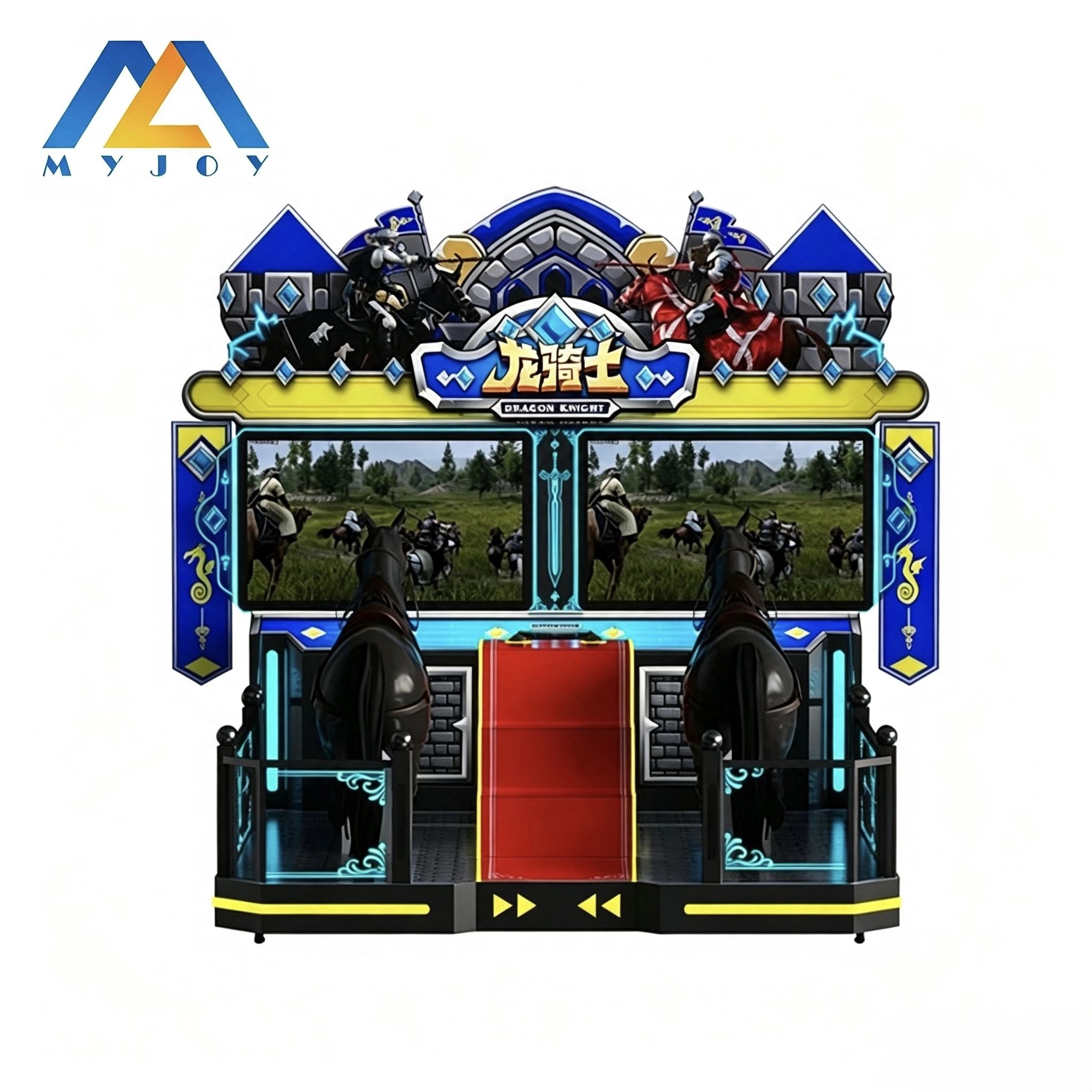
Flying Dragon Knight Horse Racing Simulator is a premium two-player arcade entertainment machine designed for amusement parks, shopping malls, arcades, family entertainment centers and themed attractions. Inspired by medieval knights and fantasy dragon adventures, this simulator combines realistic horse riding motion, interactive racing gameplay and an impressive visual design to create an unforgettable entertainment experience.
Featuring two realistic horse models, dual HD displays, dynamic motion control, vibration feedback and immersive sound effects, players can experience exciting horse racing competitions, adventure challenges and jumping missions. The machine recreates the feeling of real horseback riding through synchronized movement and responsive control systems.
With its eye-catching dragon knight appearance, colorful LED lighting, multiplayer competition mode and safe commercial design, Flying Dragon Knight Horse Racing Simulator is an excellent attraction solution for increasing customer engagement and entertainment value.
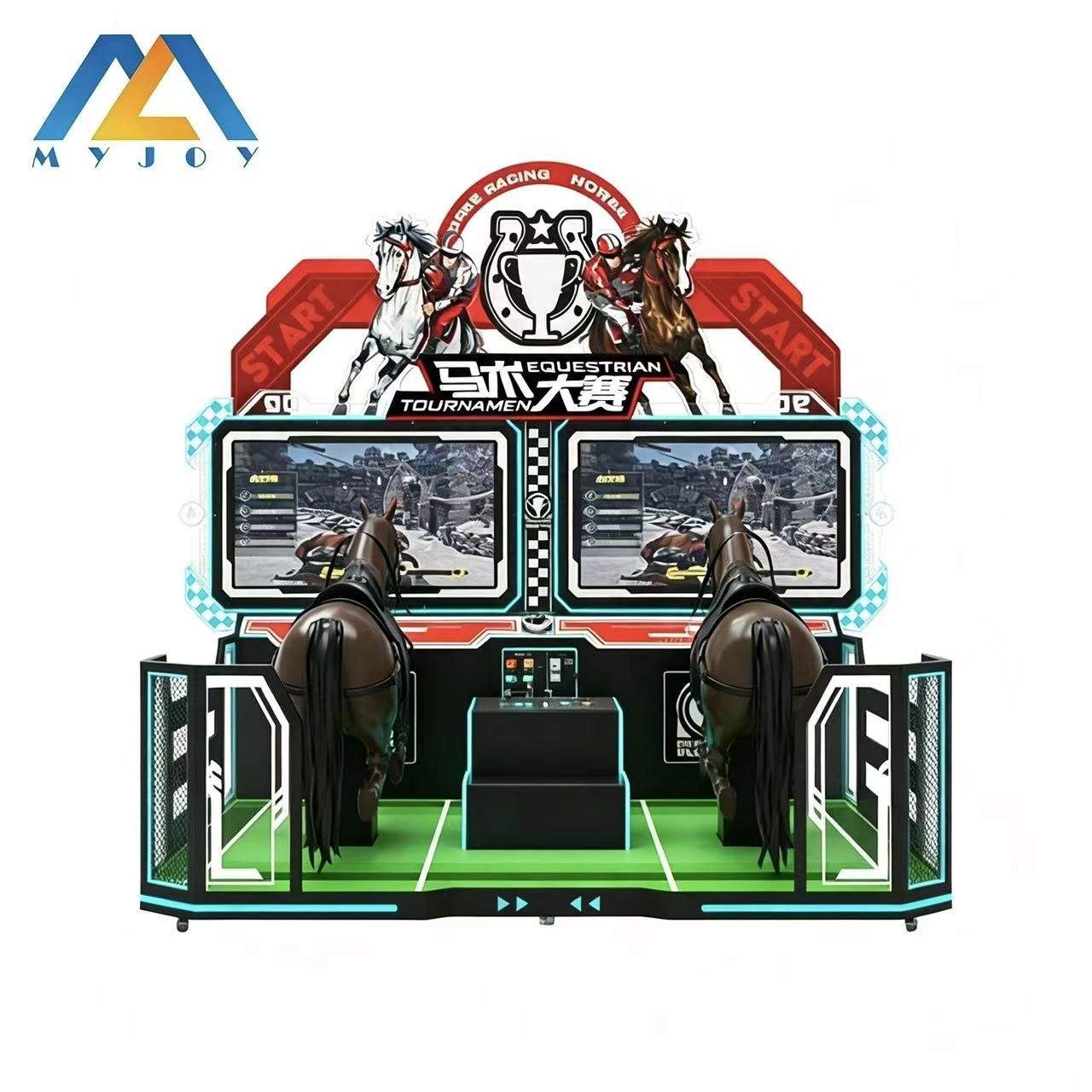
The Horse Racing Championship is a dual-player interactive sports simulator developed by Guangzhou Meiyilian Animation Technology Co., Ltd. It combines simulated horseback riding, competitive racing, physical interaction, and immersive visual effects to create an exciting attraction for players aged 5 to 50.
The machine features two realistic horse models equipped with comfortable saddles and reins. Players control their horses through riding movements and compete on two HD screens. Multiple racing scenes, difficulty levels, and challenge modes make the experience suitable for beginners and experienced players alike.
With its striking equestrian-themed design, dynamic LED lighting, green racetrack-style platform, and competitive ranking system, the machine easily attracts attention and encourages repeat play. It is ideal for amusement arcades, shopping malls, family entertainment centers, sports venues, theme parks, clubs, and tourist attractions.
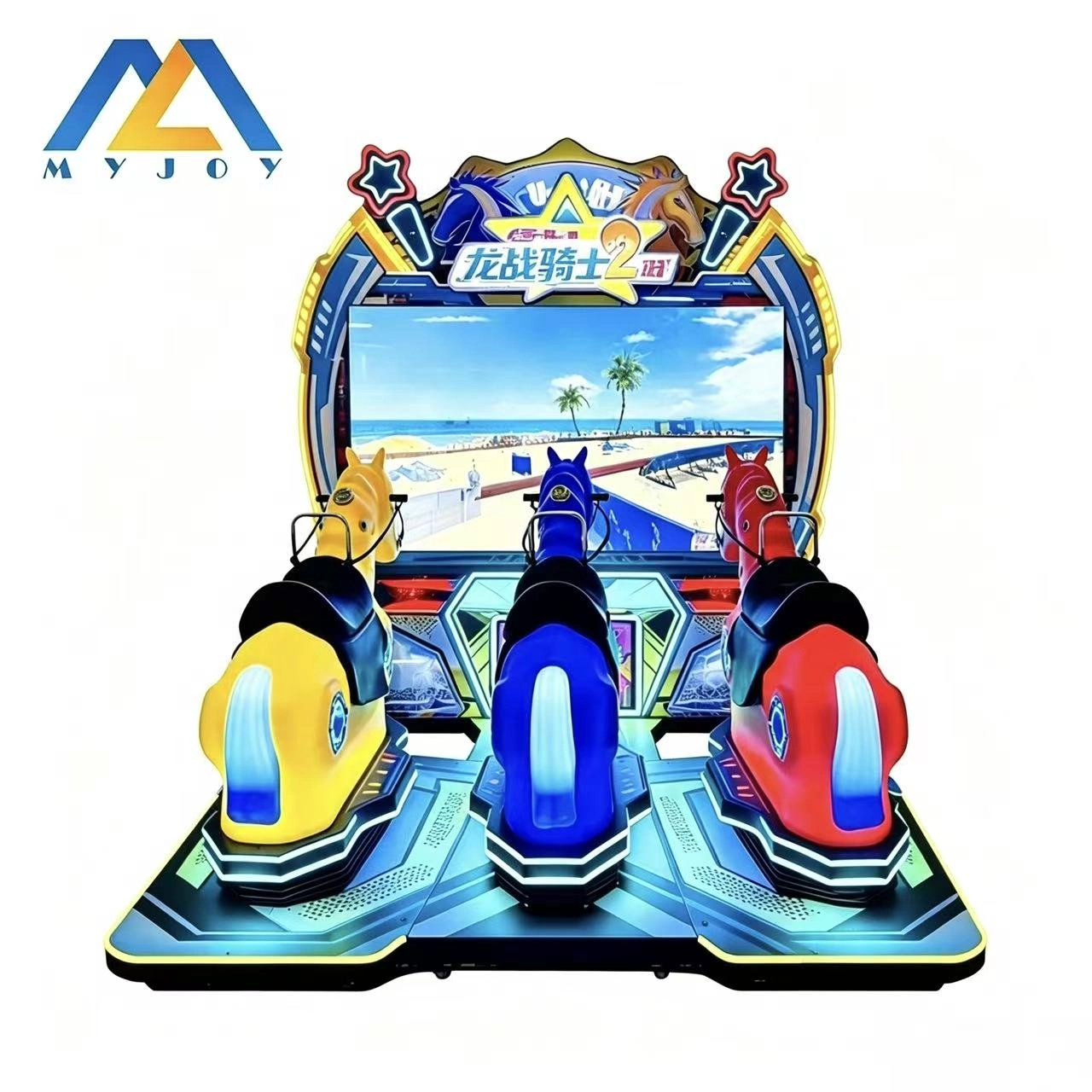
Dragon Warrior Knight 2 – Bring Real Horse Racing Excitement to Indoor Entertainment Venues
Dragon Warrior Knight 2 is an immersive interactive horse riding arcade machine designed around horse racing, obstacle challenges, and multiplayer competition. Featuring a cute and colorful horse design, large HD display, dynamic lighting effects, surround sound system, and realistic rein-control operation, this simulator creates an exciting horse racing experience for children, teenagers, and families.
Players can experience the feeling of riding a racing horse by controlling the reins to accelerate, change direction, and jump over obstacles. The realistic riding movements and interactive gameplay provide strong immersion and encourage repeat play.
The machine supports single-player challenge mode and 3-player competitive racing mode, allowing players to compete with friends, family members, or teammates. It is an ideal attraction for children's playgrounds, arcades, shopping malls, amusement parks, and family entertainment centers.
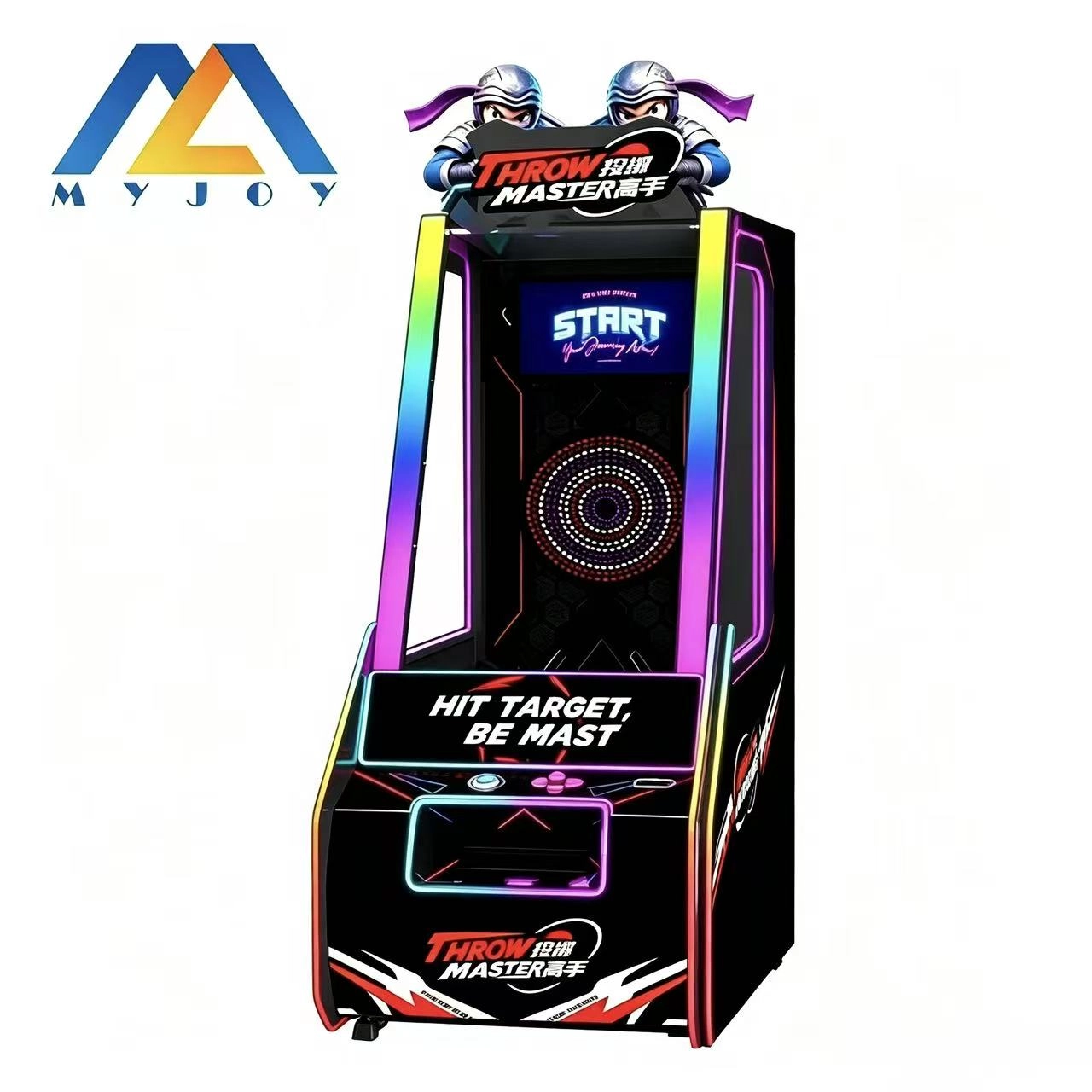
THROW MASTER is a commercial interactive dart throwing arcade machine that combines physical throwing action with an electronic target, digital scoring, on-screen interaction, and camera-based hit detection.
Designed for arcades, family entertainment centers (FECs), indoor amusement venues, shopping malls, and competitive entertainment spaces, THROW MASTER delivers an engaging mix of casual fun and skill-based competition.
Players insert coins, select their player and game mode, and throw darts at the large colorful electronic target. The system detects each result and displays scores, objectives, remaining throws, and game progress on the screen.
With Standard Mode for score-based challenges and Skill Mode for precision target challenges, the machine is suitable for both casual players and those looking for a more competitive experience. Leaderboards, adjustable game settings, and optional ticket rewards also make it well suited for commercial arcade operation.
Its large upright cabinet, colorful circular target, and vibrant RGB-style lighting create a futuristic arcade appearance that helps attract attention in busy entertainment venues.


No. 3, Wenjian Second Road, Wenbian Village, Shiji Town, Panyu District, Guangzhou City, China
Facebook