

Where to Buy ball shooting arcade games

For buyers seeking ball shooting arcade games in their region, the most practical sourcing routes are local amusement-equipment distributors, regional trading companies, and direct purchasing from an experienced overseas manufacturer. Local suppliers may offer faster delivery and simpler service, while direct factory sourcing can provide better wholesale pricing, customization, production transparency, spare-parts access, and project support. A sound purchasing decision should compare the complete landed cost, game durability, electrical compatibility, safety documentation, shipping terms, warranty response, and expected revenue rather than focusing only on the initial equipment price.
Understanding Demand and the Arcade Equipment Landscape
Why ball shooting arcade games attract venue operators
Ball shooting arcade games are popular in family entertainment centers, shopping-mall arcades, indoor playgrounds, sports parks, bowling venues, cinemas, and mixed-use leisure facilities because they are easy to understand and support short, repeatable play sessions. Players generally aim, shoot, and compete for scores, making these sports arcade games suitable for children, teenagers, adults, and group entertainment. Their visual movement, sound effects, score displays, and competitive format can also increase dwell time and encourage repeat visits.
For a venue operator, the strongest product is not always the largest or most technically complex machine. Buyers should evaluate footprint, player capacity, average play duration, cabinet visibility, ball-return reliability, screen brightness, noise level, cleaning requirements, and access to service components. A compact single-player basketball shooting machine may suit a small arcade, while linked multi-player ball shooting machines can create a stronger attraction in a larger family entertainment center.
Assessing the regional purchasing environment
Because the target market and country should be confirmed before quotation, buyers should first identify the local requirements that affect purchase decisions. These may include commercial electrical standards, plug and voltage specifications, import documentation, fire-safety rules, consumer-product requirements, venue insurance conditions, and customs classification. Requirements differ by jurisdiction, so a supplier should provide a technical file and shipping documentation that can be reviewed by the buyer’s customs broker, electrician, landlord, or local compliance adviser.
Buyers can also review sector information from the International Association of Amusement Parks and Attractions to understand current amusement-industry practices and supplier categories. Industry research should be combined with a site-specific feasibility assessment covering available floor space, customer demographics, pricing per play, peak traffic, and nearby competing attractions.
What to define before requesting quotations
A professional request for quotation should specify the desired game type, number of players, dimensions, voltage and frequency, language requirements, display format, coin or card-system interface, branding needs, delivery destination, quantity, and preferred Incoterm. It should also ask for packed dimensions, gross weight, warranty terms, recommended spare parts, installation instructions, production lead time, and a clear list of included accessories.
Providing this information at the beginning helps suppliers compare like-for-like products. It also reduces the risk of receiving a low equipment price that excludes shipping, control systems, lighting, payment-system integration, installation materials, or replacement components.
Local Distributors Versus Direct Factory Sourcing
Buying from a local distributor or trading company
Local distributors can be valuable when a buyer prioritizes short delivery times, local-language communication, on-site inspection, or domestic service. They may hold stock, arrange local installation, and understand regional payment systems. These advantages can be particularly useful for a first-time venue operator or a buyer working under a fixed opening date.
However, a local intermediary may source from several factories, making it important to confirm the actual manufacturer, model number, warranty responsibility, and spare-parts pathway. The resale price can include multiple margins, warehousing costs, local transport, and service charges. Buyers should ask whether replacement boards, sensors, motors, balls, displays, and power supplies are available locally or must still be imported.
Buying directly from an overseas manufacturer
Direct factory sourcing is often more competitive for multiple machines, new venue projects, franchise rollouts, and buyers requiring customized cabinets or software. The manufacturer can usually provide a single technical specification, production schedule, quality-control process, and packing plan. Direct communication also makes it easier to discuss logo application, cabinet colors, screen language, payment integration, linked play, game rules, and venue-wide product matching.
The buyer must, however, manage international logistics, customs coordination, payment risk, installation planning, and remote technical communication. These risks can be controlled by selecting a supplier with documented export experience, clear commercial terms, video inspections, pre-shipment testing, detailed manuals, and a defined after-sales procedure. A direct factory is not automatically the best choice; manufacturing capability and service discipline must be verified.
Channel comparison for procurement decisions
| Sourcing channel | Initial price | Lead time | Customization | Support model | Best fit |
|---|---|---|---|---|---|
| Local distributor | Usually higher because of domestic margins and handling | Potentially fast when stock is available | Often limited to available models | Local contact and possible on-site service | Urgent replacement or small quantity |
| Regional trading company | Variable and dependent on factory relationship | Stock or import schedule | Moderate, subject to supplier approval | Intermediary-managed communication | Buyers seeking sourcing assistance |
| Direct manufacturer | Often more competitive for wholesale quantities | Production plus international transit | Usually strongest option | Remote technical support and parts supply | New venues, chains, and project orders |
Compliance, Logistics, and Total Landed Cost
Checking electrical and product documentation
Before ordering ball shooting arcade games, confirm the rated voltage, frequency, plug type, power consumption, grounding method, and protection requirements. Ask the supplier for wiring diagrams, user manuals, product labels, and test documentation relevant to the destination market. Where applicable, the buyer should verify whether local authorities or landlords require specific conformity evidence before installation.
Quality-management credentials can provide useful evidence of process discipline, although certification does not replace product-specific verification. Buyers may review the principles of ISO 9001 quality management systems and ask how incoming materials, assembly, functional testing, and final inspection are controlled. For markets that reference electromagnetic compatibility requirements, buyers should also obtain the appropriate technical evidence rather than relying on an unverified logo or general statement.
Planning freight, customs, and delivery
Arcade cabinets are bulky and vulnerable to cosmetic damage if packed poorly. A quotation should identify whether the machine is shipped assembled or partially disassembled, how the cabinet is protected, whether corners are reinforced, and whether moisture protection is included. Request the carton or crate dimensions and gross weight so a freight forwarder can calculate realistic transport costs.
International orders may involve ocean freight, air freight, inland delivery, customs brokerage, duties, taxes, port charges, terminal handling, and final-mile delivery. The buyer should clarify the selected Incoterm, such as EXW, FOB, CIF, or DDP, and understand which party is responsible for each stage. Customs treatment depends on the importing country and product classification; the buyer’s broker should confirm the applicable tariff code and documentation before payment. The World Customs Organization Harmonized System overview is a useful reference for understanding international goods classification, but it does not replace local customs advice.
Reducing installation and maintenance risk
Request a pre-shipment video showing power-up, gameplay, scoring, ball movement, sound, lighting, and payment-system functions. For larger orders, buyers can use an inspection company or appoint a local representative to verify quantity, cabinet condition, accessories, and packaging before release of the balance. The purchase contract should define acceptable defects, response times, replacement-part procedures, and responsibility for transit damage.
Recommended spare parts commonly include balls, sensors, buttons, power supplies, fuses, motors, control boards, LED modules, speakers, and wiring harnesses. Keeping a starter parts kit on site can reduce downtime, particularly when a venue is distant from the supplier. A supplier that provides diagnostic videos, labeled wiring, parts diagrams, and remote troubleshooting can be more valuable than one offering a slightly lower unit price.
Evaluating Quality, ROI, and MYL ARCADE as a Factory Partner
Measuring commercial return
Return on investment should be estimated using realistic operating assumptions. A basic model can multiply the average price per play by paid plays per day and operating days per month, then subtract venue rent allocation, payment-system fees, electricity, staffing, maintenance, marketing, and depreciation. Buyers should test conservative, expected, and optimistic traffic scenarios instead of using a supplier’s best-case revenue projection.
For ball shooting arcade games, placement is often as important as the cabinet itself. Positioning near entrances, prize counters, food areas, or other high-traffic attractions may improve visibility. Operators should track plays, revenue, error codes, downtime, repeat usage, and maintenance cost after installation. A/B testing different prices or linked competition formats can reveal whether the machine performs better as a standalone attraction or as part of a broader sports arcade zone.
Why factory experience matters
MYL ARCADE was established in 2007 and is located in Guangzhou, China. Formerly known as Meilian Technology, the company has been rooted in the amusement and entertainment equipment industry for nearly two decades. Its operating philosophy emphasizes integrity, progress, practicality, and mutual benefit, supported by capabilities covering research and development, production, sales, after-sales service, project planning, and operational support.
MYL ARCADE manufactures arcade game machines, redemption machines, sports arcade games, interactive digital sports equipment, VR attractions, prize machines, children’s amusement machines, and family entertainment solutions. In China, the company reports long-term partnerships with more than 2,000 amusement centers, family entertainment centers, digital sports parks, and indoor entertainment venues. Its products have also been exported to more than 20 countries and regions, including Japan, the United States, Italy, Spain, Guyana, the Middle East, South America, and Southeast Asia.
What buyers should request from MYL ARCADE
Buyers can request a model recommendation based on venue size, target age group, player capacity, and expected use. A complete quotation should include the machine specification, customization scope, production schedule, packaging details, shipping option, warranty coverage, spare-parts recommendations, and remote installation support. For a multi-unit project, MYL ARCADE can also be evaluated as a venue-planning and product-integration partner rather than only as an equipment vendor.
As with any international purchase, buyers should conduct their own due diligence, confirm destination-market requirements, and approve a final technical specification before production. A transparent factory relationship, documented inspection process, and practical after-sales plan help make direct sourcing of ball shooting arcade games more predictable and cost-effective.
Contact MYL ARCADE for direct shipping and wholesale quotations for ball shooting arcade games to your region, supported by nearly two decades of manufacturing experience and international project service.
Frequently Asked Questions
Should I buy ball shooting arcade games from a local distributor or directly from a factory?
A local distributor may offer faster delivery, local-language support, and possible on-site service, while direct factory sourcing can provide more competitive wholesale pricing, customization, production transparency, and spare-parts access. The best option depends on quantity, urgency, service requirements, and total landed cost.
What information should I include when requesting a quotation?
Specify the game type, player capacity, dimensions, voltage and frequency, language, display format, payment-system interface, branding requirements, quantity, delivery destination, and preferred Incoterm. Also request packed dimensions, gross weight, warranty terms, spare-parts recommendations, production lead time, installation instructions, and included accessories.
What electrical and compliance documents should I request?
Ask for the rated voltage, frequency, plug type, power consumption, grounding method, wiring diagrams, user manuals, product labels, and applicable test or conformity documentation. Requirements vary by destination, so the buyer should have the documents reviewed by a local electrician, customs broker, landlord, or compliance adviser.
How can I reduce damage and customs risks during international shipping?
Confirm whether the machine ships assembled or partially disassembled, request reinforced packaging and moisture protection, and obtain carton or crate dimensions and gross weight. Clarify the Incoterm and responsibilities for freight, customs brokerage, duties, taxes, port charges, and final delivery before placing the order.
What spare parts should I keep for ball shooting arcade games?
Common starter parts include balls, sensors, buttons, power supplies, fuses, motors, control boards, LED modules, speakers, and wiring harnesses. A supplier should also provide parts diagrams, labeled wiring, diagnostic videos, and a clear replacement-part procedure.
How do I estimate the return on investment of a sports arcade machine?
Multiply the average price per play by paid plays per day and operating days per month, then subtract rent allocation, payment fees, electricity, staffing, maintenance, marketing, and depreciation. Use conservative, expected, and optimistic traffic scenarios, and track actual plays, revenue, downtime, and maintenance after installation.
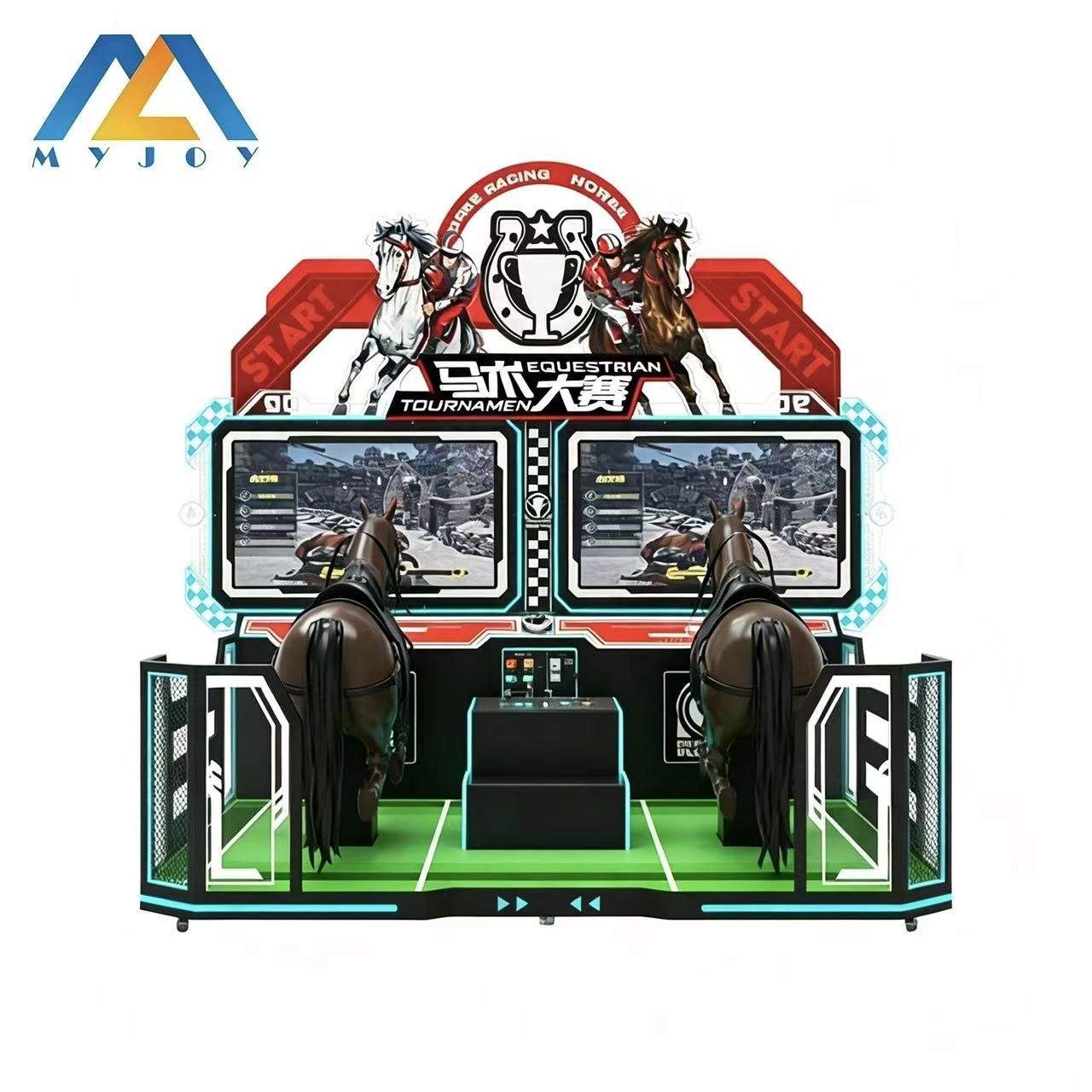
The Horse Racing Championship is a dual-player interactive sports simulator developed by Guangzhou Meiyilian Animation Technology Co., Ltd. It combines simulated horseback riding, competitive racing, physical interaction, and immersive visual effects to create an exciting attraction for players aged 5 to 50.
The machine features two realistic horse models equipped with comfortable saddles and reins. Players control their horses through riding movements and compete on two HD screens. Multiple racing scenes, difficulty levels, and challenge modes make the experience suitable for beginners and experienced players alike.
With its striking equestrian-themed design, dynamic LED lighting, green racetrack-style platform, and competitive ranking system, the machine easily attracts attention and encourages repeat play. It is ideal for amusement arcades, shopping malls, family entertainment centers, sports venues, theme parks, clubs, and tourist attractions.
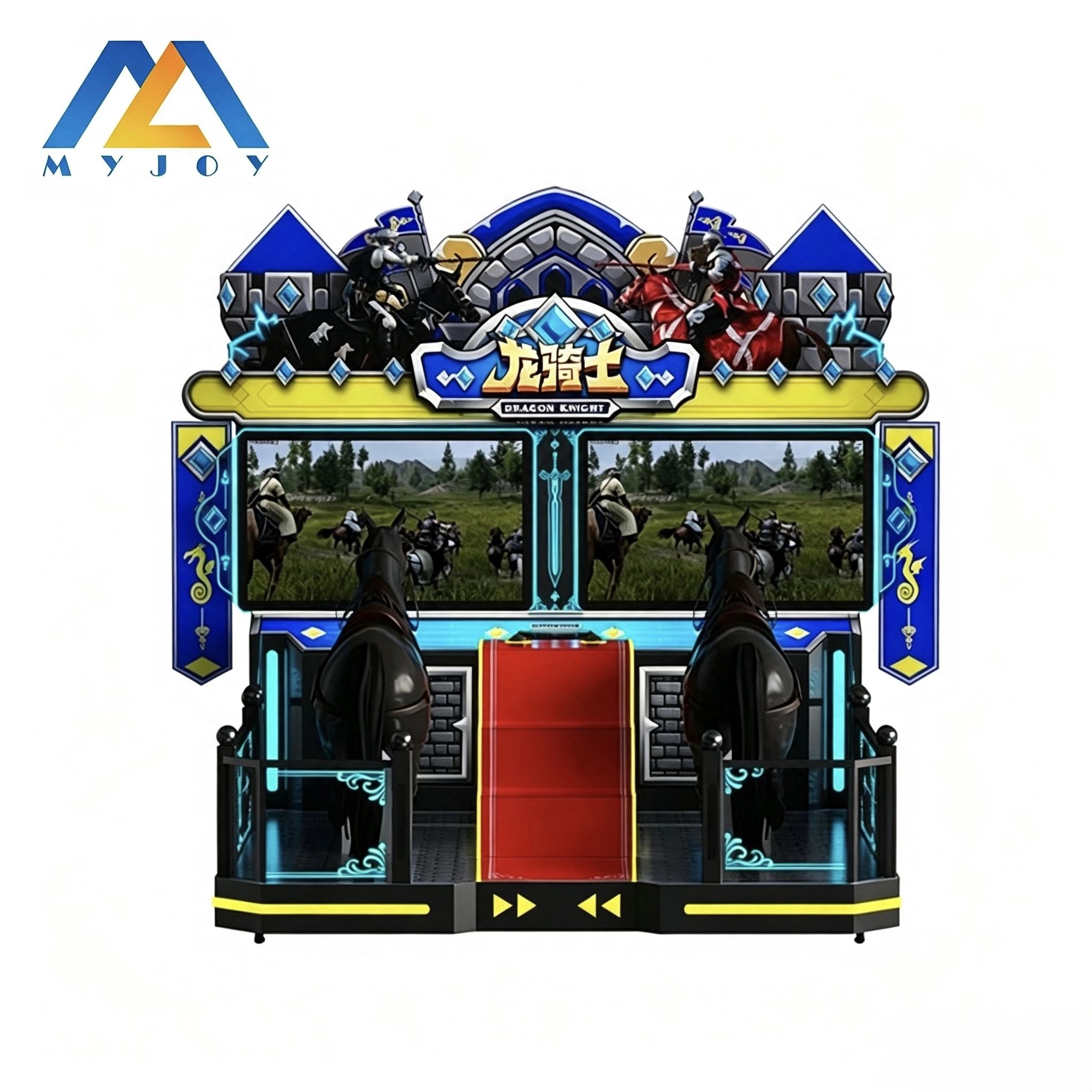
Flying Dragon Knight Horse Racing Simulator is a premium two-player arcade entertainment machine designed for amusement parks, shopping malls, arcades, family entertainment centers and themed attractions. Inspired by medieval knights and fantasy dragon adventures, this simulator combines realistic horse riding motion, interactive racing gameplay and an impressive visual design to create an unforgettable entertainment experience.
Featuring two realistic horse models, dual HD displays, dynamic motion control, vibration feedback and immersive sound effects, players can experience exciting horse racing competitions, adventure challenges and jumping missions. The machine recreates the feeling of real horseback riding through synchronized movement and responsive control systems.
With its eye-catching dragon knight appearance, colorful LED lighting, multiplayer competition mode and safe commercial design, Flying Dragon Knight Horse Racing Simulator is an excellent attraction solution for increasing customer engagement and entertainment value.
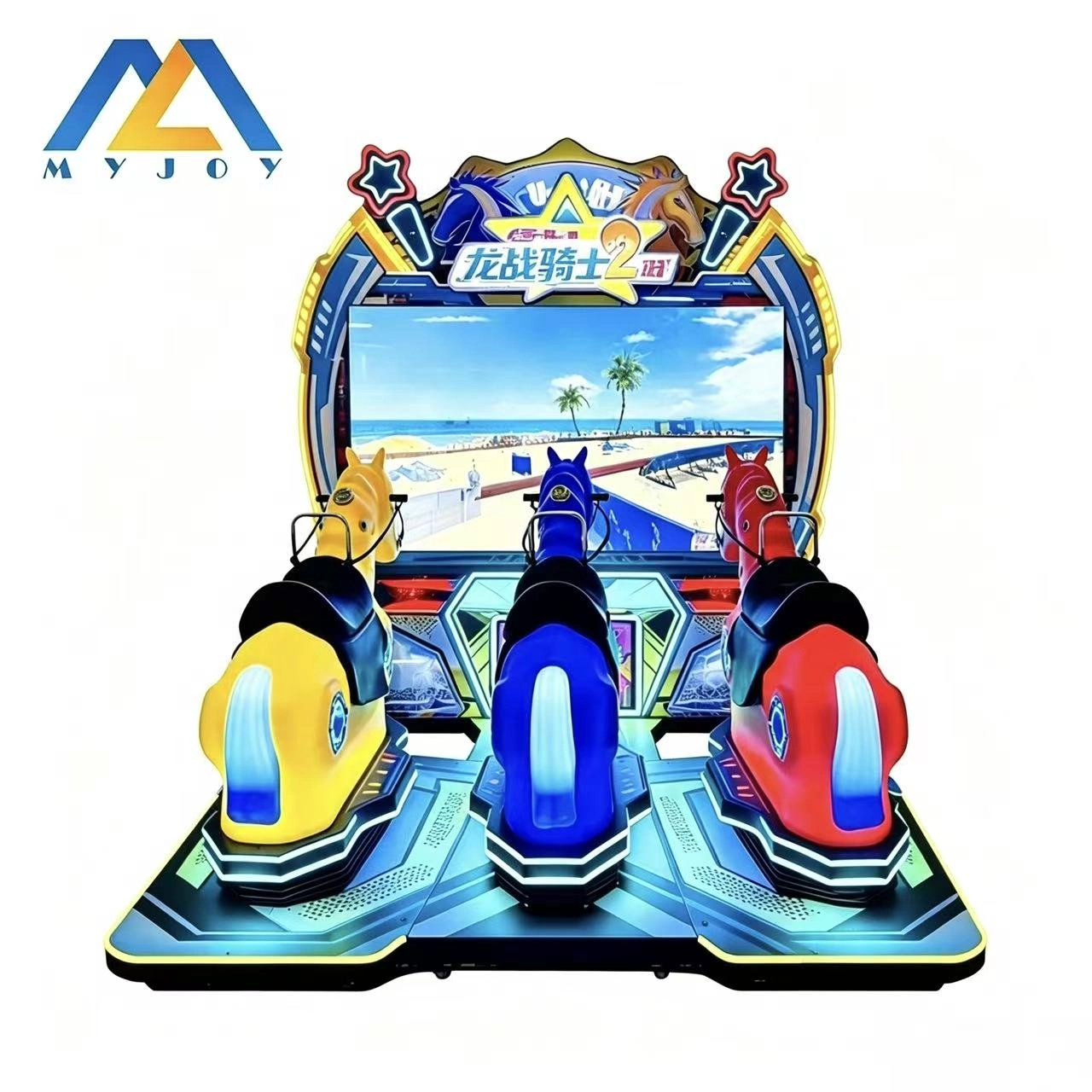
Dragon Warrior Knight 2 – Bring Real Horse Racing Excitement to Indoor Entertainment Venues
Dragon Warrior Knight 2 is an immersive interactive horse riding arcade machine designed around horse racing, obstacle challenges, and multiplayer competition. Featuring a cute and colorful horse design, large HD display, dynamic lighting effects, surround sound system, and realistic rein-control operation, this simulator creates an exciting horse racing experience for children, teenagers, and families.
Players can experience the feeling of riding a racing horse by controlling the reins to accelerate, change direction, and jump over obstacles. The realistic riding movements and interactive gameplay provide strong immersion and encourage repeat play.
The machine supports single-player challenge mode and 3-player competitive racing mode, allowing players to compete with friends, family members, or teammates. It is an ideal attraction for children's playgrounds, arcades, shopping malls, amusement parks, and family entertainment centers.
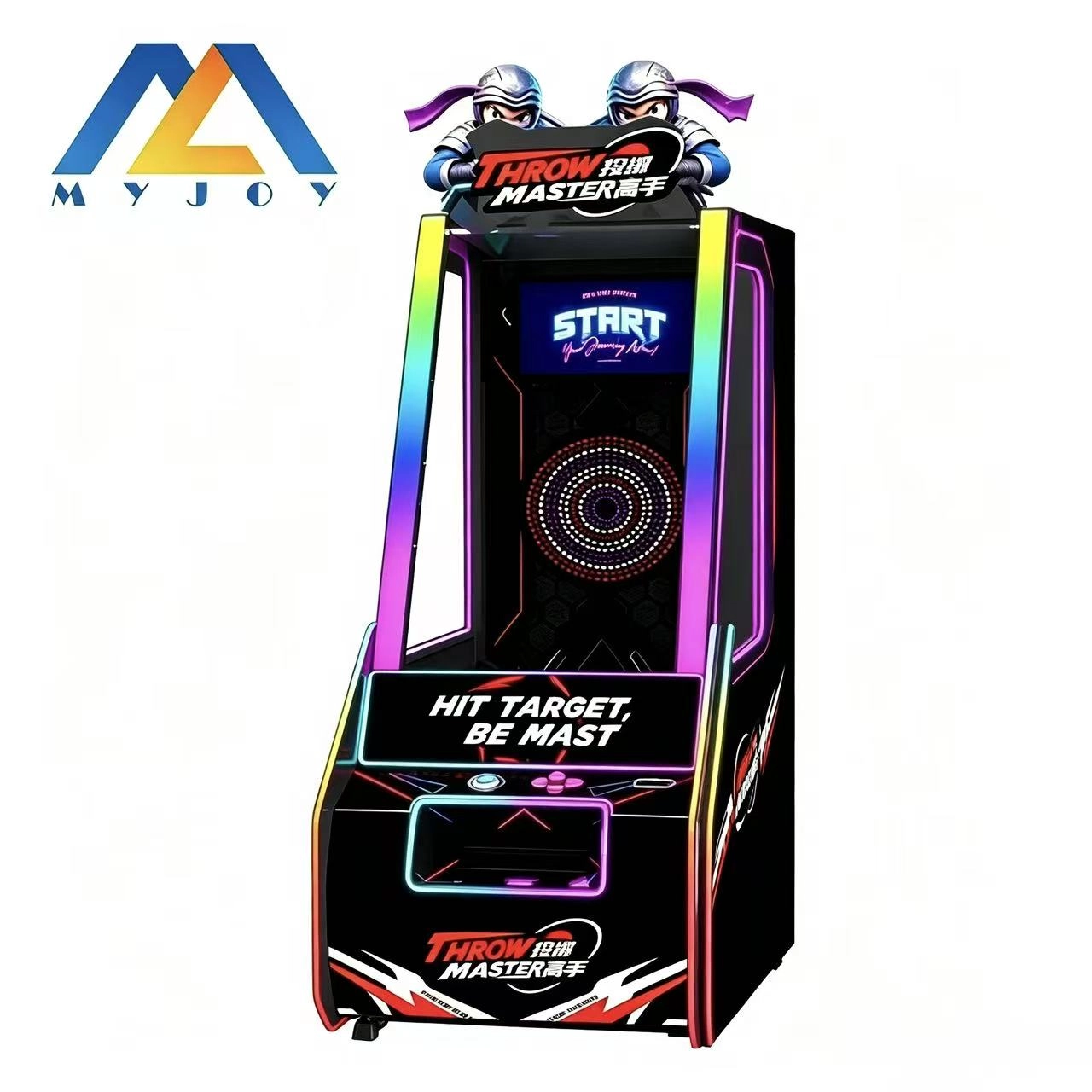
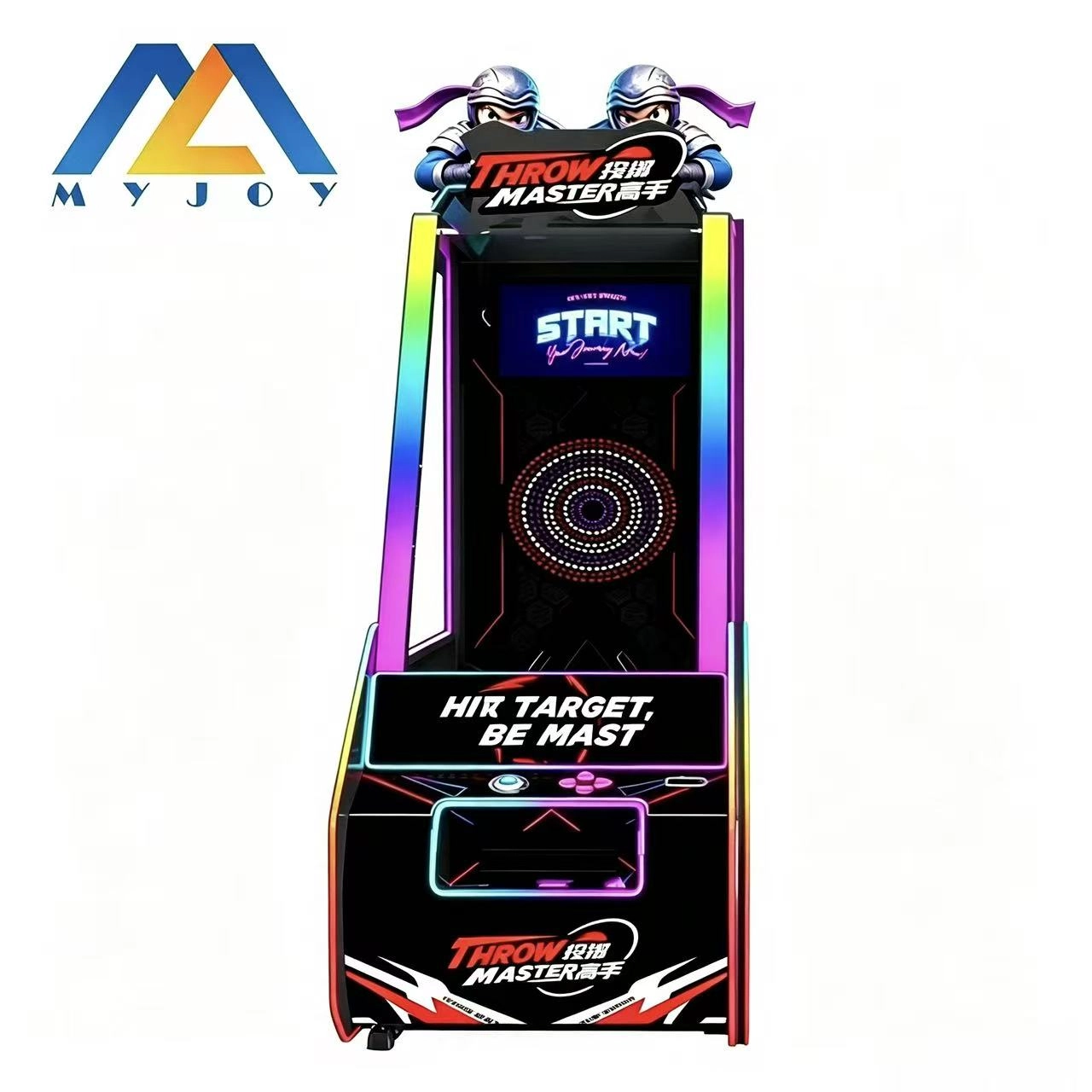
THROW MASTER is a commercial interactive dart throwing arcade machine that combines physical throwing action with an electronic target, digital scoring, on-screen interaction, and camera-based hit detection.
Designed for arcades, family entertainment centers (FECs), indoor amusement venues, shopping malls, and competitive entertainment spaces, THROW MASTER delivers an engaging mix of casual fun and skill-based competition.
Players insert coins, select their player and game mode, and throw darts at the large colorful electronic target. The system detects each result and displays scores, objectives, remaining throws, and game progress on the screen.
With Standard Mode for score-based challenges and Skill Mode for precision target challenges, the machine is suitable for both casual players and those looking for a more competitive experience. Leaderboards, adjustable game settings, and optional ticket rewards also make it well suited for commercial arcade operation.
Its large upright cabinet, colorful circular target, and vibrant RGB-style lighting create a futuristic arcade appearance that helps attract attention in busy entertainment venues.


No. 3, Wenjian Second Road, Wenbian Village, Shiji Town, Panyu District, Guangzhou City, China
Facebook