


What is family entertainment center (fec)? | MYL ARCADE Ultimate Insight

A family entertainment center (FEC) is a leisure venue designed to offer multiple activities in one destination, often combining attractions such as bowling, arcade games, soft play, laser tag, climbing, mini golf, or virtual reality with food, parties, and group events. A successful FEC aligns its concept, audience, layout, staffing, safety practices, and revenue model so that guests can enjoy a convenient, memorable visit while the business operates sustainably.
For operators, investors, landlords, and families, the term can be confusing. One venue may focus on children’s play, while another combines attractions for teens and adults. Without a clear definition, it is easy to compare unlike businesses or assume that a collection of games automatically makes a strong center.
That uncertainty matters. An unsuitable attraction mix can leave part of the intended audience with little to do, while poor circulation, unclear pricing, or weak maintenance can undermine the guest experience and increase operational risk. The practical solution is to understand an FEC as an integrated entertainment operation—not simply a building filled with equipment—and evaluate its offer against the people it aims to serve.
Understanding the Role of a Multi-Attraction Venue
What a family entertainment center is
A family entertainment center is a commercial venue that provides recreational experiences for families and other mixed-age groups. It may operate as a standalone destination, as part of a shopping or hospitality development, or as an attraction within a larger leisure complex. “Family” describes a broad audience rather than a requirement that every visitor arrive with children; many centers also serve teens, adults, birthday groups, schools, and corporate events.
The defining feature is the combination of activities and services under a coordinated guest experience. Depending on the concept, that can include active attractions, skill games, food and beverage, party rooms, redemption prizes, memberships, or event packages. An FEC may be primarily indoor, primarily outdoor, or a hybrid. Its size and equipment are not fixed by the label, so visitors and buyers should look at the actual offer, operating standards, and audience fit.
Why FECs matter to leisure and local communities
FECs provide a shared setting where different age groups can spend time together, even when they do not all want the same activity. A younger child might use a supervised play area while an older sibling bowls or plays arcade games, and adults can take part, socialize, or use food and seating areas. This variety can make a visit more flexible than a single-purpose attraction, though the result depends on thoughtful design and execution.
For a property owner or operator, a multi-attraction model can create several reasons to visit and opportunities to serve different occasions, from casual visits to birthdays and group outings. It also introduces complexity: different attractions have different space, staffing, maintenance, accessibility, and safety needs. The International Association of Amusement Parks and Attractions overview of family entertainment centers offers industry context, while the specific operating requirements for any venue depend on its attractions, location, and applicable regulations.
How FECs Work and Which Formats Are Common
The operating model behind the guest experience
An FEC turns a planned visit into a sequence of choices: guests discover the venue, understand how to participate, access attractions, take breaks, and decide whether to extend their stay or return. Operators coordinate admissions or activity pricing, reservations, queue management, staffing, cleaning, maintenance, food service, and customer support. Clear instructions and visible help are important because families may include first-time visitors and guests with different needs.
Revenue can come from admission, individual attractions, timed sessions, game cards, food and beverages, parties, memberships, or group bookings. Not every center uses every method. A pricing model should be easy to understand before purchase and should reflect what the guest receives, including any time limits, height or age restrictions, required supervision, or exclusions. Operators should assess revenue alongside guest satisfaction, repeat visits, labor, maintenance, and the cost of keeping attractions available.
Safety is part of the operating model, not an add-on. Equipment must be selected, installed, inspected, and maintained in accordance with manufacturer instructions and applicable local requirements. Staff need practical procedures for opening checks, incident response, guest rules, and escalation. For amusement devices, operators can consult the scope of ASTM International Committee F24 on amusement rides and devices; the relevant standards and legal duties depend on the attraction and jurisdiction.
Common family entertainment center formats
FECs are often described by their leading attraction, but many blend several formats. The right category depends on the venue’s primary audience, local competition, available space, and operating capabilities. The table below compares common formats at a high level; it is a planning aid, not a guarantee of performance or a substitute for local research.
| Format | Typical attractions | Planning emphasis | Potential audience |
|---|---|---|---|
| Indoor play center | Soft play, climbing structures, toddler zones | Age separation, supervision, cleaning, and safe circulation | Young children and accompanying caregivers |
| Arcade and social gaming venue | Video games, redemption games, simulators | Game mix, payment systems, visibility, and equipment uptime | Families, teens, and adult groups |
| Activity-led center | Bowling, laser tag, climbing, or go-karts | Capacity, session timing, staff training, and attraction-specific controls | Mixed-age groups, parties, and organized events |
| Outdoor or hybrid center | Mini golf, ropes courses, outdoor rides, indoor support areas | Weather planning, site access, seasonal demand, and outdoor maintenance | Families and groups seeking longer visits |
| Destination entertainment complex | Several attractions, dining, events, and party spaces | Wayfinding, coordinated operations, capacity, and service consistency | Broad local and visitor audiences |
Matching the format to the audience
A venue concept should begin with a defined audience and use case, not a shopping list of popular attractions. Consider who lives or works nearby, the age ranges the venue intends to serve, how guests are likely to arrive, and what alternatives already exist. A center targeting preschool families needs different play zones, seating, and supervision arrangements from a venue aimed at teens or mixed-age celebrations.
Accessibility should be considered from the start, including routes, entrances, restrooms, communication, and the way guests interact with attractions. A useful planning reference is the U.S. Department of Justice’s 2010 ADA Standards for Accessible Design. These standards apply in the United States, and requirements elsewhere vary. Operators should seek qualified local advice rather than treating a general guide as a complete compliance assessment.
How to Evaluate an FEC Before You Choose or Develop One
Assess the experience, safety, and suitability
For guests choosing a venue, start with practical fit: which activities are open, what ages and heights can participate, how pricing works, whether advance booking is needed, and what food, seating, or accessibility options are available. Check the center’s published rules and contact the operator if a requirement is unclear. Reviews can reveal recurring service issues, but they should be weighed alongside current information from the venue itself.
For owners or investors evaluating a site or operating business, inspect the condition and service history of attractions, the clarity of guest rules, staff training, incident procedures, cleaning routines, and maintenance records. Verify that equipment is appropriate for the intended use and that the business has a documented process for reporting and responding to incidents. The U.S. Consumer Product Safety Commission’s Public Playground Safety Handbook is a reference for public playground environments; it should not be mistaken for a complete standard covering every type of FEC attraction.
Use operational and financial measures together
No single metric proves that a family entertainment center is successful. Measures need context: seasonality, opening hours, attraction capacity, local competition, and the venue’s business model all affect results. A high visitor count, for example, does not by itself show whether guests were satisfied, whether queues were manageable, or whether the center generated a sustainable return.
Operators can build a useful dashboard around attendance, booking conversion, repeat visits, average transaction value, party and group bookings, attraction availability, labor, maintenance expense, guest feedback, and incident trends. Define each measure consistently and review it over time. Operational measures are especially useful when paired: attendance with wait times, sales with repeat visits, or equipment uptime with maintenance costs. These comparisons help reveal whether growth is improving the experience or merely increasing pressure on staff and facilities.
Review the site, investment, and long-term plan
Before selecting or purchasing an FEC, check whether the site can support the proposed experience. Evaluate access, parking or transit, visibility, neighboring uses, usable floor area, ceiling height, utilities, loading, noise constraints, and local planning requirements. Confirm that the building layout supports safe circulation, accessible routes, appropriate waiting areas, and separation between activities that have different operating needs.
Then test the business plan with transparent assumptions. Estimate the costs of equipment, installation, fit-out, staffing, insurance, utilities, maintenance, software, marketing, and periodic replacement. Model demand cautiously and test scenarios such as slower opening periods, seasonal changes, equipment downtime, or higher operating costs. Obtain quotations and qualified professional advice where needed; a generic industry benchmark cannot replace local market research or a site-specific feasibility study.
Finally, consider whether the concept can be maintained and refreshed. Attraction novelty may support initial interest, but reliable service, clean facilities, trained staff, and relevant programming are essential to repeat visits. A practical plan should assign responsibility for inspections and maintenance, set a process for guest feedback, and identify how the attraction mix will be reviewed as the audience and market change.
In short, a family entertainment center is a coordinated leisure business built around attractions and services for mixed-age groups. Its quality depends on more than the number of activities: audience fit, understandable pricing, accessibility, safety, staffing, maintenance, and financial discipline all shape the experience. Whether you are planning a visit, assessing an existing venue, or developing a new concept, evaluate the whole operation and verify important details against local requirements. Contact us to discuss your family entertainment center plans and identify the next practical steps.
Frequently Asked Questions
What is the difference between a family entertainment center and an amusement park?
A family entertainment center is typically a leisure venue that combines several activities in one location, such as arcade games, bowling, soft play, or mini golf. An amusement park is generally a larger park-style attraction with rides and themed areas, although the exact distinction varies by venue.
What activities are usually found in a family entertainment center?
Common activities include arcade games, soft play, bowling, laser tag, climbing, mini golf, go-karts, virtual reality, and party spaces. The mix varies according to the venue’s audience, size, location, and operating concept.
How does a family entertainment center make money?
Revenue may come from admissions, individual attractions, timed sessions, game cards, food and beverages, birthday parties, group bookings, or memberships. Not every center uses all of these methods, and the business model should be assessed alongside operating costs and guest experience.
What should families check before visiting an FEC?
Check which attractions are open, age or height restrictions, pricing and time limits, booking requirements, supervision rules, food options, and accessibility information. Contact the venue if published information does not answer a specific question.
What should an investor evaluate before buying or developing a family entertainment center?
Assess the local audience and competition, site suitability, attraction condition, safety and maintenance procedures, staffing, accessibility, operating costs, and realistic demand assumptions. A site-specific feasibility review and qualified local advice are important because requirements and market conditions vary.
Are family entertainment centers required to follow the same safety rules everywhere?
No. Applicable requirements depend on the location, attraction type, building, and operating model. Operators should identify relevant local laws and standards, follow manufacturer instructions, and obtain qualified guidance rather than assuming one general reference covers every venue.
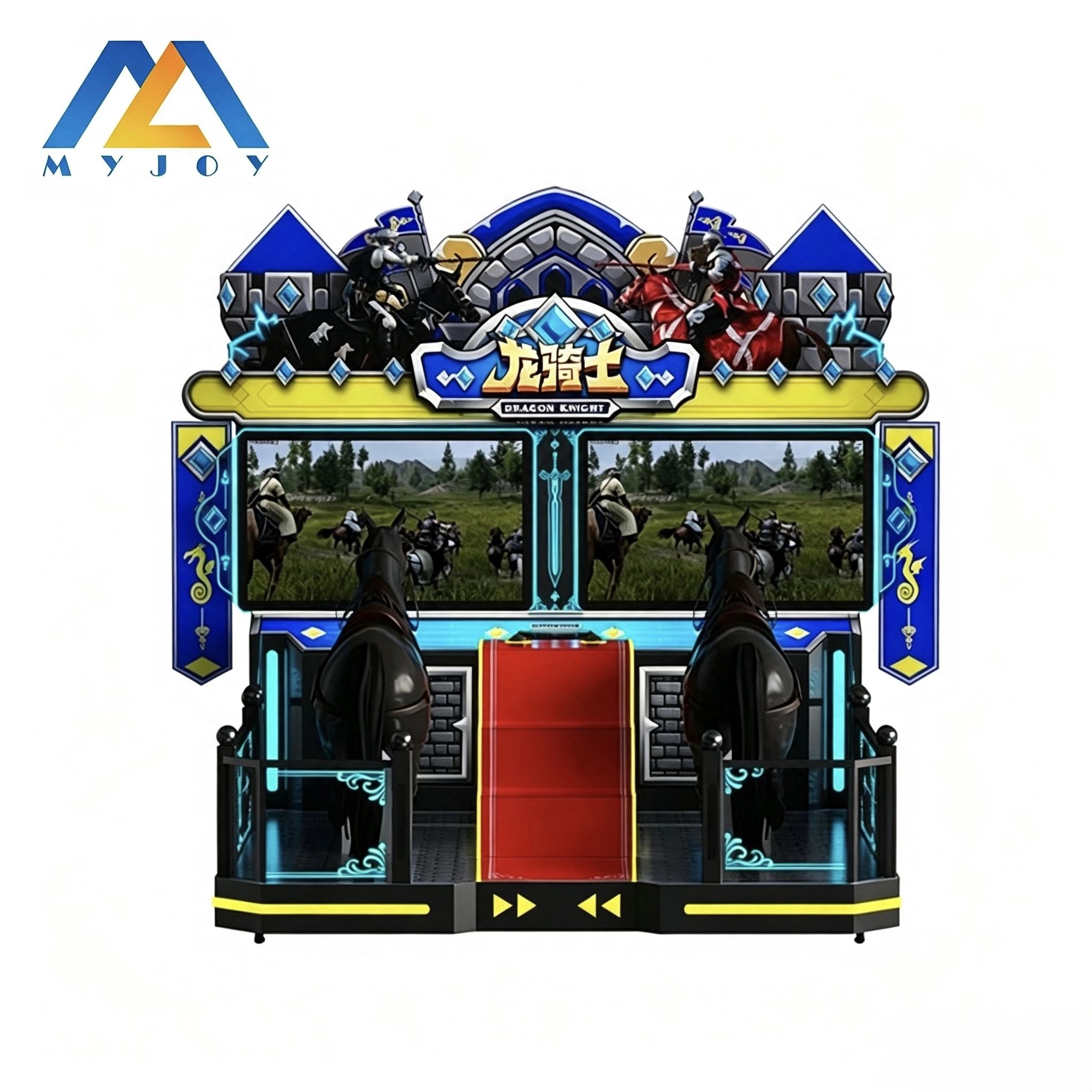
Flying Dragon Knight Horse Racing Simulator is a premium two-player arcade entertainment machine designed for amusement parks, shopping malls, arcades, family entertainment centers and themed attractions. Inspired by medieval knights and fantasy dragon adventures, this simulator combines realistic horse riding motion, interactive racing gameplay and an impressive visual design to create an unforgettable entertainment experience.
Featuring two realistic horse models, dual HD displays, dynamic motion control, vibration feedback and immersive sound effects, players can experience exciting horse racing competitions, adventure challenges and jumping missions. The machine recreates the feeling of real horseback riding through synchronized movement and responsive control systems.
With its eye-catching dragon knight appearance, colorful LED lighting, multiplayer competition mode and safe commercial design, Flying Dragon Knight Horse Racing Simulator is an excellent attraction solution for increasing customer engagement and entertainment value.
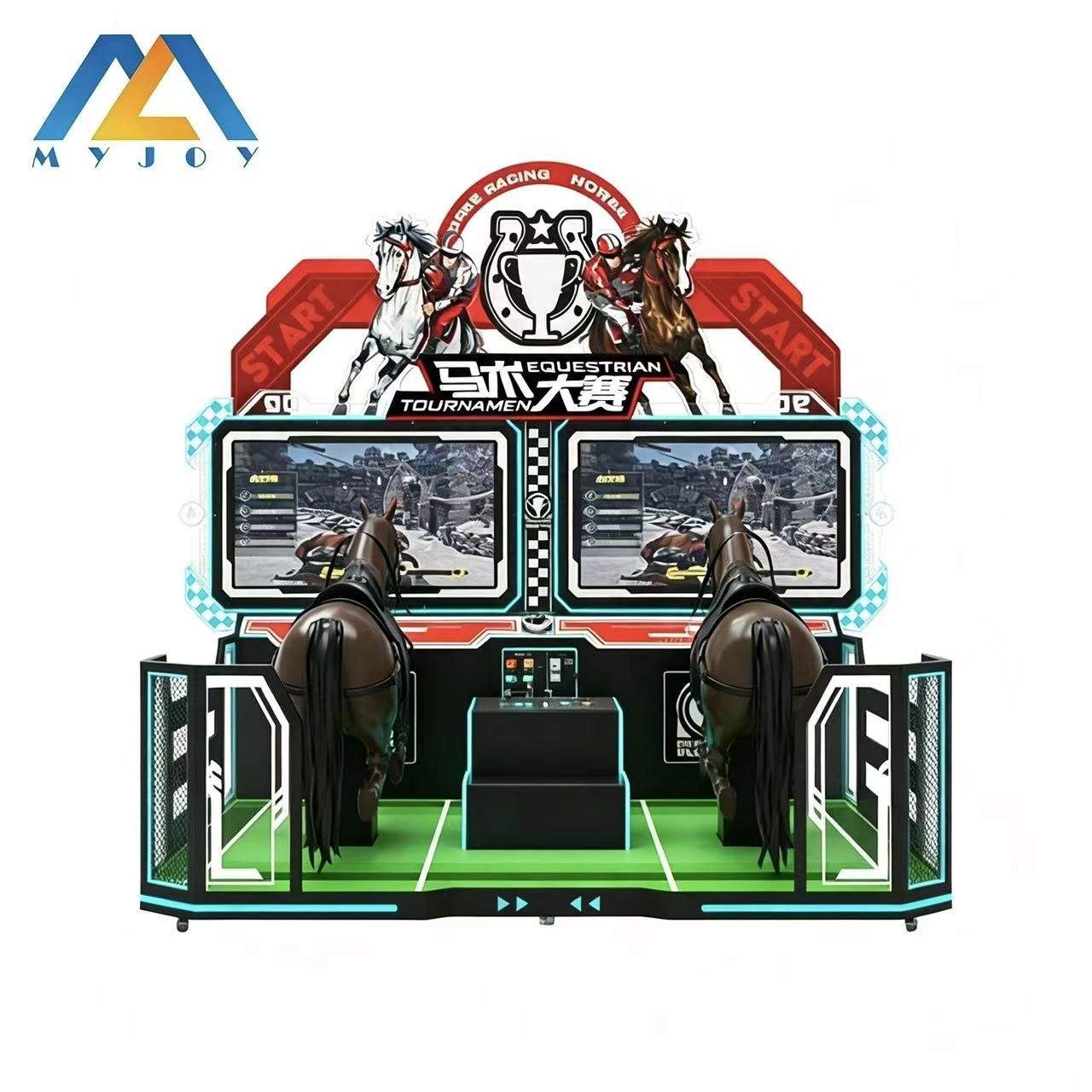
The Horse Racing Championship is a dual-player interactive sports simulator developed by Guangzhou Meiyilian Animation Technology Co., Ltd. It combines simulated horseback riding, competitive racing, physical interaction, and immersive visual effects to create an exciting attraction for players aged 5 to 50.
The machine features two realistic horse models equipped with comfortable saddles and reins. Players control their horses through riding movements and compete on two HD screens. Multiple racing scenes, difficulty levels, and challenge modes make the experience suitable for beginners and experienced players alike.
With its striking equestrian-themed design, dynamic LED lighting, green racetrack-style platform, and competitive ranking system, the machine easily attracts attention and encourages repeat play. It is ideal for amusement arcades, shopping malls, family entertainment centers, sports venues, theme parks, clubs, and tourist attractions.
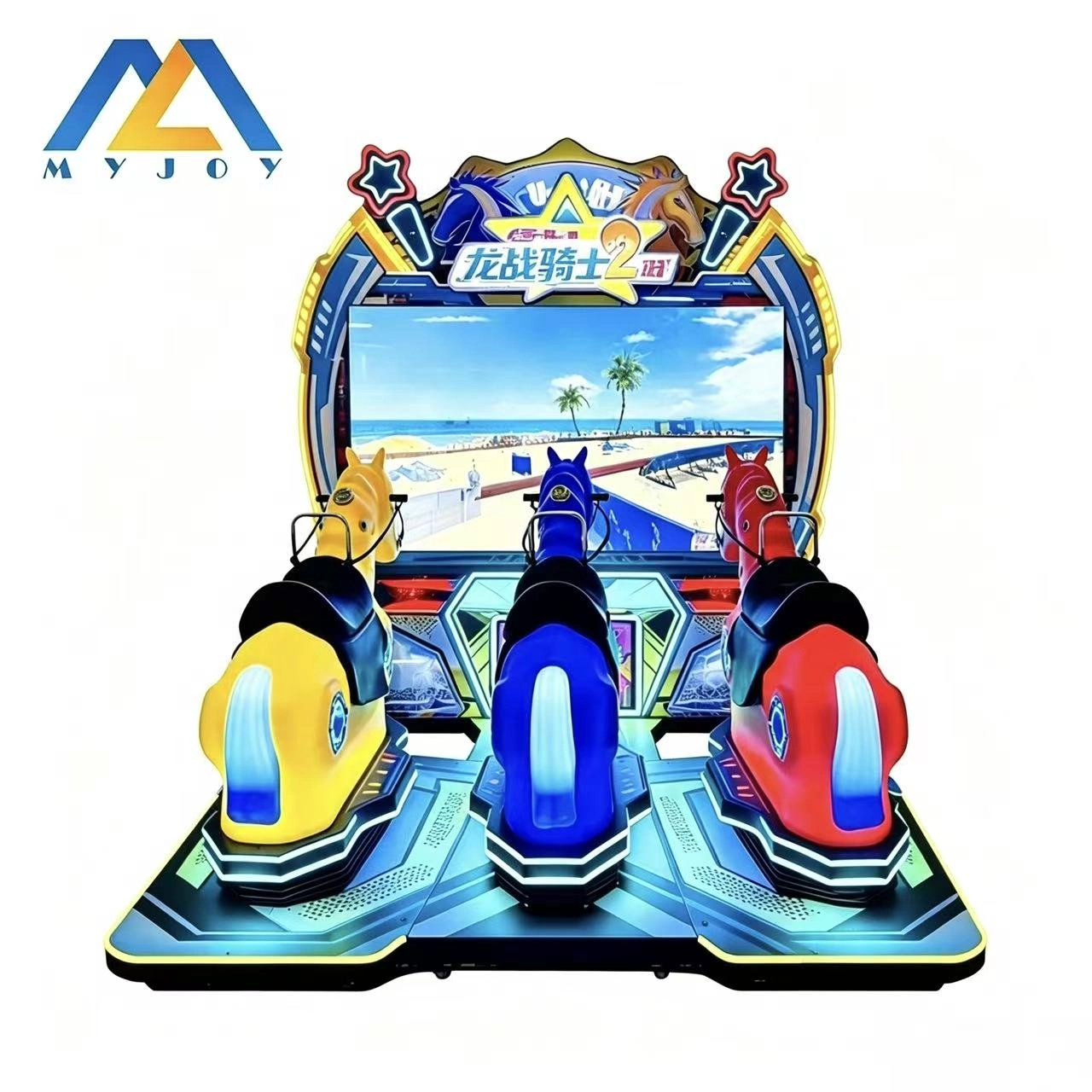
Dragon Warrior Knight 2 – Bring Real Horse Racing Excitement to Indoor Entertainment Venues
Dragon Warrior Knight 2 is an immersive interactive horse riding arcade machine designed around horse racing, obstacle challenges, and multiplayer competition. Featuring a cute and colorful horse design, large HD display, dynamic lighting effects, surround sound system, and realistic rein-control operation, this simulator creates an exciting horse racing experience for children, teenagers, and families.
Players can experience the feeling of riding a racing horse by controlling the reins to accelerate, change direction, and jump over obstacles. The realistic riding movements and interactive gameplay provide strong immersion and encourage repeat play.
The machine supports single-player challenge mode and 3-player competitive racing mode, allowing players to compete with friends, family members, or teammates. It is an ideal attraction for children's playgrounds, arcades, shopping malls, amusement parks, and family entertainment centers.
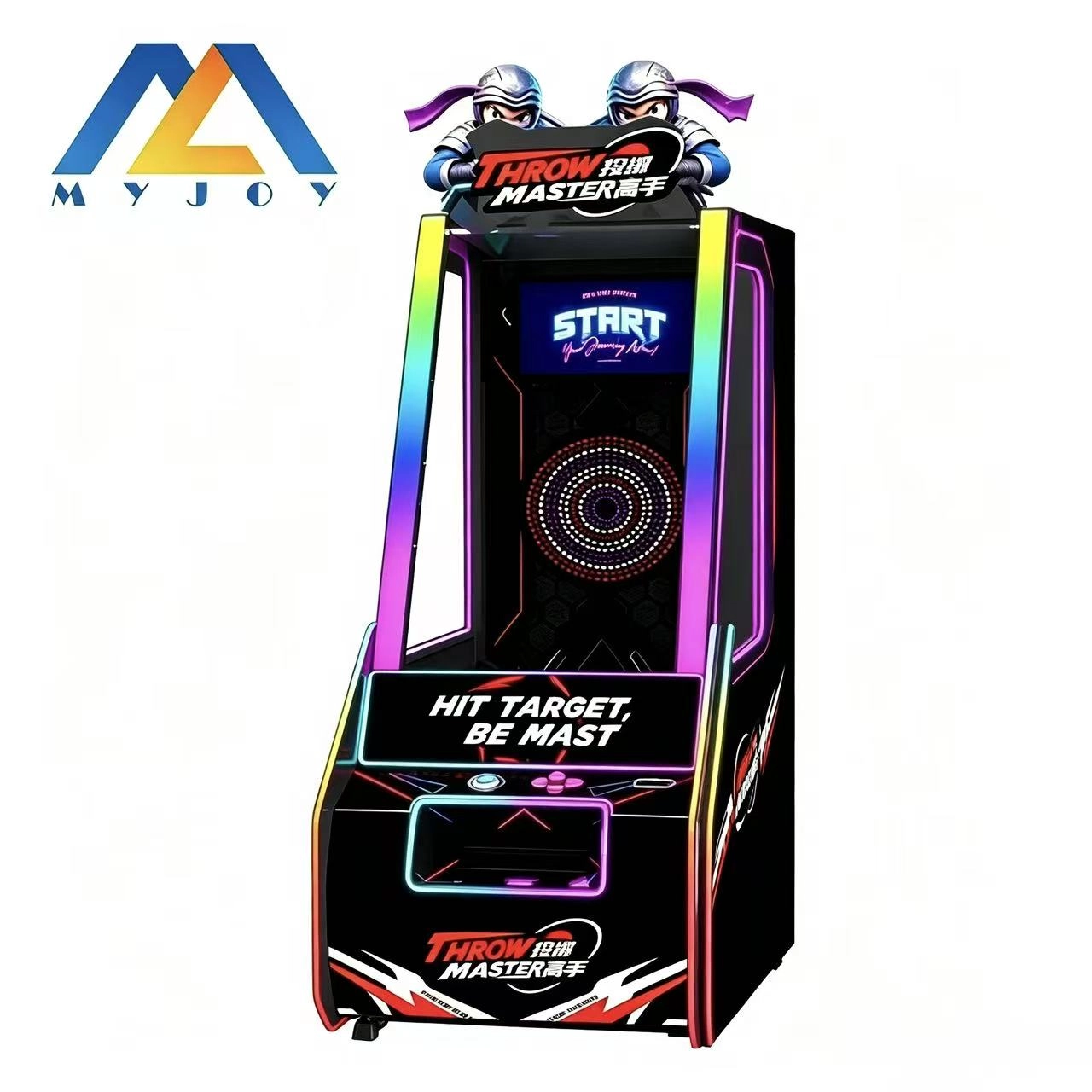
THROW MASTER is a commercial interactive dart throwing arcade machine that combines physical throwing action with an electronic target, digital scoring, on-screen interaction, and camera-based hit detection.
Designed for arcades, family entertainment centers (FECs), indoor amusement venues, shopping malls, and competitive entertainment spaces, THROW MASTER delivers an engaging mix of casual fun and skill-based competition.
Players insert coins, select their player and game mode, and throw darts at the large colorful electronic target. The system detects each result and displays scores, objectives, remaining throws, and game progress on the screen.
With Standard Mode for score-based challenges and Skill Mode for precision target challenges, the machine is suitable for both casual players and those looking for a more competitive experience. Leaderboards, adjustable game settings, and optional ticket rewards also make it well suited for commercial arcade operation.
Its large upright cabinet, colorful circular target, and vibrant RGB-style lighting create a futuristic arcade appearance that helps attract attention in busy entertainment venues.


No. 3, Wenjian Second Road, Wenbian Village, Shiji Town, Panyu District, Guangzhou City, China
Facebook