

What Is a VR Arcade Machine and How Does It Work?

A VR arcade machine is a commercial virtual reality attraction engineered to place users inside a computer-generated environment while they move, look, and interact in real time. A typical installation combines a head-mounted display, motion sensors, a gaming computer or integrated controller, specialized software, audio, physical input devices, and a protective cabinet or platform. In a public venue, the objective is not simply to provide advanced graphics; the system must also support safe operation, quick session reset, high utilization, straightforward supervision, and dependable revenue generation.
For buyers, the most important distinction is between a home VR setup and an out-of-home entertainment product. Consumer equipment is generally optimized for individual ownership and flexible play. Commercial immersive attractions are designed for repeated daily use by unfamiliar customers, including children, teenagers, families, and corporate groups. That difference affects enclosure design, sanitation procedures, cable management, software licensing, warranty terms, spare parts, staff controls, and the total cost of ownership. The definition of virtual reality broadly concerns computer-generated environments that can be experienced interactively, but an arcade installation adds an operational and commercial layer around that technology.
How Immersive Arcade Attractions Create Interactive Experiences
The hardware system behind the experience
The headset provides stereoscopic images, meaning each eye receives a slightly different view to create depth perception. A high-quality system must maintain stable image rendering with low latency because delays between a user’s movement and the visual response can cause discomfort. The computing unit processes the game engine, visual effects, sound, player position, and interaction logic. Depending on the attraction, processing may be handled by a dedicated PC, a compact embedded computer, or a platform supplied as an integrated commercial package.
Tracking hardware determines how the system understands the player’s position and orientation. Inside-out tracking uses cameras and sensors mounted on the headset, while external tracking may use fixed cameras, base stations, magnetic sensors, or dedicated motion platforms. Six-degrees-of-freedom tracking can detect movement along three spatial axes and rotation around three axes, allowing players to walk, turn, crouch, or aim more naturally. Buyers should confirm the effective tracking area, calibration process, lighting requirements, and recovery procedure if tracking is interrupted.
Software, controls, and sensory feedback
Commercial software converts physical movement into actions inside the virtual environment. A player may use handheld controllers, a steering wheel, a rifle-shaped interface, a cockpit, a treadmill, a motion seat, or a floor platform. The best input device depends on the intended experience. A racing simulator requires responsive steering and braking, while a cooperative shooting attraction benefits from accurate aiming and simple instructions that first-time users can understand within seconds.
Audio, vibration, airflow, lighting, and mechanical movement can reinforce immersion. A motion chair can simulate acceleration or turning; a fan can create wind during a flight sequence; directional speakers can make events easier to follow. These effects should be calibrated carefully rather than added indiscriminately. Excessive motion, abrupt acceleration, or poor synchronization may reduce comfort and increase staff intervention. A buyer should request a demonstration that reflects the final operating mode, including the intended session duration and user age range.
What happens during a customer session
The operating sequence normally begins with staff unlocking the attraction, checking the play area, cleaning contact surfaces, and launching the software dashboard. The customer receives a short safety briefing, is fitted with the headset, and selects or is assigned an experience. The system then runs a calibration routine to establish the user’s height, position, play boundary, and controller status.
During play, the tracking system updates the player’s position many times per second, while the rendering engine adjusts the scene from the user’s viewpoint. When the customer presses a controller button, moves a physical control, or enters a tracked zone, the software translates that action into an event. At the end of the session, the attraction returns to a start screen, records operating information where supported, and allows staff to sanitize equipment before the next player. This repeatable workflow is central to throughput and revenue planning.
Commercial Formats, Capacity, and Procurement Comparison
Common categories available to venue operators
Immersive entertainment products can be divided into several practical formats. A seated simulator uses a chair, cockpit, or enclosed cabin and is often suitable for racing, flying, motion cinema, or adventure scenarios. A standing interactive unit uses a headset and handheld controls in a defined footprint. A multiplayer arena allows several participants to share a virtual mission and can increase group appeal, although it normally requires more floor space, more equipment, and stronger staff supervision.
Free-roam systems provide a larger tracked area and allow users to move through a virtual environment. They can offer a High Quality experience, but installation planning becomes more demanding because the operator must control boundaries, sightlines, emergency access, and customer flow. Motion platforms may create a strong visual proposition in a compact footprint, but mechanical wear, servicing access, load limits, and transportation requirements deserve detailed review before purchase.
Capacity and business model considerations
Revenue potential depends on more than the retail price of a play session. Project owners should calculate available operating hours, average session length, reset time, staff capacity, attraction utilization, downtime, ticket price, and the percentage of customers who purchase additional activities. A short experience can generate more daily sessions, while a longer narrative may support High Quality pricing and stronger group satisfaction. Both models can work when matched to the venue’s audience and surrounding product mix.
Commercial buyers should also evaluate the attraction’s footprint-to-revenue ratio. A compact cabinet may be suitable for a shopping mall or small family entertainment center, while a destination venue may prefer a larger multiplayer experience that becomes a visual anchor. Electrical load, ventilation, ceiling height, access doors, floor loading, network availability, and storage for replacement parts should be documented during the site survey.
Comparison of major attraction formats
| Format | Typical operating profile | Key advantages | Primary procurement concerns |
|---|---|---|---|
| Seated immersive simulator | One user per session; controlled seating position | Compact operation, clear supervision, strong motion or racing appeal | Mechanical maintenance, user weight limits, seat and harness durability |
| Standing interactive unit | One or two users in a defined play zone | Flexible themes, moderate footprint, accessible session workflow | Hygiene, cable management, tracking calibration, controller replacement |
| Multiplayer arena | Several users participate in one shared experience | Group engagement, higher ticket potential, destination appeal | Floor area, synchronized hardware, staffing, software licensing |
| Free-roam attraction | Users move through a larger tracked environment | High immersion, High Quality positioning, strong repeat-play potential | Boundary control, installation complexity, safety monitoring, capital cost |
The table describes common commercial formats rather than guaranteed performance results. Actual throughput and return on investment vary by location, pricing, audience, software content, staffing, maintenance quality, and operating schedule. Buyers should request a project-specific capacity model instead of relying on a generic payback claim.
Safety, Maintenance, and Quality Requirements for Operators
Designing for customer safety
Safety begins with physical design. A reliable attraction should have stable flooring, protected edges, accessible emergency stops, controlled cables, sufficient clearance, and a visible staff position. Enclosures and platforms should avoid pinch points and sharp projections. Where motion is involved, the supplier should define operating limits, recommended user profiles, loading requirements, and procedures for stopping the attraction safely.
Operators should consider visual comfort as well as physical protection. Rapid camera movement, inconsistent frame delivery, intense flashing effects, and excessive mechanical motion may make some customers uncomfortable. Clear warnings, age guidance, health notices, and staff observation are practical controls. Equipment procurement can be informed by recognized safety principles, including the ISO 9241-210 human-centred design standard, although the applicable legal requirements will depend on the installation country and venue type.
Hygiene, uptime, and preventive service
Headsets and controllers are high-contact components. A venue should establish a cleaning method compatible with the manufacturer’s materials, use replaceable facial interfaces where appropriate, and allow adequate drying time between users. Ventilation around computing equipment should remain unobstructed, and filters, fans, connectors, belts, seats, and motion assemblies should be inspected according to a documented schedule.
Serviceability has a direct effect on revenue. Modular parts, accessible panels, clear fault codes, remote troubleshooting, and available replacement components can reduce downtime. Buyers should ask whether the supplier provides wiring diagrams, operating manuals, software recovery tools, training, spare-part recommendations, and response-time commitments. A low purchase price can become expensive if a minor failure requires a long international shipment or specialist intervention.
Compliance and technical due diligence
Certification requirements differ by destination market. Buyers should confirm which electrical, electromagnetic compatibility, machinery, toy, accessibility, fire, and venue regulations apply to the complete installation rather than only to individual components. The ISO 12100 machinery safety framework is a useful reference for risk assessment and risk reduction principles. Electrical and electronic systems may also require region-specific conformity documentation, testing records, and correctly rated power supplies.
Technical due diligence should include a factory inspection or equivalent quality review, sample testing, packaging assessment, spare-part planning, and acceptance criteria. The purchase agreement should specify the delivered configuration, software language, warranty scope, installation responsibilities, commissioning tests, and training obligations. These details protect both the investor and the supplier by reducing ambiguity after shipment.
Why MYL ARCADE Supports Complete Immersive Entertainment Projects
Integrated manufacturing and project planning
MYL ARCADE was established in 2007 in Guangzhou, China, and was formerly known as Meilian Technology. For nearly two decades, our organization has focused on the amusement and entertainment equipment industry. We have developed as an integrated manufacturer and venue planning service provider covering research and development, production, sales, after-sales service, project planning, and operation support.
For a buyer sourcing immersive attractions, this integrated structure helps connect product selection with site conditions and business objectives. Our team can evaluate available floor area, customer profile, desired price positioning, attraction mix, traffic flow, and staff requirements before recommending a configuration. This approach is valuable when an investor is building a family entertainment center, upgrading an existing arcade, or adding digital attractions to a shopping mall venue.
Product range and technical capability
Our product portfolio includes arcade game machines, redemption equipment, sports arcade games, interactive digital sports equipment, VR attractions, prize machines, children’s amusement machines, and family entertainment solutions. This broader range allows project owners to combine immersive play with competitive games, ticket redemption, physical interaction, and children’s activities rather than treating one attraction as an isolated purchase.
Our manufacturing process is structured around practical commercial requirements: durable cabinets, maintainable internal layouts, clear operator controls, stable software deployment, appropriate packaging, and compatibility with international project conditions. Configuration can be discussed according to theme, footprint, player capacity, control method, display requirement, and venue concept. Buyers should still validate the final specification through drawings, samples, testing, and written acceptance terms.
International market experience and after-sales support
In China, MYL ARCADE has established long-term partnerships with more than 2,000 amusement centers, family entertainment centers, digital sports parks, and indoor entertainment venues. Internationally, our equipment has been exported to more than 20 countries and regions, including Japan, the United States, Italy, Spain, Guyana, the Middle East, South America, and Southeast Asia.
Our corporate philosophy is based on integrity, progress, practicality, and mutual benefit. These principles are especially relevant to capital equipment procurement, where project owners need transparent specifications, realistic delivery planning, installation coordination, and support after commissioning. A supplier evaluation should examine not only product appearance, but also engineering communication, production control, export experience, documentation, spare parts, and the ability to support a complete venue solution.
Operators considering immersive attractions should compare suppliers using a total-project checklist: product suitability, user safety, software content, throughput, maintenance access, warranty terms, compliance documentation, logistics, installation, staff training, and expected commercial positioning. MYL ARCADE can support this evaluation with equipment options and venue planning services designed for amusement centers, family entertainment venues, digital sports parks, and other indoor entertainment projects.
Contact MYL ARCADE to discuss an immersive attraction configuration, request product information, and plan a commercially practical entertainment venue solution.
Frequently Asked Questions
What is a VR arcade machine?
A VR arcade machine is a commercial virtual reality attraction that combines a head-mounted display, tracking sensors, computing hardware, interactive controls, software, audio, and a protective cabinet or platform for public entertainment use.
How does a commercial VR attraction work?
The headset displays stereoscopic images while tracking hardware detects the user’s position and orientation. Software converts movement and controller inputs into actions inside a virtual environment, and the system resets for the next customer after the session.
What is the difference between home VR and arcade VR equipment?
Home VR equipment is generally designed for individual ownership and flexible use, while arcade equipment is built for repeated public operation and places greater emphasis on durability, hygiene, safety, staff controls, quick reset, serviceability, and commercial throughput.
What should buyers check before purchasing an immersive arcade attraction?
Buyers should check the footprint, electrical load, ventilation, tracking area, session length, throughput, software licensing, safety controls, compliance documentation, warranty, spare parts, installation support, staff training, and the supplier’s maintenance response process.
Are VR arcade attractions suitable for family entertainment centers?
They can be suitable when the experience, age guidance, motion intensity, floor space, supervision model, and pricing are matched to the venue’s audience. A broader equipment mix can combine immersive attractions with arcade, redemption, sports, and children’s entertainment products.
Does MYL ARCADE provide more than VR equipment?
Yes. MYL ARCADE provides arcade game machines, redemption machines, sports arcade games, interactive digital sports equipment, VR attractions, prize machines, children’s amusement machines, family entertainment solutions, venue planning, after-sales service, and operation support.
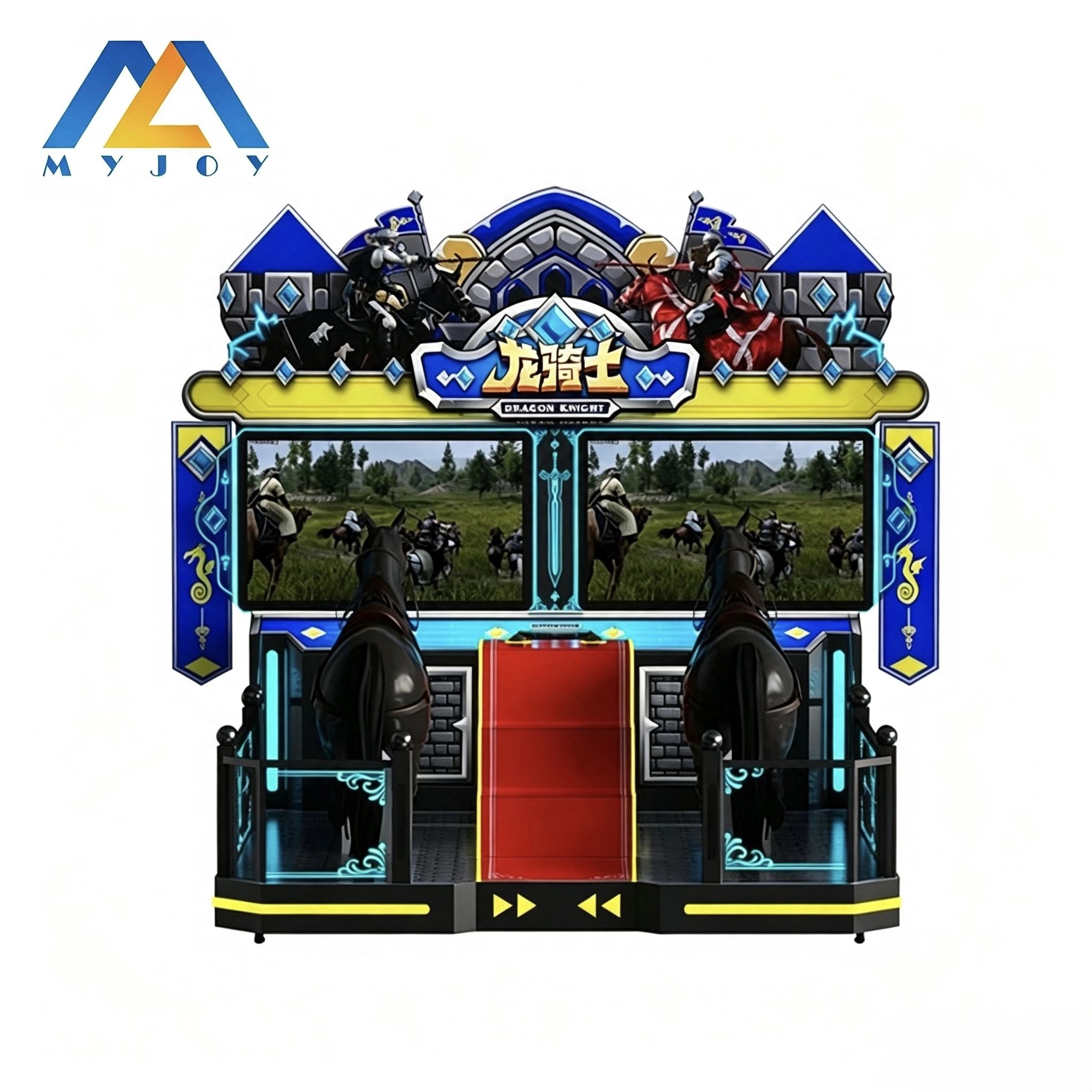
Flying Dragon Knight Horse Racing Simulator is a premium two-player arcade entertainment machine designed for amusement parks, shopping malls, arcades, family entertainment centers and themed attractions. Inspired by medieval knights and fantasy dragon adventures, this simulator combines realistic horse riding motion, interactive racing gameplay and an impressive visual design to create an unforgettable entertainment experience.
Featuring two realistic horse models, dual HD displays, dynamic motion control, vibration feedback and immersive sound effects, players can experience exciting horse racing competitions, adventure challenges and jumping missions. The machine recreates the feeling of real horseback riding through synchronized movement and responsive control systems.
With its eye-catching dragon knight appearance, colorful LED lighting, multiplayer competition mode and safe commercial design, Flying Dragon Knight Horse Racing Simulator is an excellent attraction solution for increasing customer engagement and entertainment value.
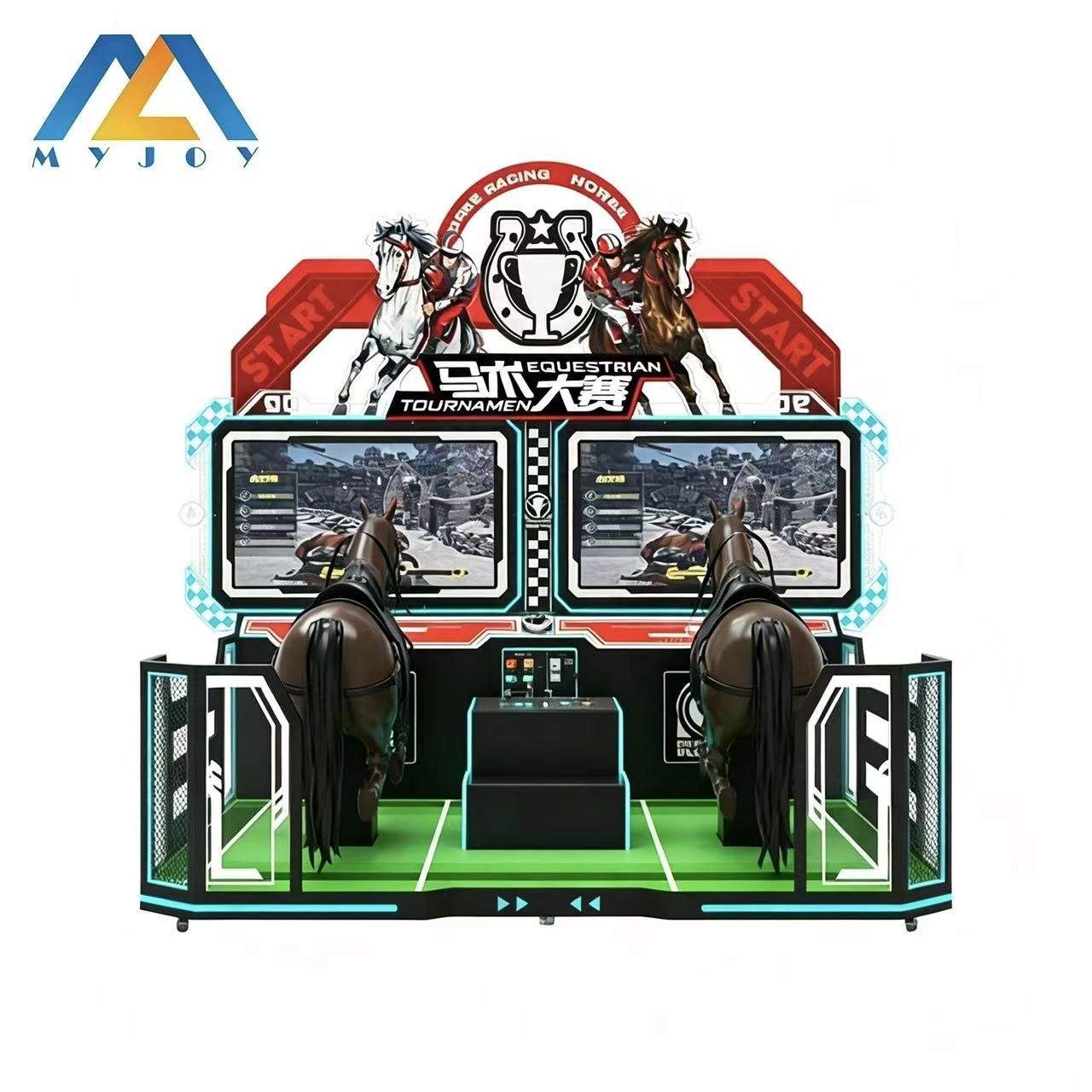
The Horse Racing Championship is a dual-player interactive sports simulator developed by Guangzhou Meiyilian Animation Technology Co., Ltd. It combines simulated horseback riding, competitive racing, physical interaction, and immersive visual effects to create an exciting attraction for players aged 5 to 50.
The machine features two realistic horse models equipped with comfortable saddles and reins. Players control their horses through riding movements and compete on two HD screens. Multiple racing scenes, difficulty levels, and challenge modes make the experience suitable for beginners and experienced players alike.
With its striking equestrian-themed design, dynamic LED lighting, green racetrack-style platform, and competitive ranking system, the machine easily attracts attention and encourages repeat play. It is ideal for amusement arcades, shopping malls, family entertainment centers, sports venues, theme parks, clubs, and tourist attractions.
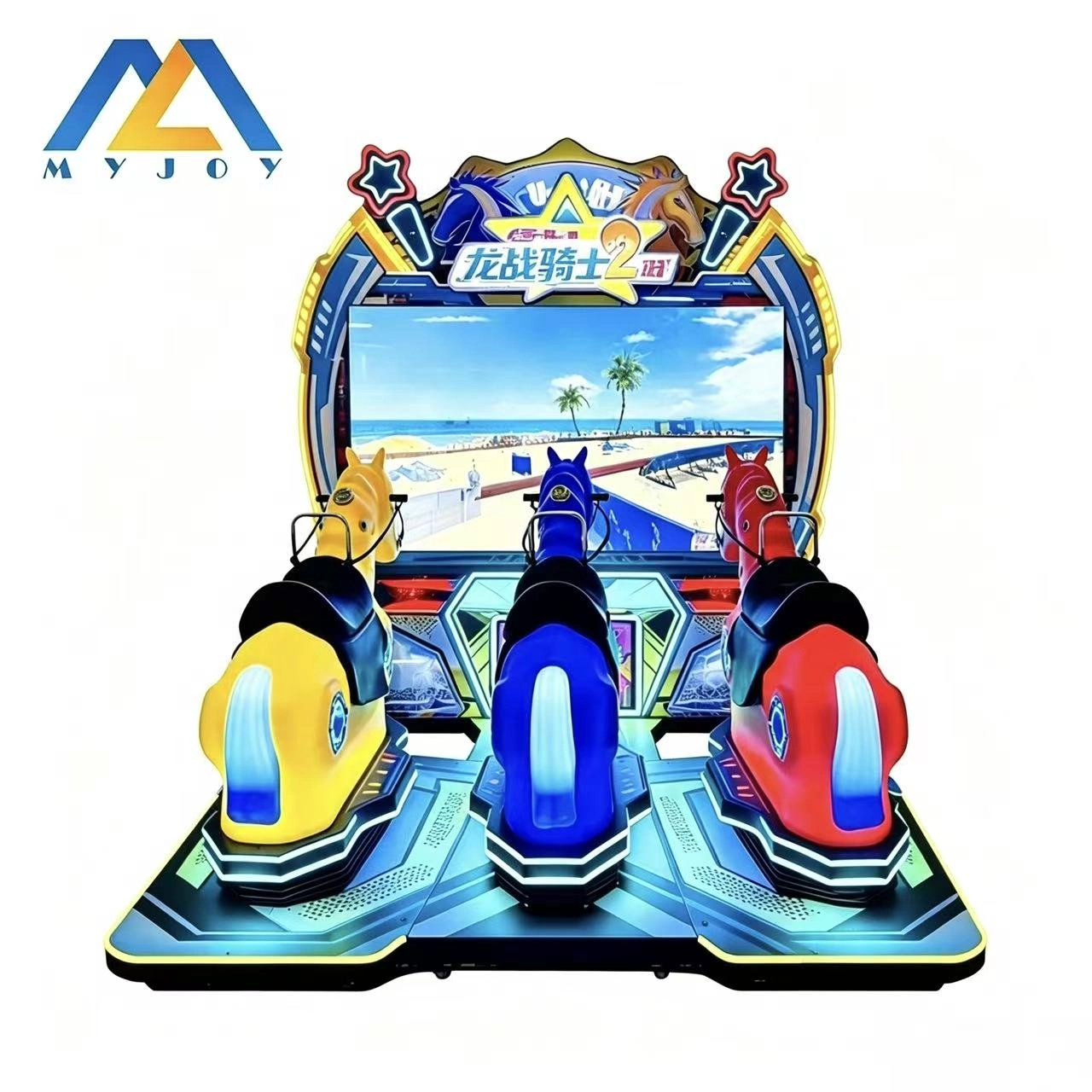
Dragon Warrior Knight 2 – Bring Real Horse Racing Excitement to Indoor Entertainment Venues
Dragon Warrior Knight 2 is an immersive interactive horse riding arcade machine designed around horse racing, obstacle challenges, and multiplayer competition. Featuring a cute and colorful horse design, large HD display, dynamic lighting effects, surround sound system, and realistic rein-control operation, this simulator creates an exciting horse racing experience for children, teenagers, and families.
Players can experience the feeling of riding a racing horse by controlling the reins to accelerate, change direction, and jump over obstacles. The realistic riding movements and interactive gameplay provide strong immersion and encourage repeat play.
The machine supports single-player challenge mode and 3-player competitive racing mode, allowing players to compete with friends, family members, or teammates. It is an ideal attraction for children's playgrounds, arcades, shopping malls, amusement parks, and family entertainment centers.
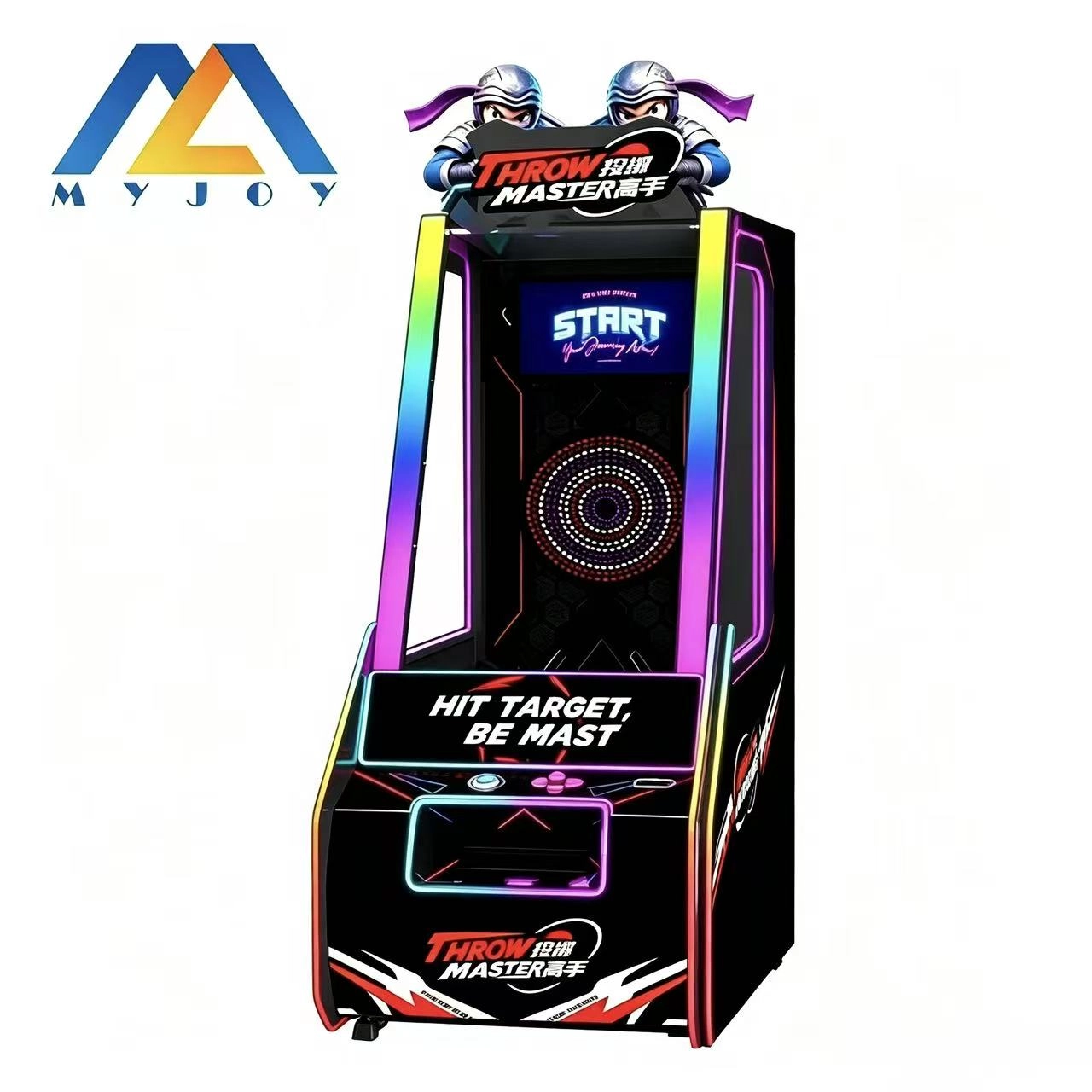
THROW MASTER is a commercial interactive dart throwing arcade machine that combines physical throwing action with an electronic target, digital scoring, on-screen interaction, and camera-based hit detection.
Designed for arcades, family entertainment centers (FECs), indoor amusement venues, shopping malls, and competitive entertainment spaces, THROW MASTER delivers an engaging mix of casual fun and skill-based competition.
Players insert coins, select their player and game mode, and throw darts at the large colorful electronic target. The system detects each result and displays scores, objectives, remaining throws, and game progress on the screen.
With Standard Mode for score-based challenges and Skill Mode for precision target challenges, the machine is suitable for both casual players and those looking for a more competitive experience. Leaderboards, adjustable game settings, and optional ticket rewards also make it well suited for commercial arcade operation.
Its large upright cabinet, colorful circular target, and vibrant RGB-style lighting create a futuristic arcade appearance that helps attract attention in busy entertainment venues.


No. 3, Wenjian Second Road, Wenbian Village, Shiji Town, Panyu District, Guangzhou City, China
Facebook