

Interactive LED Floor Game vs. Traditional LED Dance Floor: Key Differences

An interactive LED floor game combines pressure-sensitive or motion-responsive flooring, LED modules, control software, and game content to encourage physical participation, while a traditional LED dance floor is mainly a programmable illuminated surface used for atmosphere, decoration, and event enhancement. The central difference is commercial function: one is an activity-based attraction designed to generate repeated play, and the other is an ambient visual installation designed to support music, branding, and venue aesthetics. Buyers comparing these solutions should assess guest engagement, revenue potential, maintenance, safety, installation complexity, content flexibility, and total cost of ownership rather than comparing panel prices alone.
For operators, the decision influences dwell time, queue behavior, staffing, cleaning routines, replacement parts, electrical planning, and marketing strategy. A responsive floor can support competitive play, fitness activities, children’s entertainment, team challenges, and digital sports programming. A conventional illuminated dance surface may be more appropriate for weddings, clubs, exhibitions, stage productions, themed restaurants, and venues where visual impact is more important than structured gameplay. The best procurement outcome comes from matching the technology to the intended customer journey.
How Responsive Play Flooring Differs from Decorative LED Surfaces
Primary purpose and user interaction
The first distinction is the role of the floor in the venue. A traditional LED dance floor displays colors, patterns, logos, animations, and music-synchronized effects. Guests may walk or dance on it, but the surface generally does not interpret their actions as game commands. Its value is experiential atmosphere: it makes a room appear more dynamic and can reinforce a brand theme or event concept.
A game-enabled LED floor is designed around cause and effect. Stepping, jumping, avoiding, chasing, or touching a highlighted zone produces an immediate visual or audio response. This feedback loop creates a clear objective and makes the attraction easier to understand without extensive staff explanation. The result is typically more active participation, stronger repeat-play potential, and better suitability for ticketed sessions or pay-per-play operation.
Hardware architecture
Both systems may use modular LED panels, protective top layers, structural frames, power supplies, and control units. However, an entertainment floor requires additional engineering for sensing, signal processing, synchronization, and game logic. Depending on the design, detection may use pressure sensors, infrared systems, cameras, capacitive technology, or other tracking methods. Buyers should confirm the sensing method, response time, calibration process, maximum simultaneous players, and replacement procedure before signing a purchase order.
The visible LED specification is also only one part of performance. Pixel pitch, brightness, viewing angle, refresh rate, color consistency, ingress protection, load rating, anti-slip treatment, impact resistance, and heat dissipation all affect suitability. A floor that looks impressive in a showroom may not perform reliably under continuous foot traffic if its structural protection and thermal design are inadequate. Relevant workplace and equipment risk principles can be reviewed through ISO 12100 machinery safety guidance and applicable local electrical regulations.
Content and operating logic
Decorative flooring usually operates through preset patterns, DMX control, music synchronization, or a central lighting console. This makes it relatively straightforward for event technicians and production teams to manage. The content objective is visual continuity rather than measurable player performance.
Interactive systems require a content layer that can manage levels, scores, timers, difficulty, player identification, sound effects, leaderboards, and reset functions. The software should be evaluated as carefully as the cabinet or floor panel. Important questions include whether new games can be added, whether language settings can be changed, whether operators can adjust session duration, and whether diagnostic information is available remotely or locally.
Commercial and Technical Comparison for Venue Buyers
Operational differences that affect return on investment
A decorative dance surface often supports a one-time installation model. Once installed, it can remain in place and contribute to the venue’s appearance with relatively limited operator involvement. Revenue is usually indirect, coming from event bookings, food and beverage sales, room rental, admission value, or improved brand presentation.
A responsive digital play zone can create direct revenue through timed sessions, memberships, birthday packages, group bookings, tournaments, and bundled attractions. It may also increase repeat visitation because users can attempt to improve scores or experience different game modes. That revenue potential comes with greater operational responsibility. Staff may need to explain rules, supervise younger players, reset sessions, clean touch surfaces, manage queues, and monitor equipment condition.
| Evaluation factor | Traditional LED dance floor | Interactive digital floor attraction | Buyer implication |
|---|---|---|---|
| Main function | Lighting, decoration, and event ambiance | Physical gameplay and responsive entertainment | Select according to whether the floor is an atmosphere asset or a revenue-generating attraction |
| User feedback | Primarily visual and audio | Visual, audio, and action-based feedback | Responsive feedback generally supports clearer gameplay and repeat participation |
| Content management | Lighting scenes, colors, patterns, and music synchronization | Games, scoring, timers, difficulty levels, and player results | Interactive content requires stronger software support and operator training |
| Typical commercial model | Event enhancement, venue differentiation, and indirect sales | Pay-per-play, packages, memberships, tournaments, and group activities | Build the financial model around expected utilization and session pricing |
| Maintenance profile | LED modules, controllers, power supplies, and surface protection | All decorative components plus sensors, software, calibration, and game controls | Ask for spare-part availability, remote support, and service procedures |
| Best-fit locations | Clubs, stages, hotels, weddings, exhibitions, and themed interiors | Family entertainment centers, arcades, sports parks, malls, and activity venues | Traffic pattern and audience behavior should drive the selection |
The table describes common system characteristics rather than universal specifications. Product performance varies by manufacturer, construction method, software architecture, and installation environment. Buyers should request a technical datasheet and a site-specific proposal instead of relying on generic marketing claims.
Safety, accessibility, and facility planning
Floor attractions must be assessed as part of the entire facility. The design should address trip hazards, edge transitions, emergency access, load distribution, cable routing, ventilation, cleaning chemicals, moisture exposure, and safe shutdown procedures. Anti-slip performance becomes particularly important when users are moving quickly or when the venue uses frequent wet cleaning. Operators should also define age guidance, supervision rules, maximum occupancy, and procedures for medical or accessibility needs.
Accessibility planning should consider clear routes, visual contrast, audio cues, alternative participation modes, and the height or reach required by game controls. While no single product configuration meets every local requirement, buyers can use ISO 21542 accessibility principles for the built environment as a reference point alongside local building and fire codes. Electrical and audiovisual equipment should be reviewed against the regulations applicable in the installation country; IEC standards and conformity resources can help structure that compliance discussion.
Durability and total cost of ownership
Initial purchase price does not provide a reliable comparison. A project owner should calculate the expected cost of panels, sensors, controllers, spare modules, software updates, labor, cleaning, electricity, freight, import duties, installation, and planned refurbishment. The calculation should also include downtime. An attraction that is inexpensive to purchase but difficult to repair can create a higher long-term cost than a more robust system with accessible service architecture.
Ask suppliers whether floor modules can be replaced individually, whether components are standardized, how quickly replacement parts can be shipped, and whether troubleshooting can be performed without removing the entire installation. A preventive maintenance schedule should identify inspection frequency for connectors, protective surfaces, structural supports, sensor calibration, ventilation, and software backups. Product safety documentation and conformity evidence should be available for the target market; buyers can consult the ISO 9001 quality management framework when evaluating a manufacturer’s process discipline.
Choosing the Right Floor Technology for Different Business Models
When a conventional illuminated dance floor is the better choice
A traditional LED dance floor is often suitable when the venue’s main requirement is visual transformation. Wedding halls, nightclubs, hotels, fashion events, product launches, exhibition booths, and stage environments may value elegant lighting scenes more than structured play. The system can also work well where the floor must support multiple event themes without requiring staff to operate a game interface.
This option can simplify integration with existing lighting consoles and entertainment systems. It is particularly practical when the surface is used intermittently, when the operator wants low training requirements, or when the commercial value is tied to room rental and event presentation. The procurement brief should still define surface strength, maintenance access, color uniformity, brightness control, and compatibility with the venue’s control infrastructure.
When a game-centered floor creates stronger business value
A floor-based digital attraction is a stronger candidate when the venue needs an activity that is easy to demonstrate, visually visible from a distance, and capable of supporting repeat play. Family entertainment centers can use it for age-appropriate challenges, while digital sports parks may incorporate reaction training, agility exercises, team competition, and timed performance. Arcades and malls can use a compact installation as a high-visibility anchor that encourages group participation.
The commercial case becomes stronger when the attraction is integrated with a wider operating plan. For example, a venue can sell a ten-minute session, combine play with redemption points, include the attraction in birthday packages, or use tournament rankings to create recurring visits. The floor should not be evaluated only as a hardware purchase; it should be treated as a content-driven business unit with a defined audience, price point, staffing model, and promotional calendar.
Questions to include in a supplier tender
- What is the recommended floor area and how many players can participate simultaneously?
- What sensing technology is used, and how is calibration completed after installation?
- What are the rated load, slip-resistance characteristics, ingress protection, and operating temperature range?
- Can the software support multiple languages, scoring modes, timed sessions, and operator access levels?
- Which parts are consumable, and what is the normal lead time for replacement modules and controllers?
- Does the supplier provide layout design, installation guidance, staff training, commissioning, and after-sales support?
- What documentation is supplied for electrical safety, material specifications, warranty coverage, and local compliance review?
Why MYL ARCADE Is a Practical Partner for Interactive Entertainment Projects
Integrated manufacturing and venue planning capability
MYL ARCADE was established in 2007 in Guangzhou, China, and was formerly known as Meilian Technology. With nearly two decades in the amusement and entertainment equipment industry, our organization has developed from a product manufacturer into a comprehensive partner covering research and development, production, sales, after-sales service, project planning, and operation support.
For buyers comparing a responsive LED play system with a conventional illuminated surface, this integrated model is valuable because the project typically involves more than equipment selection. Layout, audience flow, game positioning, electrical preparation, installation access, staff operation, and maintenance planning all influence the final result. Our team can evaluate the attraction as part of a broader venue concept rather than treating the floor as an isolated component.
Relevant product portfolio and technical application
Our portfolio includes arcade game machines, redemption machines, sports arcade games, interactive digital sports equipment, VR attractions, prize machines, children’s amusement machines, and family entertainment solutions. This product breadth supports coordinated procurement for venues that want to combine floor-based activity with arcade entertainment, redemption, sports challenges, or immersive attractions.
Our engineering and manufacturing process focuses on practical deployment requirements: stable operation, clear user interaction, maintainable components, attractive presentation, and suitability for commercial environments. Depending on the project brief, a buyer may request a responsive floor game zone as a standalone attraction or as part of a larger digital sports and family entertainment package. The correct configuration should be determined by venue size, target age group, expected throughput, local regulations, and operating model.
Industry reach and after-sales support
In China, MYL ARCADE has established long-term partnerships with more than 2,000 amusement centers, family entertainment centers, digital sports parks, and indoor entertainment venues. Internationally, our products have been exported to more than 20 countries and regions, including Japan, the United States, Italy, Spain, Guyana, the Middle East, South America, and Southeast Asia.
This international footprint gives project owners and distributors a useful basis for discussing export documentation, packaging, installation coordination, spare parts, training, and post-delivery communication. Our business philosophy is built on integrity, progress, practicality, and mutual benefit. In procurement terms, that means the project discussion should cover the full lifecycle: concept validation, technical configuration, production quality control, delivery, commissioning, operational support, and future expansion.
Whether the preferred solution is an atmospheric LED dance surface or a revenue-oriented digital game floor, MYL ARCADE can help buyers compare the options according to application, budget, traffic, and long-term commercial objectives. A site-specific proposal should include a floor plan, technical configuration, game or lighting functions, installation requirements, warranty terms, maintenance recommendations, and a realistic implementation schedule.
Frequently Asked Questions
What is the main difference between an interactive LED floor game and a traditional LED dance floor?
A traditional LED dance floor primarily provides programmable lighting, visual effects, and event ambiance. An interactive LED floor game adds sensing technology, software, scoring, and responsive feedback so users can participate in structured physical gameplay.
Which type of LED floor is better for a family entertainment center?
A game-centered responsive floor is generally more suitable for a family entertainment center because it can support timed sessions, repeat play, group challenges, tournaments, and direct revenue models such as pay-per-play or package sales.
Are interactive LED floors more difficult to maintain?
Yes, they usually require maintenance for LED modules, protective surfaces, sensors, controllers, software, calibration, and structural components. Buyers should confirm spare-part availability, diagnostic procedures, remote support, and replacement lead times before purchase.
What safety issues should buyers review before installing a digital LED floor?
Buyers should review trip hazards, edge transitions, anti-slip performance, load rating, cable routing, moisture exposure, ventilation, emergency access, cleaning procedures, maximum occupancy, supervision rules, and compliance with local electrical, building, and fire regulations.
Can an interactive floor be used for more than children’s entertainment?
Yes. Depending on the software and configuration, it can support family activities, digital sports, reaction training, agility exercises, team competitions, mall activations, corporate events, and tournament-based programming.
What should be included in a supplier quotation for an LED floor attraction?
A complete quotation should identify the floor area, panel and sensor specifications, software functions, player capacity, structural requirements, installation scope, training, warranty, spare parts, shipping, documentation, after-sales support, and the expected project schedule.
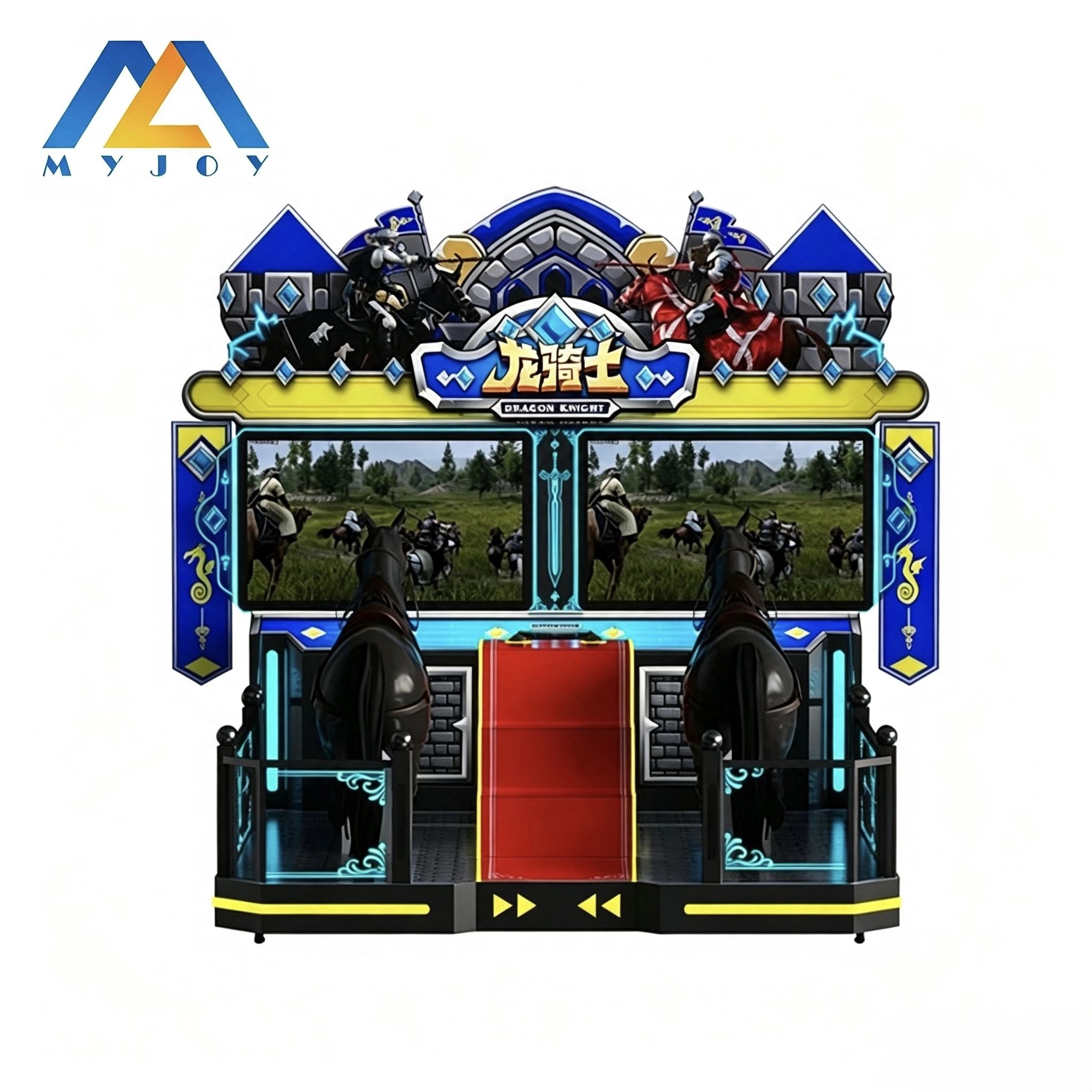
Flying Dragon Knight Horse Racing Simulator is a premium two-player arcade entertainment machine designed for amusement parks, shopping malls, arcades, family entertainment centers and themed attractions. Inspired by medieval knights and fantasy dragon adventures, this simulator combines realistic horse riding motion, interactive racing gameplay and an impressive visual design to create an unforgettable entertainment experience.
Featuring two realistic horse models, dual HD displays, dynamic motion control, vibration feedback and immersive sound effects, players can experience exciting horse racing competitions, adventure challenges and jumping missions. The machine recreates the feeling of real horseback riding through synchronized movement and responsive control systems.
With its eye-catching dragon knight appearance, colorful LED lighting, multiplayer competition mode and safe commercial design, Flying Dragon Knight Horse Racing Simulator is an excellent attraction solution for increasing customer engagement and entertainment value.
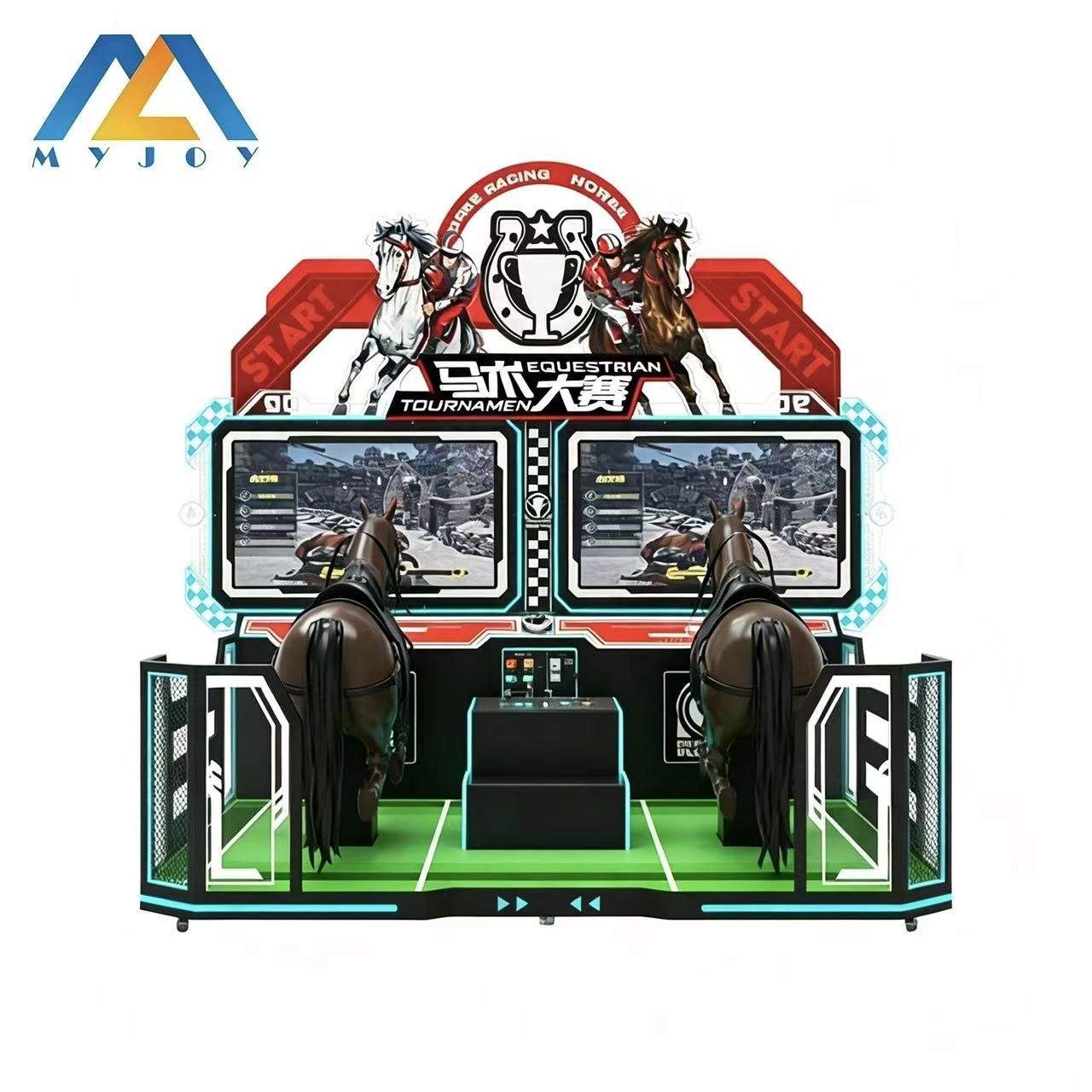
The Horse Racing Championship is a dual-player interactive sports simulator developed by Guangzhou Meiyilian Animation Technology Co., Ltd. It combines simulated horseback riding, competitive racing, physical interaction, and immersive visual effects to create an exciting attraction for players aged 5 to 50.
The machine features two realistic horse models equipped with comfortable saddles and reins. Players control their horses through riding movements and compete on two HD screens. Multiple racing scenes, difficulty levels, and challenge modes make the experience suitable for beginners and experienced players alike.
With its striking equestrian-themed design, dynamic LED lighting, green racetrack-style platform, and competitive ranking system, the machine easily attracts attention and encourages repeat play. It is ideal for amusement arcades, shopping malls, family entertainment centers, sports venues, theme parks, clubs, and tourist attractions.
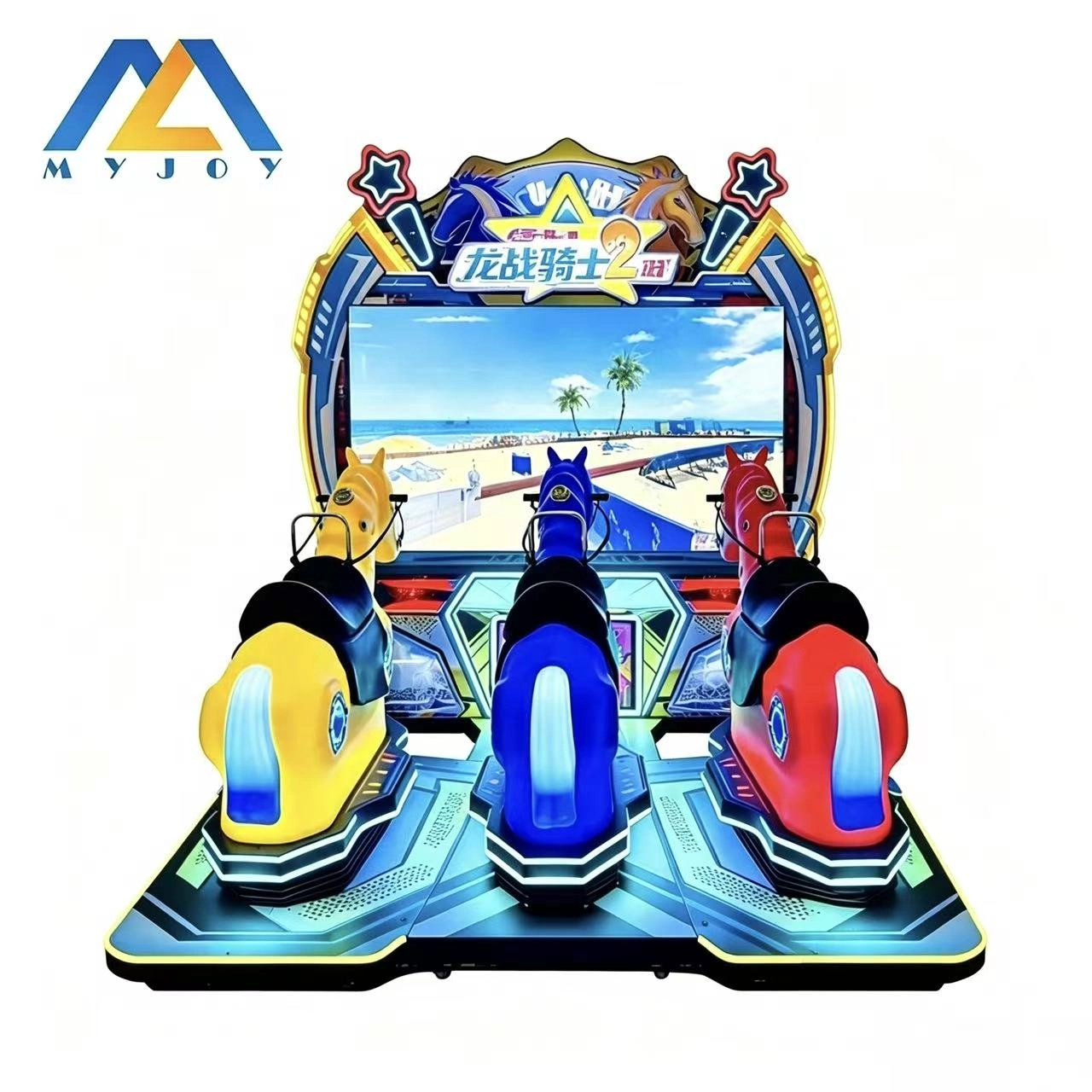
Dragon Warrior Knight 2 – Bring Real Horse Racing Excitement to Indoor Entertainment Venues
Dragon Warrior Knight 2 is an immersive interactive horse riding arcade machine designed around horse racing, obstacle challenges, and multiplayer competition. Featuring a cute and colorful horse design, large HD display, dynamic lighting effects, surround sound system, and realistic rein-control operation, this simulator creates an exciting horse racing experience for children, teenagers, and families.
Players can experience the feeling of riding a racing horse by controlling the reins to accelerate, change direction, and jump over obstacles. The realistic riding movements and interactive gameplay provide strong immersion and encourage repeat play.
The machine supports single-player challenge mode and 3-player competitive racing mode, allowing players to compete with friends, family members, or teammates. It is an ideal attraction for children's playgrounds, arcades, shopping malls, amusement parks, and family entertainment centers.
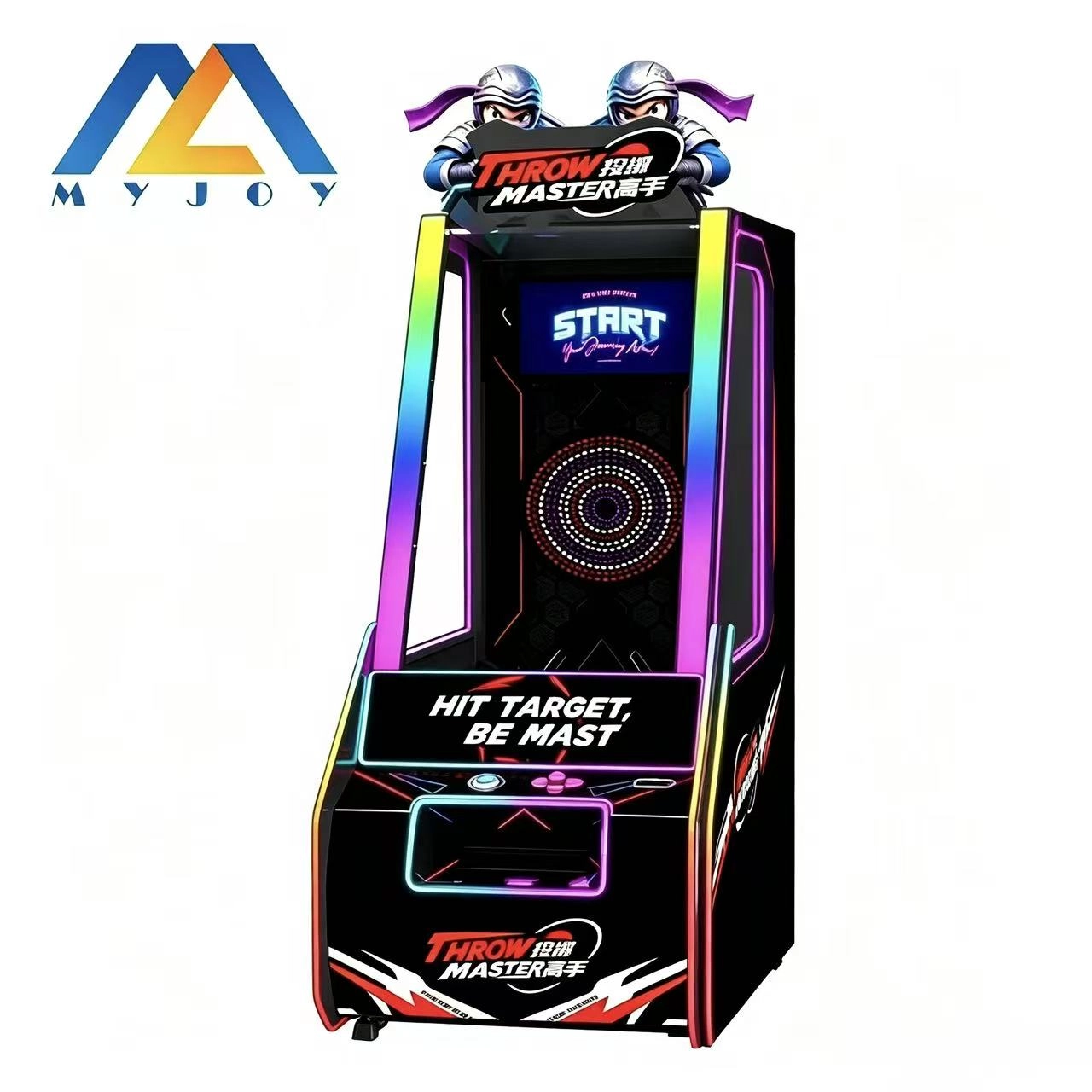
THROW MASTER is a commercial interactive dart throwing arcade machine that combines physical throwing action with an electronic target, digital scoring, on-screen interaction, and camera-based hit detection.
Designed for arcades, family entertainment centers (FECs), indoor amusement venues, shopping malls, and competitive entertainment spaces, THROW MASTER delivers an engaging mix of casual fun and skill-based competition.
Players insert coins, select their player and game mode, and throw darts at the large colorful electronic target. The system detects each result and displays scores, objectives, remaining throws, and game progress on the screen.
With Standard Mode for score-based challenges and Skill Mode for precision target challenges, the machine is suitable for both casual players and those looking for a more competitive experience. Leaderboards, adjustable game settings, and optional ticket rewards also make it well suited for commercial arcade operation.
Its large upright cabinet, colorful circular target, and vibrant RGB-style lighting create a futuristic arcade appearance that helps attract attention in busy entertainment venues.


No. 3, Wenjian Second Road, Wenbian Village, Shiji Town, Panyu District, Guangzhou City, China
Facebook