

Interactive Basketball Arcade Game vs. Traditional Basketball Arcade Machine

An interactive basketball arcade game uses sensors, digital scoring, visual feedback, connected software, and responsive gameplay to create a more immersive sports attraction, while a traditional basketball arcade machine primarily measures successful shots through a physical hoop, timer, and score display. For family entertainment centers, arcades, shopping malls, sports parks, and indoor amusement venues, the right choice depends on target visitors, available floor space, expected throughput, maintenance capability, capital budget, and the desired balance between proven simplicity and differentiated digital engagement.
How Modern Basketball Arcade Attractions Differ from Conventional Hoop Games
Gameplay mechanics and player engagement
A conventional basketball cabinet typically presents a clear challenge: players shoot as many balls as possible within a fixed period, and the electronic counter records the result. This familiar format has strong advantages. It is easy to understand, requires minimal instruction, supports rapid turnover, and works well in locations where customers make quick purchasing decisions. The straightforward competition also makes the machine accessible to children, teenagers, casual players, and groups.
A sensor-based basketball attraction expands this basic loop with animated targets, multiple modes, progressive difficulty, illuminated interfaces, sound effects, digital characters, or competitive rankings. Depending on the configuration, cameras, infrared sensors, pressure detection, or other electronic components can track timing, accuracy, movement, or shot outcomes. The result is a more theatrical experience that can encourage repeat play, social sharing, and longer dwell time within a venue.
Buyers should not assume that more technology automatically creates better commercial performance. Gameplay must remain intuitive, responsive, and reliable. If the interface is difficult to understand, the detection system misses shots, or the visual effects distract from the objective, additional features can reduce satisfaction. A supplier should therefore demonstrate the complete player journey, including attract mode, game selection, scoring, error recovery, and end-of-game communication.
Physical construction and operating environment
Traditional units often use a robust cabinet, rebound area, metal frame, physical basketballs, a hoop assembly, a backboard, and an electronic scoring module. Their mechanical architecture is comparatively easy for operators to inspect. Wear points usually include the net, rim, ball return, ball storage area, sensors, wiring, and high-contact cabinet surfaces.
Digital sports equipment adds displays, lighting systems, speakers, control boards, sensor arrays, software, and potentially network functionality. These components create opportunities for richer content but also require closer attention to ventilation, cable management, electrical protection, firmware stability, and replacement-part availability. In high-traffic venues, the cabinet should be designed for repeated impact, accidental contact, and continuous daily operation.
Procurement teams should evaluate materials, weld quality, powder coating, fastener security, screen protection, ball durability, and access panels before approving a purchase. Equipment should also be positioned according to the manufacturer’s clearance requirements so that players can move safely and staff can perform maintenance without disrupting nearby attractions. Guidance on general machine safety and risk reduction can be reviewed through ISO 12100 principles for machinery safety.
Commercial performance and customer behavior
The conventional format is often suitable for operators seeking dependable throughput. A short round allows more sessions per hour, which can be valuable in compact arcades, cinema entertainment zones, restaurant-based family venues, and locations with strong walk-in traffic. Its simple rules also reduce staff training requirements and make it easier to place the unit near other redemption or ticket-based attractions.
A technologically enhanced model may support stronger visual differentiation. Large displays, interactive lighting, team modes, tournament features, and themed content can help an operator create a destination attraction rather than another standard cabinet. This can be particularly relevant to digital sports parks, modern family entertainment centers, and venues competing for attention in shopping or mixed-use developments.
Revenue should be measured through more than the purchase price. A buyer should estimate sessions per day, price per play, utilization by daypart, downtime, expected service cost, floor-space value, and the effect of the machine on adjacent attractions. The International Association of Amusement Parks and Attractions provides industry resources that can help project owners frame operational and safety discussions through IAAPA safety resources.
Buyer Comparison: Digital Interaction or Proven Mechanical Simplicity?
Decision criteria for venue owners
The strongest purchase decision begins with the venue model rather than the product category. A small arcade with limited technical support may prioritize a durable, easy-to-service cabinet. A High Quality entertainment complex may accept higher system complexity if the attraction creates stronger visual impact, supports competitive events, or integrates with a broader digital sports concept.
Location demographics also matter. Younger guests may respond positively to animated challenges and multiplayer features, while mixed-age family audiences often value clear instructions and immediate playability. In a tourist venue, language options and visual guidance can reduce barriers. In a competitive sports environment, ranking systems, timed challenges, and measurable skill progression may be more important than decorative effects.
Comparison table for procurement planning
| Evaluation factor | Traditional basketball machine | Interactive digital sports attraction | Procurement implication |
|---|---|---|---|
| Learning curve | Very low; shoot and score | Low to moderate; depends on interface and modes | Test the first-play experience with representative users |
| Visual impact | Moderate and familiar | High when screens, lighting, and animation are well integrated | Important for open malls and High Quality entertainment venues |
| Mechanical complexity | Lower | Moderate to high | Review service access, spare parts, and technical support |
| Game variety | Usually limited to timed scoring | Can include missions, levels, team play, and tournaments | Confirm software update and content-support policy |
| Throughput potential | Strong for short repeat sessions | Strong if the interface remains fast and intuitive | Measure average session duration and queue tolerance |
| Maintenance profile | Focuses on hoop, balls, rebound system, wiring, and sensors | Includes those items plus displays, controls, audio, lighting, and software | Calculate total cost of ownership, not only purchase price |
| Best-fit venue | Compact arcades, restaurants, and general family zones | Digital sports parks, FECs, malls, and themed attractions | Match the equipment to the venue’s positioning and staff capability |
The table is a practical screening tool rather than a guarantee of revenue. Actual results depend on pricing, placement, local consumer behavior, machine availability, neighboring attractions, and operating discipline. Buyers should request factory test videos, technical specifications, installation drawings, electrical requirements, warranty terms, and references from comparable venues before signing a purchase order.
Space, power, and installation planning
Basketball equipment needs more than the footprint shown in a catalog. The project plan should include player approach space, ball retrieval clearance, queue space, circulation paths, emergency access, ceiling height, delivery routes, and service access. If the machine uses a large display or overhead structure, the team must confirm visibility from the main customer flow without creating an obstruction.
Electrical planning should cover voltage, frequency, rated power, plug standards, circuit capacity, grounding, surge protection, and local compliance requirements. For international projects, the importer and operator remain responsible for confirming applicable national regulations and certification needs. Equipment documentation should be translated where necessary, and installation personnel should understand both the hardware and software configuration.
How MYL ARCADE Supports Basketball and Digital Sports Projects
Integrated product development and manufacturing
MYL ARCADE was established in 2007 in Guangzhou, China, and was formerly known as Meilian Technology. For nearly two decades, our organization has focused on the amusement and entertainment equipment industry. Our capabilities combine research and development, production, sales, after-sales service, project planning, and operation support, allowing buyers to coordinate more of the project through one experienced manufacturing partner.
Our product portfolio includes arcade game machines, redemption machines, sports arcade games, interactive digital sports equipment, VR attractions, prize machines, children’s amusement machines, and complete family entertainment solutions. For basketball-focused projects, this broader product range makes it possible to consider the court-style attraction as part of a balanced entertainment mix rather than as an isolated purchase.
Our engineering and production process is designed around practical venue requirements: durable structures, accessible service points, stable electronic integration, clear player instructions, and efficient shipment preparation. Product selection can be aligned with the operator’s audience, floor plan, budget, visual identity, and expected operating hours. Buyers should still conduct their own due diligence, including factory audits, sample approval, commercial contract review, and local compliance verification.
Project planning and international delivery capability
In China, MYL ARCADE has established long-term partnerships with more than 2,000 amusement centers, family entertainment centers, digital sports parks, and indoor entertainment venues. Internationally, our products have been exported to more than 20 countries and regions, including Japan, the United States, Italy, Spain, Guyana, the Middle East, South America, and Southeast Asia.
This project exposure helps our team understand recurring buyer concerns: how to maximize revenue per square meter, how to coordinate equipment themes, how to prepare for installation, how to reduce commissioning delays, and how to maintain machines after launch. Our support can include product recommendations, layout coordination, quotation preparation, shipping arrangements, installation guidance, operating suggestions, and after-sales communication.
For distributors, our manufacturing background can support product sourcing and market development. For venue owners, the value lies in selecting equipment that fits the operating model and can be supported over its commercial life. For investors building a new entertainment center, a coordinated equipment package can simplify procurement and create a more consistent customer journey across arcade, redemption, sports, VR, and children’s amusement zones.
Quality, service, and return-on-investment considerations
A reliable supplier should communicate specifications clearly and provide documentation covering dimensions, power, materials, game functions, warranty scope, replacement parts, and recommended maintenance. Operators should establish a daily inspection routine for balls, nets, rims, rebound paths, displays, controls, cabinet surfaces, and electrical connections. Preventive cleaning and prompt repair can protect both player experience and asset value.
Our corporate philosophy is based on integrity, progress, practicality, and mutual benefit. These principles are relevant to procurement because a successful installation requires more than an attractive product image. The supplier must understand commercial objectives, identify technical risks early, and remain responsive after delivery. Buyers evaluating our basketball and digital sports solutions can compare specifications, expected use cases, customization options, lead times, packaging, warranty support, and total project requirements before making a decision.
Technology should serve the business model. A traditional hoop cabinet may be the right choice when simplicity, compact placement, and fast turnover are decisive. A connected, sensor-driven sports attraction may be the better investment when the venue needs stronger visual presence, game variety, social competition, and a differentiated digital experience. In both cases, equipment quality, placement, pricing, maintenance, and supplier support determine commercial results more than product labels alone.
Contact MYL ARCADE to review basketball arcade equipment, digital sports attractions, and complete venue solutions for your next entertainment project.
Frequently Asked Questions
What is the main difference between an interactive basketball arcade game and a traditional basketball arcade machine?
A traditional machine generally measures timed shots through a physical hoop and score counter, while an interactive digital sports attraction can add sensors, animated targets, visual feedback, multiple modes, rankings, and other software-supported features.
Which basketball arcade format is better for a small arcade?
A traditional cabinet is often suitable for a small arcade because it has a simple learning curve, strong session throughput, and a comparatively straightforward maintenance profile; the final decision should also consider floor space, audience, pricing, and available technical support.
Are interactive basketball machines more difficult to maintain?
They can require broader maintenance because, in addition to the hoop, balls, rebound system, wiring, and sensors, operators may need to service displays, controls, audio, lighting, and software. Buyers should confirm service access, spare-parts availability, warranty coverage, and technical support before purchase.
What should buyers check before importing basketball arcade equipment?
Buyers should review dimensions, clearance, ceiling height, voltage, frequency, rated power, plug standards, grounding, shipping requirements, installation drawings, warranty terms, replacement parts, local compliance requirements, and factory test results.
Can a basketball arcade attraction be included in a larger family entertainment center project?
Yes. Basketball equipment can be planned alongside arcade games, redemption machines, VR attractions, prize machines, children’s amusement equipment, and other digital sports products to create a balanced customer journey and make better use of the venue’s available floor space.
How does MYL ARCADE support international amusement equipment projects?
MYL ARCADE provides product development, manufacturing, sales, after-sales service, project planning, and operation support. The company has partnered with more than 2,000 venues in China and exported products to more than 20 countries and regions, including markets in Asia, Europe, the Americas, the Middle East, and Southeast Asia.
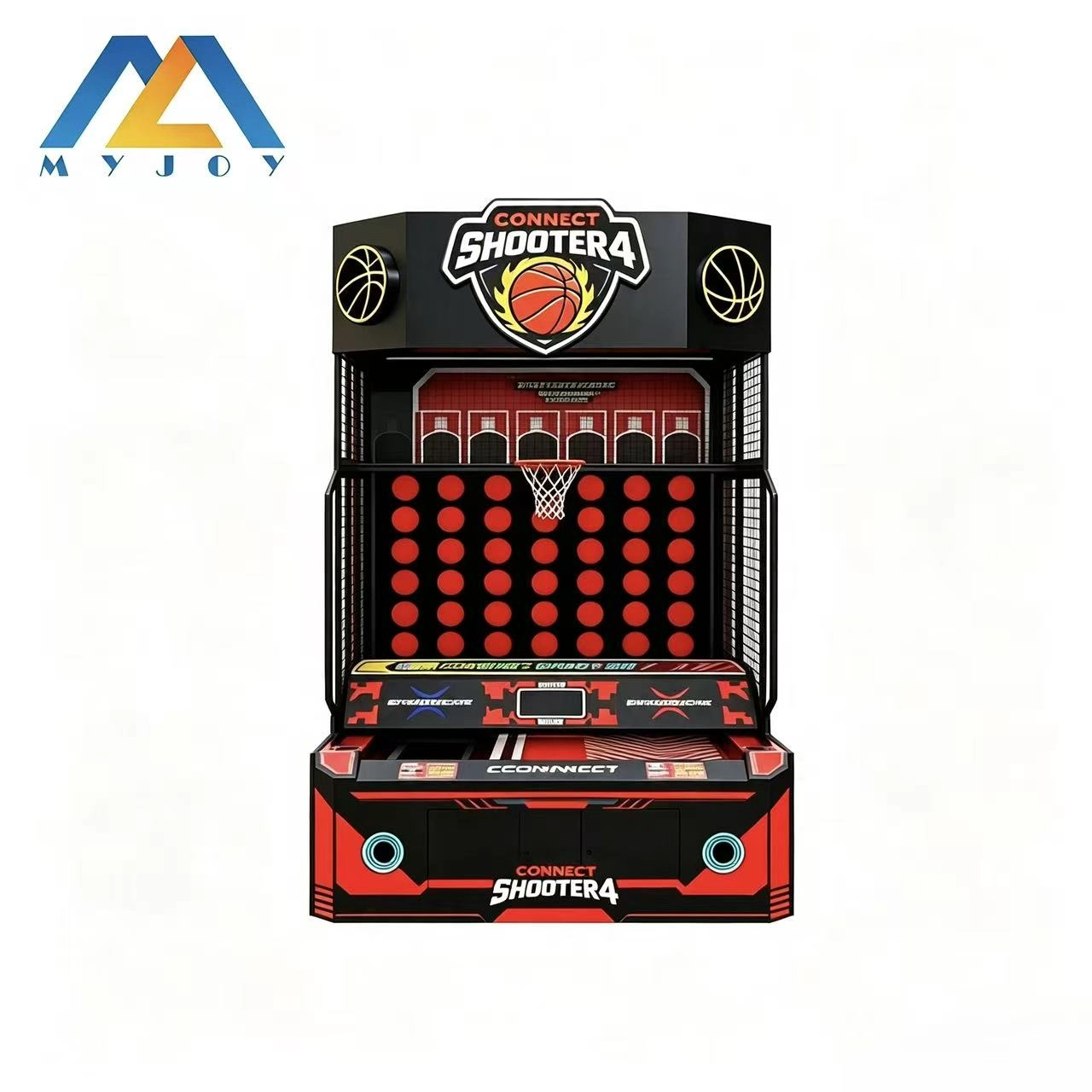
Connect Shooter 4 Mechanical -Version is an interactive basketball arcade machine that combines basketball shooting with the classic Connect Four strategy game. Players shoot red or blue balls into different positions and compete to connect four or more balls of the same color horizontally, vertically or diagonally.
The machine supports both Two-Player Battle Mode and Single-Player Challenge Mode, with Easy, Standard and Hard difficulty levels available for individual players. It combines shooting accuracy, strategic thinking and competitive interaction, making every round exciting and different.
Featuring an eye-catching basketball-themed design, illuminated decorations and a protective net structure, Connect Shooter 4 is ideal for arcades, family entertainment centers, shopping malls, indoor playgrounds and sports entertainment venues. Its simple rules and engaging gameplay make it suitable for children, teenagers, adults and family groups.
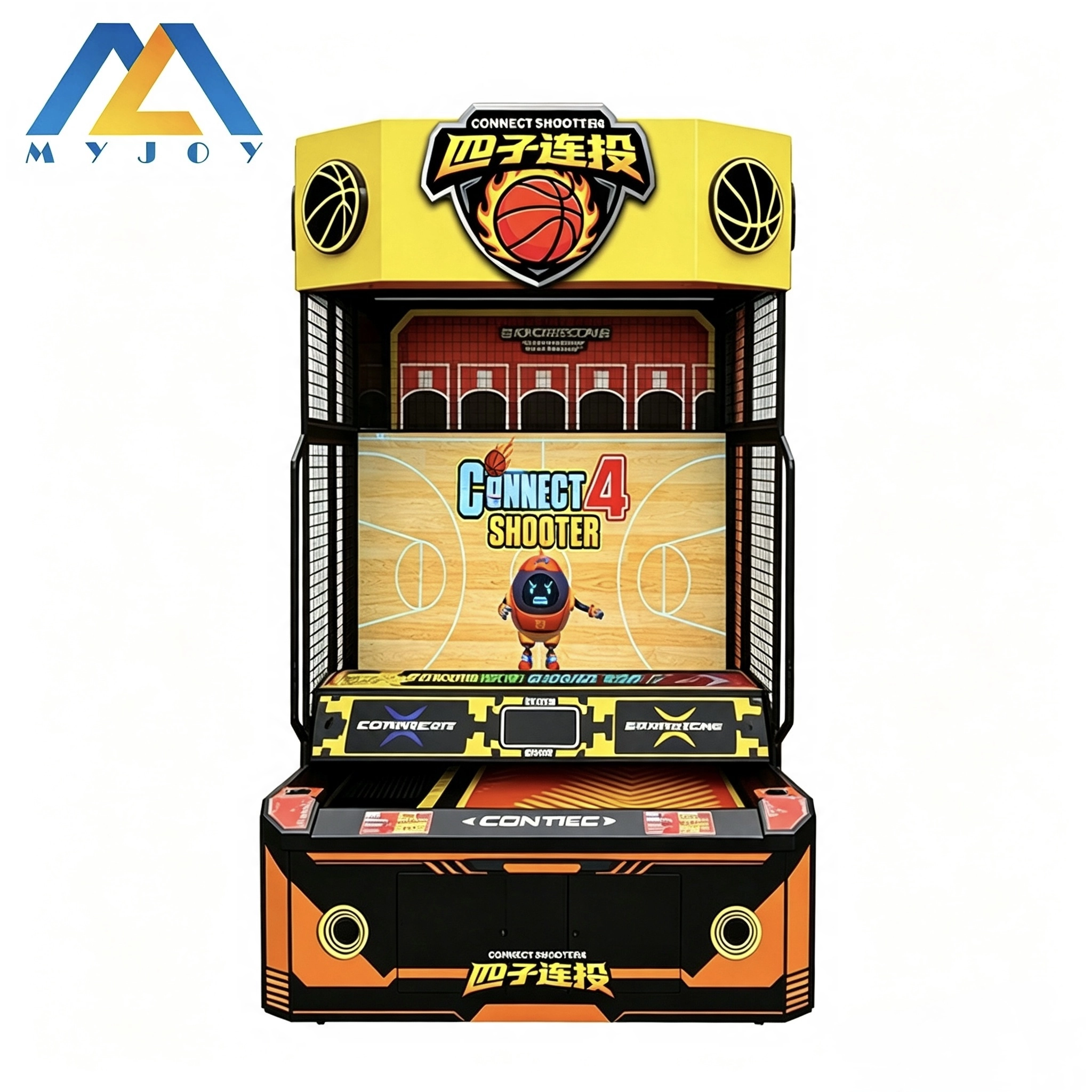
Connect Shooter 4 is an interactive basketball arcade machine that combines shooting skills with the classic Connect Four strategy game. Players shoot red or blue balls into selected positions and compete to connect four or more balls horizontally, vertically, or diagonally. It supports two-player competitive mode and single-player challenges against the computer, with Easy, Standard, and Hard difficulty levels. Its eye-catching basketball-themed design, fast-paced gameplay, and strong player interaction make it ideal for arcades, FECs, shopping malls, indoor playgrounds, sports entertainment centers, and other commercial venues.
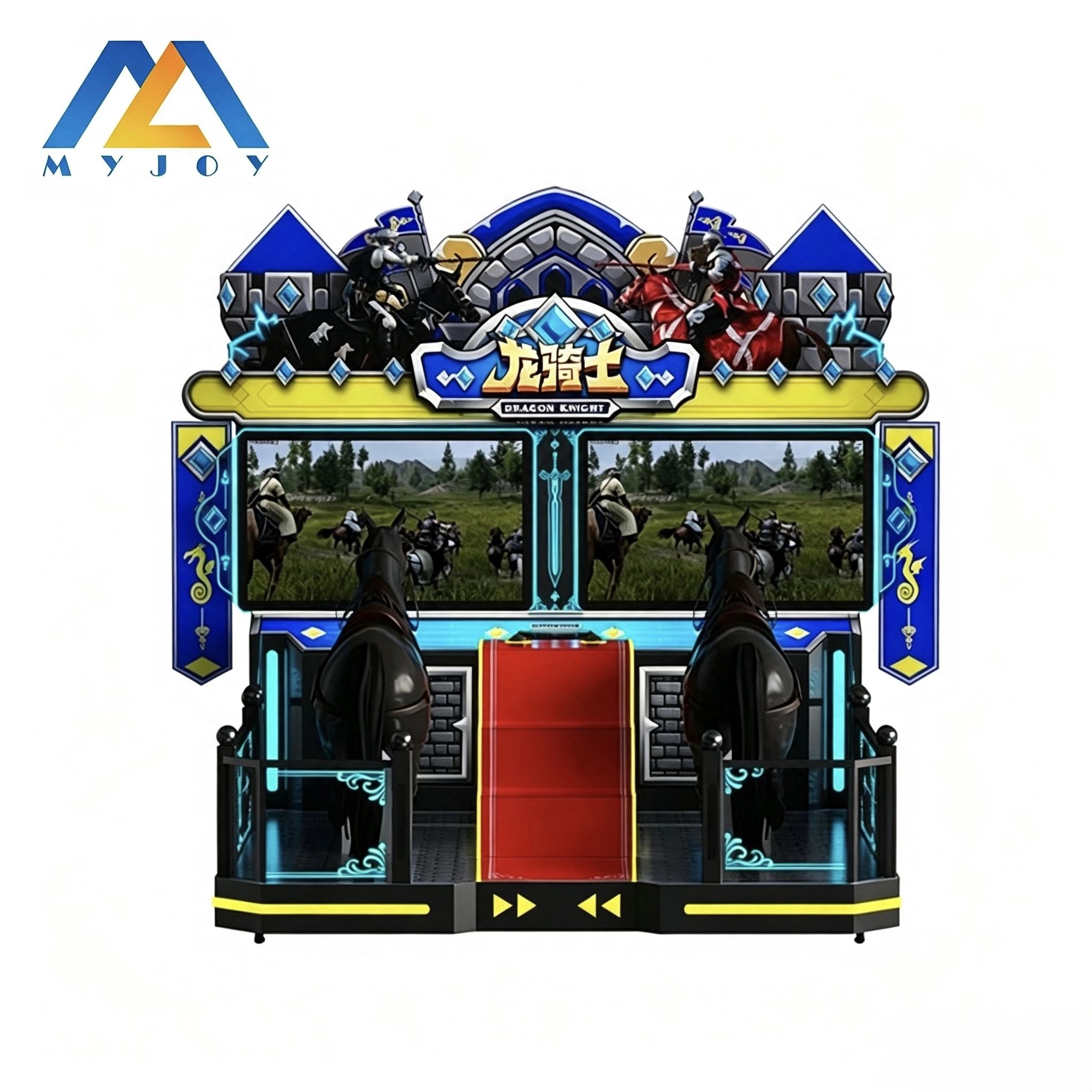
Flying Dragon Knight Horse Racing Simulator is a premium two-player arcade entertainment machine designed for amusement parks, shopping malls, arcades, family entertainment centers and themed attractions. Inspired by medieval knights and fantasy dragon adventures, this simulator combines realistic horse riding motion, interactive racing gameplay and an impressive visual design to create an unforgettable entertainment experience.
Featuring two realistic horse models, dual HD displays, dynamic motion control, vibration feedback and immersive sound effects, players can experience exciting horse racing competitions, adventure challenges and jumping missions. The machine recreates the feeling of real horseback riding through synchronized movement and responsive control systems.
With its eye-catching dragon knight appearance, colorful LED lighting, multiplayer competition mode and safe commercial design, Flying Dragon Knight Horse Racing Simulator is an excellent attraction solution for increasing customer engagement and entertainment value.
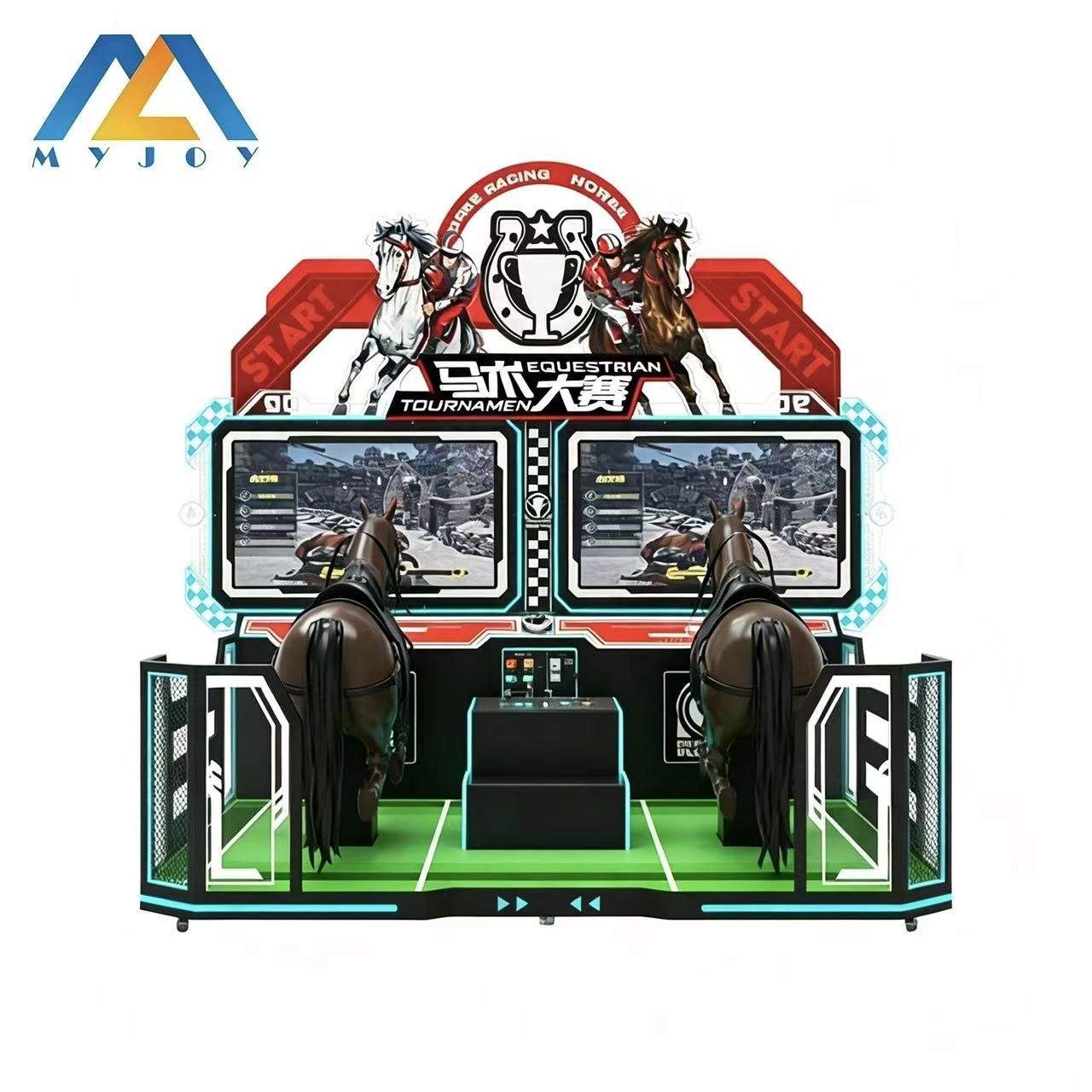
The Horse Racing Championship is a dual-player interactive sports simulator developed by Guangzhou Meiyilian Animation Technology Co., Ltd. It combines simulated horseback riding, competitive racing, physical interaction, and immersive visual effects to create an exciting attraction for players aged 5 to 50.
The machine features two realistic horse models equipped with comfortable saddles and reins. Players control their horses through riding movements and compete on two HD screens. Multiple racing scenes, difficulty levels, and challenge modes make the experience suitable for beginners and experienced players alike.
With its striking equestrian-themed design, dynamic LED lighting, green racetrack-style platform, and competitive ranking system, the machine easily attracts attention and encourages repeat play. It is ideal for amusement arcades, shopping malls, family entertainment centers, sports venues, theme parks, clubs, and tourist attractions.


No. 3, Wenjian Second Road, Wenbian Village, Shiji Town, Panyu District, Guangzhou City, China
Facebook