


What Is an Interactive Basketball Arcade Game? A Complete Buyer’s Guide

An interactive basketball arcade game is a commercial sports entertainment machine that transforms basketball shooting into a timed, score-based digital experience. Unlike a basic hoop with a mechanical counter, this type of attraction typically combines a backboard, rim, ball-return system, electronic scoring sensors, display screen, speakers, lighting effects, countdown controls, and software-driven game rules. Some models support solo play, while others provide head-to-head competition, progressive difficulty, ranking displays, ticket redemption, or connection to a venue’s payment system.
For B2B buyers, the central question is not simply whether a cabinet looks attractive. The purchase should be assessed as a revenue-generating attraction within a specific venue environment. Floor area, player throughput, age range, maintenance access, noise level, power supply, shipping volume, spare-parts availability, and local operating regulations all affect the total cost of ownership. A reliable procurement decision connects game design with the commercial objectives of the facility.
How Digital Basketball Shooting Attractions Work
Core hardware and sensing system
A commercial basketball shooting cabinet generally uses optical, infrared, pressure, or other electronic sensing methods to detect successful shots and calculate scores. The ball-return channel is equally important because it determines how quickly a player can attempt the next shot. A well-designed return path reduces interruptions, prevents balls from accumulating around the player area, and supports a consistent game rhythm.
The cabinet normally includes a steel or reinforced frame, protective panels, a basketball hoop assembly, a scoring display, control buttons, audio components, and LED effects. Buyers should request technical drawings that show the overall height, width, depth, clearance zone, and recommended ceiling height. These measurements must be compared with the actual floor plan rather than the packaged shipping dimensions alone.
Software, game modes, and player engagement
Software determines whether the attraction remains appealing after the first visit. Common modes include countdown shooting, fixed-ball challenges, accuracy practice, two-player competition, tournament play, and progressive levels. Some machines award tickets or digital points according to score thresholds. Others focus on sports simulation and repeat play without prize output.
Game rules should be easy to understand within a few seconds. A bright score display, visible timer, clear start button, and immediate shot feedback reduce the need for staff assistance. For family entertainment centers, adjustable difficulty can accommodate children, teenagers, and adults. For sports-themed venues, ranking functions and competitive rounds can support longer sessions and group engagement.
Relationship between physical design and commercial performance
The basketball hoop height is a meaningful design consideration. Official basketball regulations use a hoop height of 3.05 meters, or 10 feet, as documented in the FIBA Official Basketball Rules. Arcade equipment may use a different, more accessible configuration depending on the intended audience, cabinet structure, and game objective. Buyers should confirm whether the product is designed for children, general family use, competitive play, or a mixed audience.
Visual presence also affects performance. A cabinet positioned near an entrance, food court, prize counter, or central circulation route may attract more spontaneous play than a visually obstructed unit. However, high-traffic placement requires sufficient queue space and safe separation from nearby attractions. The most attractive machine can underperform if players cannot approach it comfortably or if balls and spectators interfere with adjacent equipment.
Key Buying Criteria for Commercial Operators
Capacity, footprint, and venue compatibility
Start with the business model and available floor area. A compact single-player cabinet may suit a small arcade, hotel, restaurant, cinema, or convenience entertainment zone. A dual-player or linked configuration may be more suitable for a family entertainment center, sports park, or high-volume amusement venue. The buyer should measure not only the machine footprint but also player stance, ball retrieval, queue formation, cleaning access, and emergency circulation.
Throughput depends on game duration, reset time, number of players, and payment process. A short-round machine may generate more sessions per hour, while a longer competitive format may create higher perceived value per play. The correct configuration depends on pricing, customer dwell time, and the venue’s overall mix of attractions.
Construction quality, safety, and maintainability
Commercial equipment must tolerate repeated impact, vibration, cleaning, transportation, and continuous operation. Buyers should inspect frame materials, panel thickness, fastener quality, cable routing, ball-return durability, ventilation, and access to electronic components. Rounded edges, stable feet, secure hoop mounting, and protected wiring are practical details that reduce operational risk.
Electrical documentation should be reviewed before purchase, particularly when equipment will be imported. Depending on the destination, the buyer may need conformity documentation, voltage and frequency compatibility, plug specifications, electromagnetic compatibility information, and installation instructions. ISO 9001 is a quality-management framework rather than a product safety certificate; its role and scope are explained by the International Organization for Standardization. Buyers should therefore request product-specific compliance information instead of treating a general management certification as proof that every technical requirement has been met.
Payment, scoring, and operational controls
Commercial models may support coin acceptors, token systems, card readers, QR payment, free-play settings, or integration with a venue management platform. The preferred option depends on the operator’s existing infrastructure and local payment habits. A machine that requires a completely separate payment process can create staff workload and complicate revenue reporting.
Operators should also confirm whether scores, play counts, fault codes, and ticket settings can be configured locally. Menu access should be protected against unauthorized changes while remaining practical for trained staff. If network connectivity is available, clarify whether it is used for remote diagnostics, software updates, leaderboards, or payment management, and ask how data is stored and protected.
| Configuration | Typical application | Commercial advantage | Buyer consideration |
|---|---|---|---|
| Single-player shooting cabinet | Small arcades, restaurants, hotels, compact FEC zones | Lower footprint and simpler installation | Less social competition and lower simultaneous capacity |
| Two-player competitive unit | Family entertainment centers and sports-themed venues | Stronger group appeal and higher interaction | Requires more floor clearance and queue planning |
| Ticket or prize-enabled model | Redemption arcades and mixed amusement venues | Connects sports play with reward motivation | Requires ticket calibration, prize economics, and maintenance controls |
| Networked or leaderboard model | Digital sports parks, tournaments, branded campaigns | Supports repeat competition and event programming | Needs reliable software support and network administration |
Procurement, Installation, and Return on Floor Space
Questions to ask before placing an order
A professional request for quotation should include the target market, venue type, quantity, destination country, voltage, desired payment method, branding requirements, delivery deadline, and after-sales expectations. Ask for a complete specification sheet, product videos, cabinet drawings, packing dimensions, net and gross weight, warranty terms, spare-parts list, recommended operating environment, and installation guide.
Buyers should also request clarification on customization. Cabinet artwork, screen size, language, sound volume, basketball quantity, hoop height, game duration, ticket output, and logo placement may be adjustable, but customization can affect tooling, lead time, minimum order quantity, and replacement-part compatibility. Each change should be documented in an approved technical confirmation before production begins.
Installation and ongoing operation
Before delivery, the venue should prepare a level floor, suitable electrical outlet, adequate ceiling clearance, and enough space for assembly and servicing. Large cabinets may require stairway checks, elevator measurements, door-width verification, and a lifting plan. Failure to complete these checks can create avoidable unloading and installation costs.
Daily operating procedures should include visual inspection of the hoop, net, balls, cabinet panels, display, controls, and floor area. Staff should remove damaged balls, clean high-touch surfaces, check unusual sounds, and record recurring error codes. Preventive maintenance is usually less disruptive than waiting for a sensor, ball-return component, or display module to fail during peak hours.
Evaluating ROI and total cost of ownership
Return on investment should be calculated using realistic utilization rather than optimistic footfall. A basic model can compare purchase and installation cost against expected paid plays, average price per session, operating days, downtime, payment fees, staffing, maintenance, and venue allocation. The calculation should also account for the attraction’s contribution to dwell time, cross-selling, birthday-party packages, tournaments, and repeat visitation.
For example, a machine with a moderate price but frequent downtime may be less profitable than a higher-quality unit with dependable components and responsive technical support. Buyers should evaluate warranty coverage, replacement-part lead times, remote troubleshooting, and the supplier’s ability to provide service documentation. These factors directly influence uptime and long-term operating confidence.
Why MYL ARCADE Is a Practical Manufacturing Partner
Nearly two decades of amusement equipment capability
MYL ARCADE was established in 2007 in Guangzhou, China, and was formerly known as Meilian Technology. For nearly two decades, our organization has remained focused on the amusement and entertainment equipment industry. We have developed an integrated capability covering research and development, production, sales, after-sales service, project planning, and operation support.
Our product portfolio includes arcade game machines, redemption machines, sports arcade games, interactive digital sports equipment, VR attractions, prize machines, children’s amusement machines, and family entertainment solutions. This range allows project owners to evaluate a basketball shooting attraction as part of a broader venue concept rather than as an isolated cabinet purchase.
Engineering and project planning for different venue formats
Our engineering and project teams support buyers with product selection, configuration discussions, venue planning, installation coordination, and operational recommendations. For a sports-themed facility, the equipment can be considered alongside other digital sports attractions. For a family entertainment center, the selection can be coordinated with redemption equipment, children’s rides, prize machines, and arcade products to create a balanced customer journey.
We understand that buyers may require different cabinet dimensions, payment systems, artwork, language settings, game rules, or branding treatments. These requirements are reviewed according to production feasibility, operating environment, target users, and maintenance needs. A structured confirmation process helps reduce specification errors between the quotation, manufacturing stage, shipment, and on-site installation.
Established domestic and international market coverage
In China, MYL ARCADE has established long-term partnerships with more than 2,000 amusement centers, family entertainment centers, digital sports parks, and indoor entertainment venues. Internationally, our products have been exported to more than 20 countries and regions, including Japan, the United States, Italy, Spain, Guyana, the Middle East, South America, and Southeast Asia.
This market coverage supports practical communication around packaging, export documentation, voltage requirements, delivery coordination, and regional operating conditions. Our business philosophy is based on integrity, progress, practicality, and mutual benefit. For distributors and investors, the value of a supplier is therefore measured not only by the initial equipment quotation but also by consistency, communication, product breadth, and the ability to support future venue expansion.
Recommended buyer due diligence for MYL ARCADE products
Before final approval, buyers should align the selected model with the venue floor plan, intended age range, payment method, power standard, shipping route, and service plan. Product demonstrations, technical specifications, packaging details, warranty conditions, and spare-parts arrangements should be included in the commercial discussion. This process gives operators a clearer basis for comparing machines and forecasting actual operating performance.
For additional context on physical activity terminology and health communication, buyers can consult the World Health Organization physical activity guidance; however, an amusement machine should not be marketed as a medical or therapeutic device unless it has the appropriate evidence and regulatory basis. Similarly, connected equipment should be assessed with appropriate information-security awareness, including principles described in the NIST Cybersecurity Framework when network features or customer data are involved.
A successful purchase combines engaging gameplay with disciplined commercial planning. The best basketball-themed arcade attraction is the one that fits the venue, attracts the intended audience, withstands frequent use, can be serviced efficiently, and produces measurable value from the occupied floor space.
Frequently Asked Questions
What is an interactive basketball arcade game?
It is a commercial sports entertainment machine that combines basketball shooting with electronic scoring, timed challenges, audiovisual feedback, and sometimes competitive rankings, ticket redemption, or network functions.
How much space is needed for a basketball shooting arcade machine?
The required space depends on the cabinet design, player position, ball-return path, queue area, service access, and safety clearance. Buyers should use the supplier’s technical drawing and add practical circulation space rather than relying only on the cabinet footprint.
Can a basketball arcade machine support different payment systems?
Many commercial models can be configured for coin acceptors, tokens, card readers, QR payment, free play, or venue management systems. Compatibility should be confirmed with the supplier before ordering because local payment integration may affect configuration and lead time.
What should buyers check about safety and compliance?
Buyers should review frame stability, protected wiring, rounded edges, hoop mounting, ventilation, electrical specifications, voltage compatibility, installation instructions, and destination-country conformity requirements. A general quality-management certification should not be treated as a product-specific safety certificate.
Are basketball arcade machines suitable for family entertainment centers?
Yes. Models with adjustable difficulty, clear controls, short game rounds, two-player competition, and optional ticket functions can suit family entertainment centers. The final choice should match the venue’s age range, floor plan, pricing model, and attraction mix.
How can operators improve the return on investment?
Operators can improve returns by selecting the correct location, setting pricing according to local demand, minimizing downtime, maintaining the ball-return and scoring systems, using tournaments or ranking features, and evaluating revenue together with dwell time, group play, and cross-selling opportunities.
What support should an equipment supplier provide?
A reliable supplier should provide product specifications, technical drawings, packing information, installation guidance, warranty terms, spare-parts support, troubleshooting assistance, and clear communication about customization, delivery, and after-sales service.
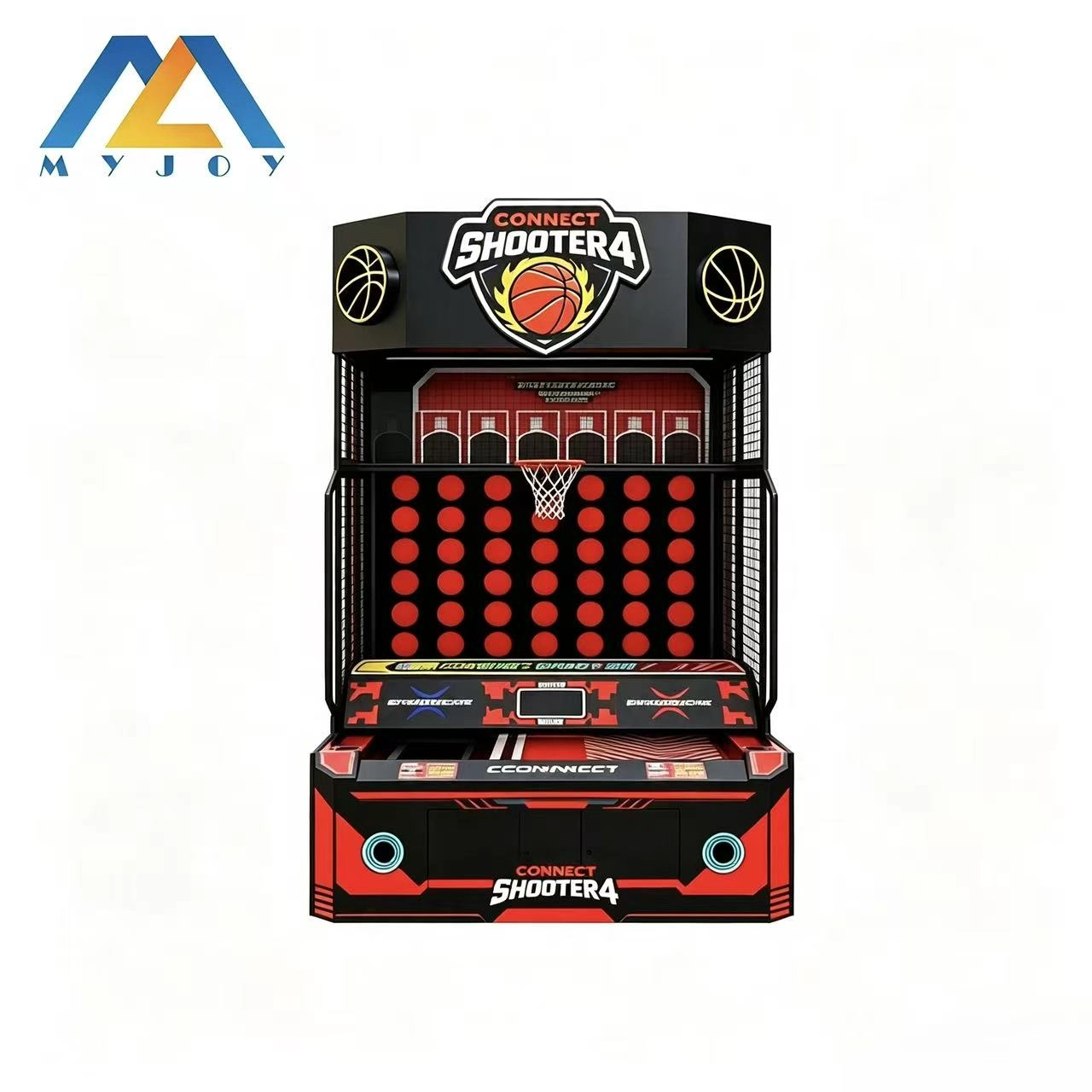
Connect Shooter 4 Mechanical -Version is an interactive basketball arcade machine that combines basketball shooting with the classic Connect Four strategy game. Players shoot red or blue balls into different positions and compete to connect four or more balls of the same color horizontally, vertically or diagonally.
The machine supports both Two-Player Battle Mode and Single-Player Challenge Mode, with Easy, Standard and Hard difficulty levels available for individual players. It combines shooting accuracy, strategic thinking and competitive interaction, making every round exciting and different.
Featuring an eye-catching basketball-themed design, illuminated decorations and a protective net structure, Connect Shooter 4 is ideal for arcades, family entertainment centers, shopping malls, indoor playgrounds and sports entertainment venues. Its simple rules and engaging gameplay make it suitable for children, teenagers, adults and family groups.
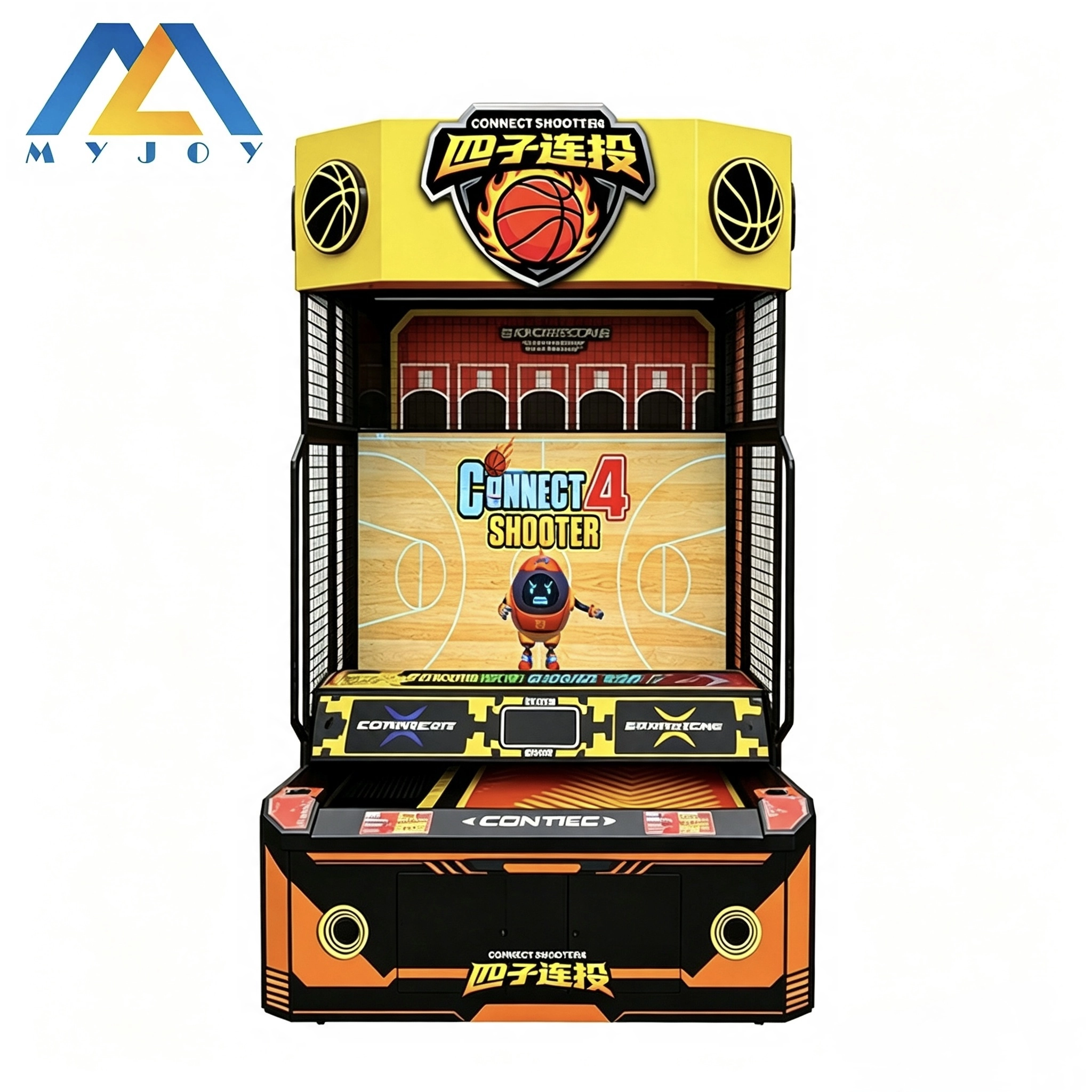
Connect Shooter 4 is an interactive basketball arcade machine that combines shooting skills with the classic Connect Four strategy game. Players shoot red or blue balls into selected positions and compete to connect four or more balls horizontally, vertically, or diagonally. It supports two-player competitive mode and single-player challenges against the computer, with Easy, Standard, and Hard difficulty levels. Its eye-catching basketball-themed design, fast-paced gameplay, and strong player interaction make it ideal for arcades, FECs, shopping malls, indoor playgrounds, sports entertainment centers, and other commercial venues.
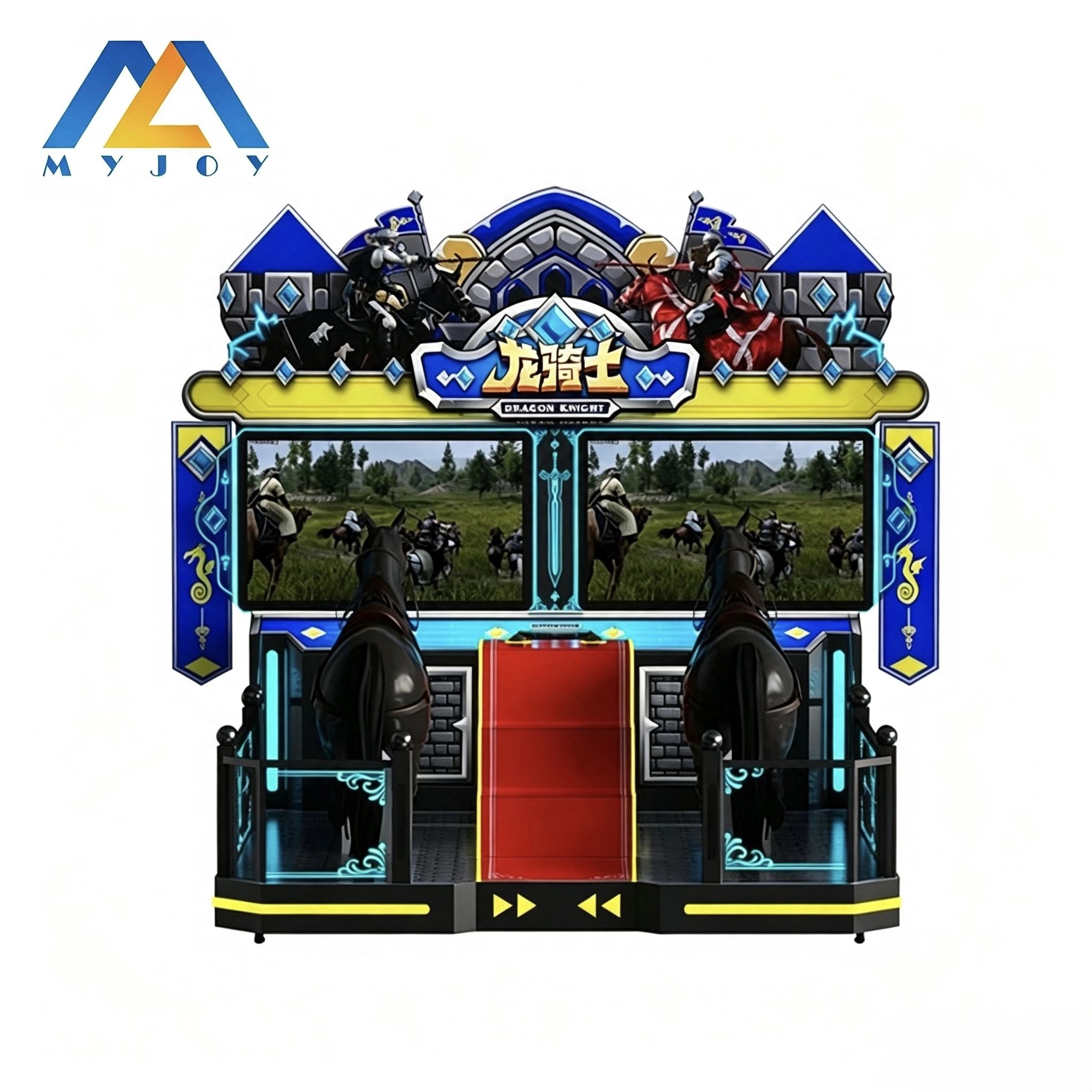
Flying Dragon Knight Horse Racing Simulator is a premium two-player arcade entertainment machine designed for amusement parks, shopping malls, arcades, family entertainment centers and themed attractions. Inspired by medieval knights and fantasy dragon adventures, this simulator combines realistic horse riding motion, interactive racing gameplay and an impressive visual design to create an unforgettable entertainment experience.
Featuring two realistic horse models, dual HD displays, dynamic motion control, vibration feedback and immersive sound effects, players can experience exciting horse racing competitions, adventure challenges and jumping missions. The machine recreates the feeling of real horseback riding through synchronized movement and responsive control systems.
With its eye-catching dragon knight appearance, colorful LED lighting, multiplayer competition mode and safe commercial design, Flying Dragon Knight Horse Racing Simulator is an excellent attraction solution for increasing customer engagement and entertainment value.
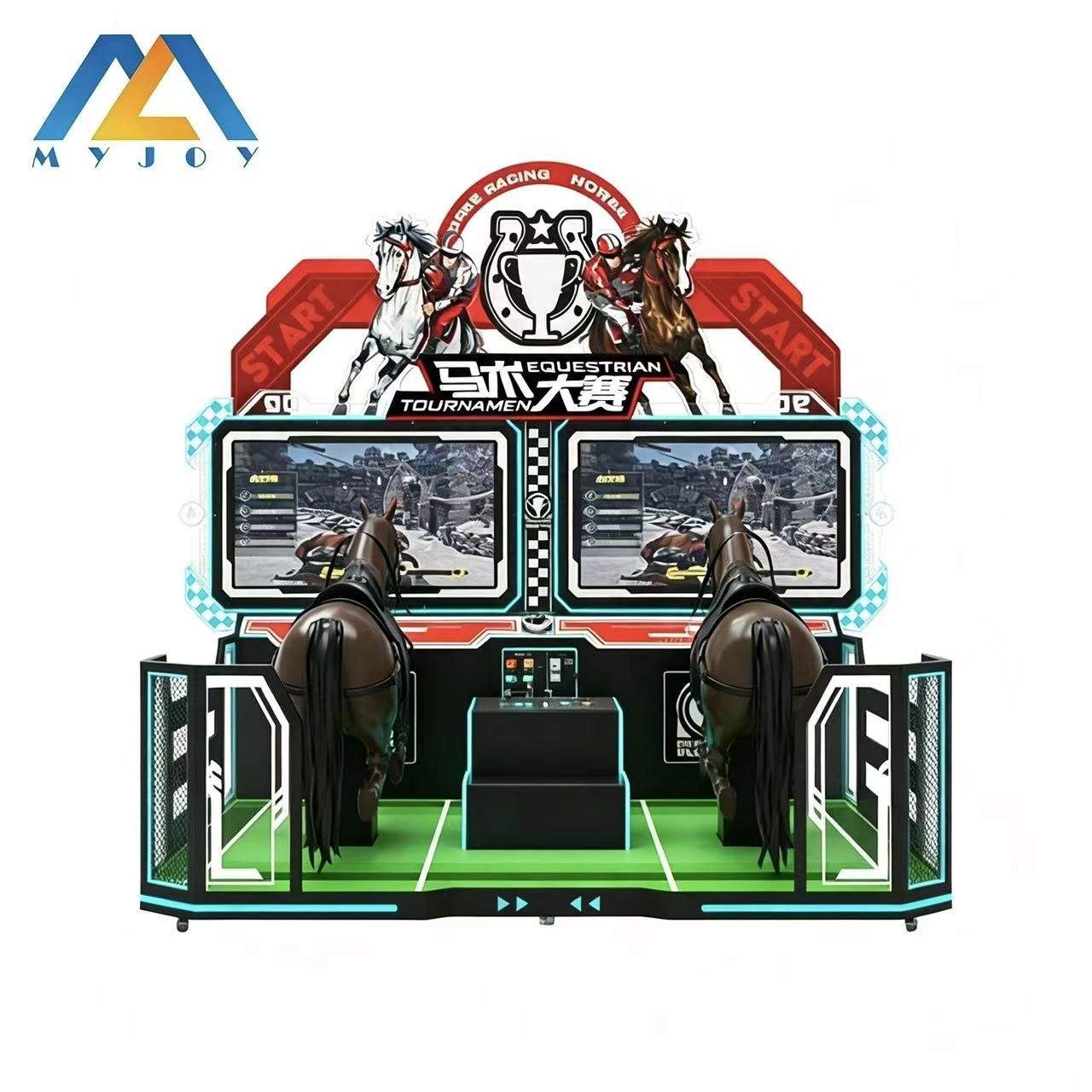
The Horse Racing Championship is a dual-player interactive sports simulator developed by Guangzhou Meiyilian Animation Technology Co., Ltd. It combines simulated horseback riding, competitive racing, physical interaction, and immersive visual effects to create an exciting attraction for players aged 5 to 50.
The machine features two realistic horse models equipped with comfortable saddles and reins. Players control their horses through riding movements and compete on two HD screens. Multiple racing scenes, difficulty levels, and challenge modes make the experience suitable for beginners and experienced players alike.
With its striking equestrian-themed design, dynamic LED lighting, green racetrack-style platform, and competitive ranking system, the machine easily attracts attention and encourages repeat play. It is ideal for amusement arcades, shopping malls, family entertainment centers, sports venues, theme parks, clubs, and tourist attractions.


No. 3, Wenjian Second Road, Wenbian Village, Shiji Town, Panyu District, Guangzhou City, China
Facebook