


How to Select the Right Interactive Basketball Arcade Game Size

Selecting the right interactive basketball arcade game size requires more than comparing cabinet dimensions on a supplier catalog. Buyers must evaluate the available floor area, ceiling clearance, player circulation, queue formation, electrical access, shipping route, accessibility, game format, and expected revenue per square meter. Compact one-player basketball shooting machines are suitable for narrow retail zones and small arcades, while two-player competitive units generally require greater width, front clearance, and overhead space. The most reliable purchasing decision combines a measured venue plan with the equipment's assembled dimensions, operating envelope, maintenance access, and delivery requirements. This approach helps family entertainment centers, arcades, shopping malls, sports parks, and distributors select a basketball amusement machine that fits safely, attracts players, and supports long-term commercial performance.
How to Match Basketball Arcade Dimensions With Venue Conditions
Measure the complete operating footprint
The catalog width and depth represent only the physical cabinet. A commercial buyer must also calculate the functional footprint: the space occupied by players, the front approach, the ball-return area, the queue, and the technician's access zone. A machine that measures 1.2 meters wide may need substantially more space when two players stand beside each other or when customers gather behind the active users.
Before requesting quotations, project owners should create a scaled floor plan showing walls, columns, doors, emergency exits, counters, seating, fire equipment, and neighboring attractions. The proposed location should then include the cabinet outline plus a clearly defined player zone. This prevents a common installation error in which the product technically fits but blocks circulation or creates conflict with redemption counters and other high-traffic attractions.
Check ceiling height and overhead movement
Basketball shooting attractions often include a raised backboard, illuminated header, protective frame, or electronic scoring display. Ceiling height should therefore be measured from the finished floor to the lowest obstruction, including sprinkler pipes, ventilation ducts, lighting tracks, signage, and suspended decoration. A unit may fit under the nominal ceiling but still appear visually compressed or become difficult to install if the upper frame cannot be tilted into position.
Buyers should request the product's assembled height, shipping height, maximum installation tilt angle, and recommended overhead clearance. If the venue has a low ceiling, a compact cabinet with a lower header can be more practical than modifying the building. For new construction, the equipment layout should be reviewed before ceiling services and decorative structures are finalized.
Allow space for circulation and accessibility
Player movement is a safety and revenue issue. Customers need a clear route to enter the game, retrieve balls, leave after a round, and join a queue without crossing another player's shooting area. The accessible route should remain usable when the attraction is busy. In the United States, buyers can consult the 2010 ADA Standards for Accessible Design when planning public accommodation areas; international projects should also review local accessibility rules.
Although an amusement cabinet is not automatically classified as an accessible facility element, the overall venue still needs an inclusive circulation strategy. Consider approach space, control-panel height, turning areas, visual reach, and whether staff can support players with different physical abilities. A larger competitive model may produce stronger social engagement, but a compact unit may be easier to position without compromising the accessible route.
Choose the Appropriate Cabinet Format for Commercial Use
Compact single-player models
Single-player basketball shooting machines are often the most efficient option for convenience stores, cinemas, restaurant entertainment areas, hotel game rooms, and small arcades. Their narrower footprint can support placement along a wall or in a secondary traffic zone. They are also easier to transport through standard doors and elevators, which can reduce installation labor in shopping centers and multi-story venues.
The commercial trade-off is lower simultaneous capacity. If the attraction is placed in a busy family entertainment center, one lane may create a queue during peak periods. Operators should compare the expected hourly demand with the game's cycle time, not simply the purchase price. A compact unit can deliver strong returns when the location has limited space and moderate demand, while two smaller units may outperform one oversized attraction by serving more independent players.
Two-player competitive configurations
Dual-lane basketball arcade machines create head-to-head play, spectator appeal, and social interaction. They are commonly suited to larger arcades, sports-themed venues, university recreation areas, bowling centers, and family entertainment centers. Their width is only one part of the requirement: both players need standing room, the scoreboard must remain visible, and the queue should not spill into adjacent games.
Project owners should examine whether the floor can support parallel player positions without forcing users to stand in an aisle. The two sides should have comparable access to controls and ball returns. If the unit includes linked scoring, network functions, or tournament features, the venue must also provide appropriate power and connectivity arrangements according to the manufacturer's specifications.
High Quality motion and digital sports formats
Some modern sports arcade products combine physical shooting with sensors, projected graphics, LED displays, camera tracking, or interactive scoring. These products can require additional side and front clearance because players move more actively and spectators stand farther away to view the experience. A sensor-based installation may also need an unobstructed detection zone and controlled lighting conditions.
Purchasers should distinguish between the cabinet footprint and the experience footprint. The latter includes the area in which players raise their arms, step sideways, collect balls, or react during competitive play. If the venue intends to place digital sports equipment next to virtual reality attractions or motion rides, the layout should consider sound leakage, queue separation, and safe distances between active experiences.
| Equipment planning factor | Compact single-player unit | Two-player competitive unit | High Quality interactive sports unit |
|---|---|---|---|
| Best use case | Small arcades, retail zones, cinemas, hotel game rooms | FECs, bowling centers, sports venues, high-traffic arcades | Digital sports parks, branded entertainment zones, High Quality FECs |
| Space priority | Efficient width and simple access | Parallel player positions and queue capacity | Full experience envelope and sensor clearance |
| Installation complexity | Generally lower | Moderate; verify delivery path and electrical load | Higher; verify lighting, connectivity, calibration, and service access |
| Revenue consideration | Good for distributed placement and impulse play | Strong social appeal and competitive repeat play | Potentially higher attraction value with greater planning requirements |
The table is a planning framework rather than a substitute for a manufacturer's technical drawing. Exact dimensions, power consumption, weight, clearance, and operating requirements vary by model. A supplier should provide a final dimensional sheet before a purchase order is released.
Validate Safety, Logistics, and Return on Space
Review construction and safety documentation
Commercial amusement equipment should be evaluated for cabinet stability, rounded or protected edges, secure fasteners, ball containment, wiring quality, ventilation, emergency access, and routine inspection points. Buyers can use the principles of ISO 12100 safety of machinery as a useful reference for hazard identification and risk reduction, while local regulations and venue policies remain decisive.
Electrical documentation is equally important. The quotation package should identify rated voltage, frequency, power consumption, plug standard, fuse or breaker requirements, grounding expectations, and any battery or backup requirements. For information and communication technology components, the IEC 62368-1 product safety standard provides a recognized framework for certain audio, video, information, and communication technology equipment; applicability should be confirmed with the manufacturer and local authority.
Plan delivery, installation, and maintenance access
A well-sized product can still fail operationally if it cannot reach the intended site. Measure loading bays, corridors, elevators, stairwells, door openings, turning points, and floor thresholds. Compare those measurements with the packaged dimensions rather than the assembled cabinet dimensions. Large amusement equipment may arrive in several sections, so the buyer should clarify whether assembly is performed on site and what tools or labor are required.
Maintenance clearance should be preserved after installation. Technicians may need access to the power supply, control board, display, ball sensor, ticket or card reader, speakers, and mechanical return system. Placing the back of a cabinet tightly against a wall can make a small fault expensive to resolve. A dependable quotation includes spare-part availability, troubleshooting support, warranty scope, response times, and recommended preventive maintenance.
Evaluate revenue per square meter
Size selection should be linked to the operator's commercial model. A larger two-player attraction may command more attention and encourage group play, but it also consumes valuable floor area and may have higher shipping, installation, and service costs. A compact unit may produce better space efficiency when positioned near a queue, entrance, food court, or prize counter.
Buyers should estimate plays per hour, average price per play, peak utilization, downtime, consumable costs, and the percentage of users who repeat the experience. A simple comparison can calculate expected monthly gross revenue by multiplying available operating hours, realistic utilization, price per play, and equipment capacity. The calculation should use conservative utilization rather than promotional assumptions. The objective is not to buy the largest cabinet; it is to select the format that converts the available location into sustainable player engagement.
Why MYL ARCADE Supports Better Equipment and Venue Decisions
Integrated manufacturing and project planning
MYL ARCADE was established in 2007 in Guangzhou, China, and was formerly known as Meilian Technology. With nearly two decades in the amusement and entertainment equipment industry, our company integrates research and development, production, sales, after-sales service, project planning, and operation support.
Our team understands that a basketball shooting attraction is part of a venue system rather than an isolated cabinet. We can help buyers compare compact sports arcade machines, two-player basketball games, interactive digital sports equipment, redemption machines, arcade products, VR attractions, prize machines, and children's amusement equipment according to the available floor plan and business model. This broader product range helps project owners balance anchor attractions, repeat-play products, prize redemption, and family-oriented experiences.
Technical capability and product selection support
Our engineering and manufacturing process focuses on practical commercial requirements, including cabinet structure, display integration, control systems, player interaction, ball-return performance, service access, and configuration selection. Final recommendations should always be based on the customer's measured venue conditions, target users, shipping route, local power standard, and operating expectations.
For distributors and investors, this project-based approach can simplify product assortment decisions. A compact sports game may suit a convenience-oriented location, while a linked competitive model can become a visible attraction in a larger family entertainment center. Our team can also coordinate product combinations and venue planning so that equipment sizes support circulation, visual merchandising, and operational supervision.
Industry experience and international cooperation
In China, MYL ARCADE has built long-term partnerships with more than 2,000 amusement centers, family entertainment centers, digital sports parks, and indoor entertainment venues. Internationally, our products have been exported to more than 20 countries and regions, including Japan, the United States, Italy, Spain, Guyana, the Middle East, South America, and Southeast Asia.
This operating background supports buyers that need more than a standard product list. Our corporate philosophy emphasizes integrity, progress, practicality, and mutual benefit. We provide project communication, manufacturing coordination, shipment preparation, after-sales support, and operational guidance designed to reduce procurement uncertainty. Buyers should still conduct their own site measurements, compliance review, and financial analysis, but a supplier with integrated capabilities can make those steps more organized and actionable.
For an accurate recommendation, the project brief should include venue length and width, clear ceiling height, door and elevator dimensions, target player age, expected daily traffic, preferred payment system, local electrical requirements, delivery destination, and available service access. MYL ARCADE can then help identify a suitable cabinet category and prepare the technical information needed for layout approval, quotation comparison, and installation planning.
Contact MYL ARCADE to review your venue dimensions and explore a properly sized basketball arcade, interactive digital sports product, or complete family entertainment equipment solution.
Frequently Asked Questions
How much space is needed for a basketball arcade machine?
The required area depends on the cabinet dimensions, player positions, ball-return zone, front clearance, queue, and maintenance access. Buyers should use the assembled dimensions plus the complete operating footprint shown on the supplier's technical drawing.
Is a single-player or two-player basketball game better for a small venue?
A compact single-player unit is generally easier to place in a narrow retail zone, cinema, hotel game room, or small arcade. A two-player model needs greater width and circulation space but can deliver stronger social and competitive appeal in a larger venue.
Why does ceiling height matter when selecting a basketball shooting attraction?
Raised backboards, illuminated headers, scoring displays, ducts, sprinklers, and lighting can affect installation and visual clearance. Buyers should measure the finished floor-to-obstruction height and confirm the product's assembled and shipping height before ordering.
What should buyers check before importing a basketball arcade machine?
Buyers should verify packaged dimensions, loading-bay access, door and elevator measurements, rated voltage, frequency, plug standard, power consumption, grounding requirements, warranty coverage, spare-parts availability, and installation responsibilities.
How can operators compare the profitability of different cabinet sizes?
Operators should compare expected plays per hour, price per play, peak utilization, downtime, maintenance costs, equipment capacity, and floor area consumed. The most profitable option is not necessarily the largest machine; it is the format that generates sustainable engagement from the available location.
Can MYL ARCADE help with venue planning as well as equipment supply?
Yes. MYL ARCADE integrates research and development, production, sales, after-sales service, project planning, and operation support, and can help buyers compare sports arcade games, interactive digital sports equipment, arcade products, redemption machines, VR attractions, prize machines, and children's amusement equipment.
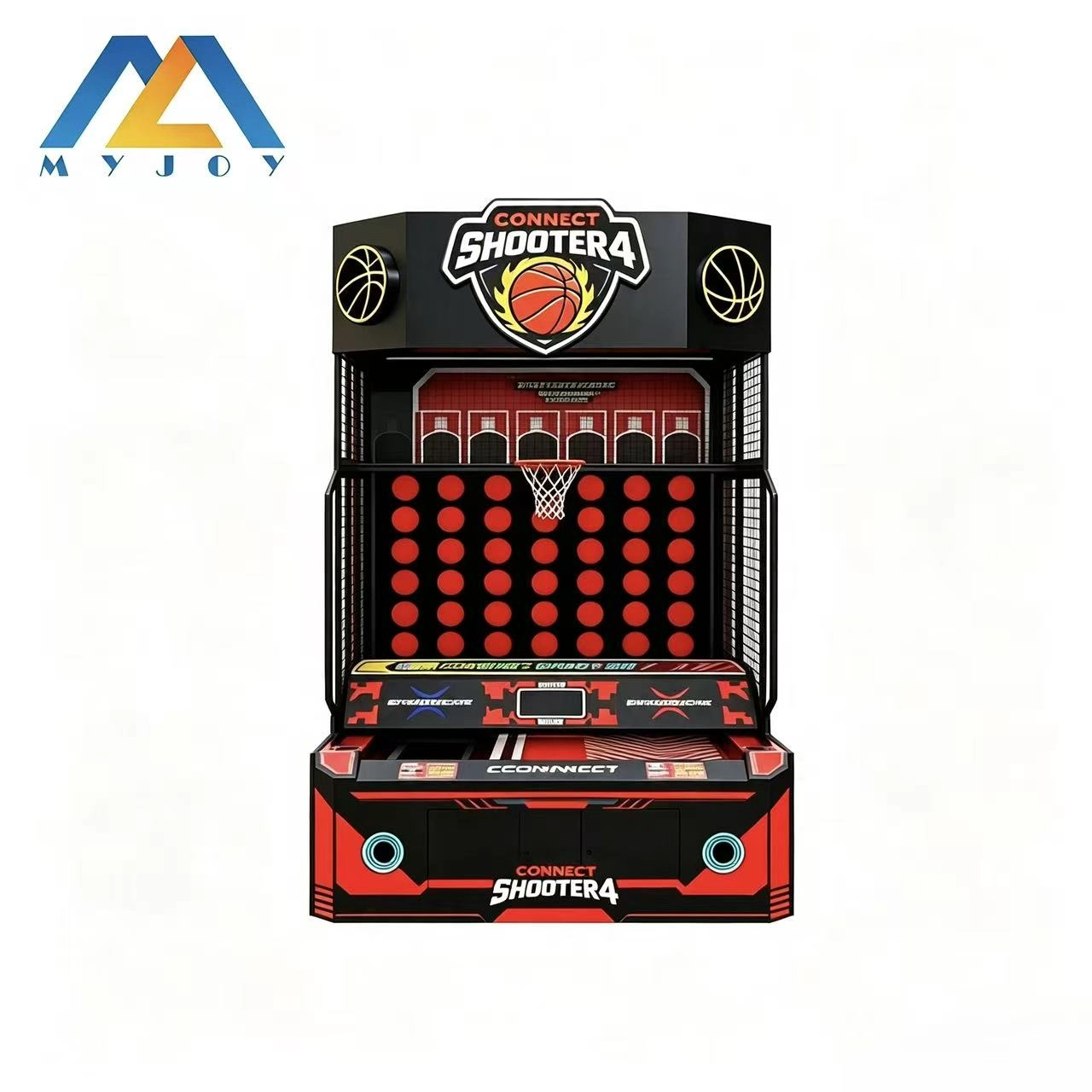
Connect Shooter 4 Mechanical -Version is an interactive basketball arcade machine that combines basketball shooting with the classic Connect Four strategy game. Players shoot red or blue balls into different positions and compete to connect four or more balls of the same color horizontally, vertically or diagonally.
The machine supports both Two-Player Battle Mode and Single-Player Challenge Mode, with Easy, Standard and Hard difficulty levels available for individual players. It combines shooting accuracy, strategic thinking and competitive interaction, making every round exciting and different.
Featuring an eye-catching basketball-themed design, illuminated decorations and a protective net structure, Connect Shooter 4 is ideal for arcades, family entertainment centers, shopping malls, indoor playgrounds and sports entertainment venues. Its simple rules and engaging gameplay make it suitable for children, teenagers, adults and family groups.
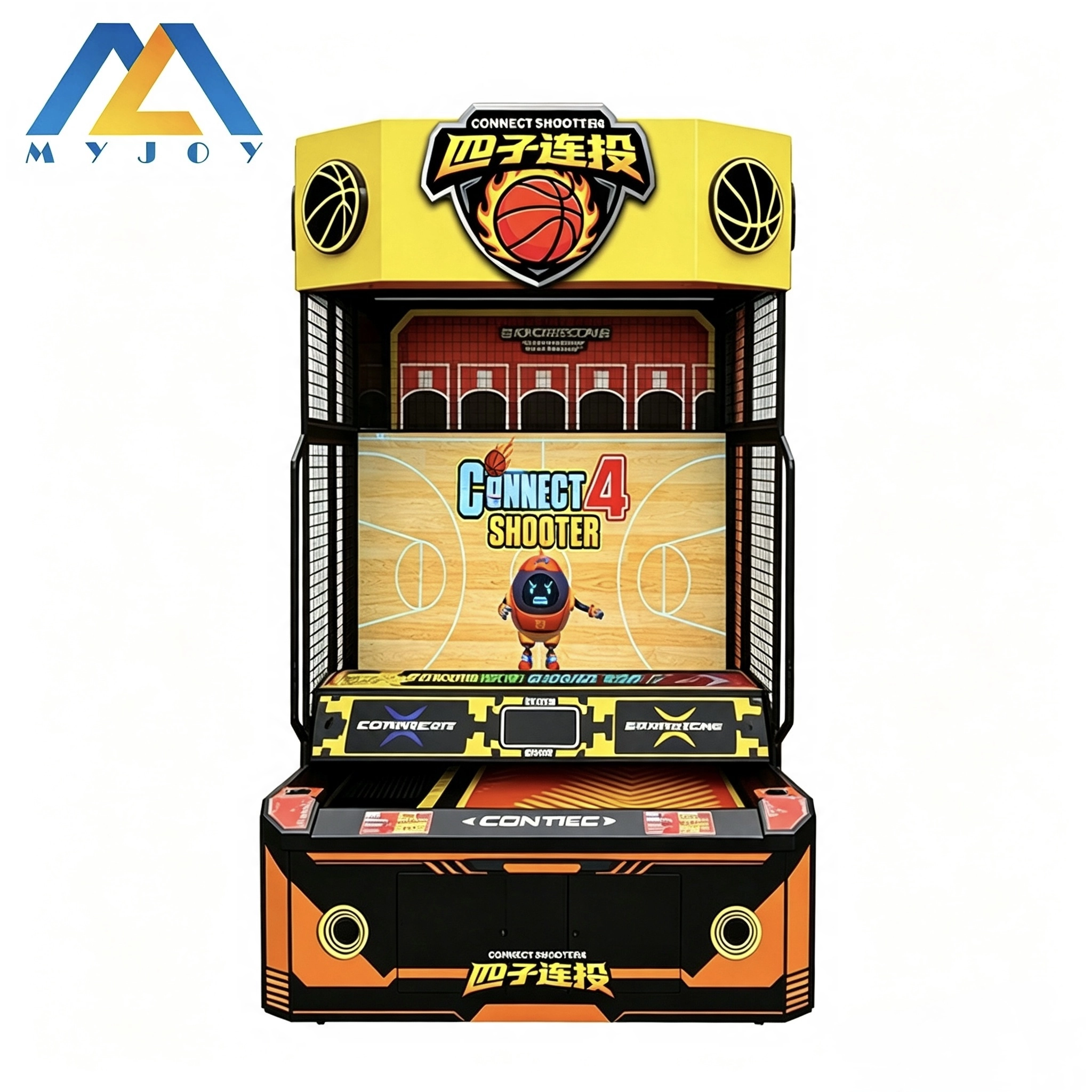
Connect Shooter 4 is an interactive basketball arcade machine that combines shooting skills with the classic Connect Four strategy game. Players shoot red or blue balls into selected positions and compete to connect four or more balls horizontally, vertically, or diagonally. It supports two-player competitive mode and single-player challenges against the computer, with Easy, Standard, and Hard difficulty levels. Its eye-catching basketball-themed design, fast-paced gameplay, and strong player interaction make it ideal for arcades, FECs, shopping malls, indoor playgrounds, sports entertainment centers, and other commercial venues.
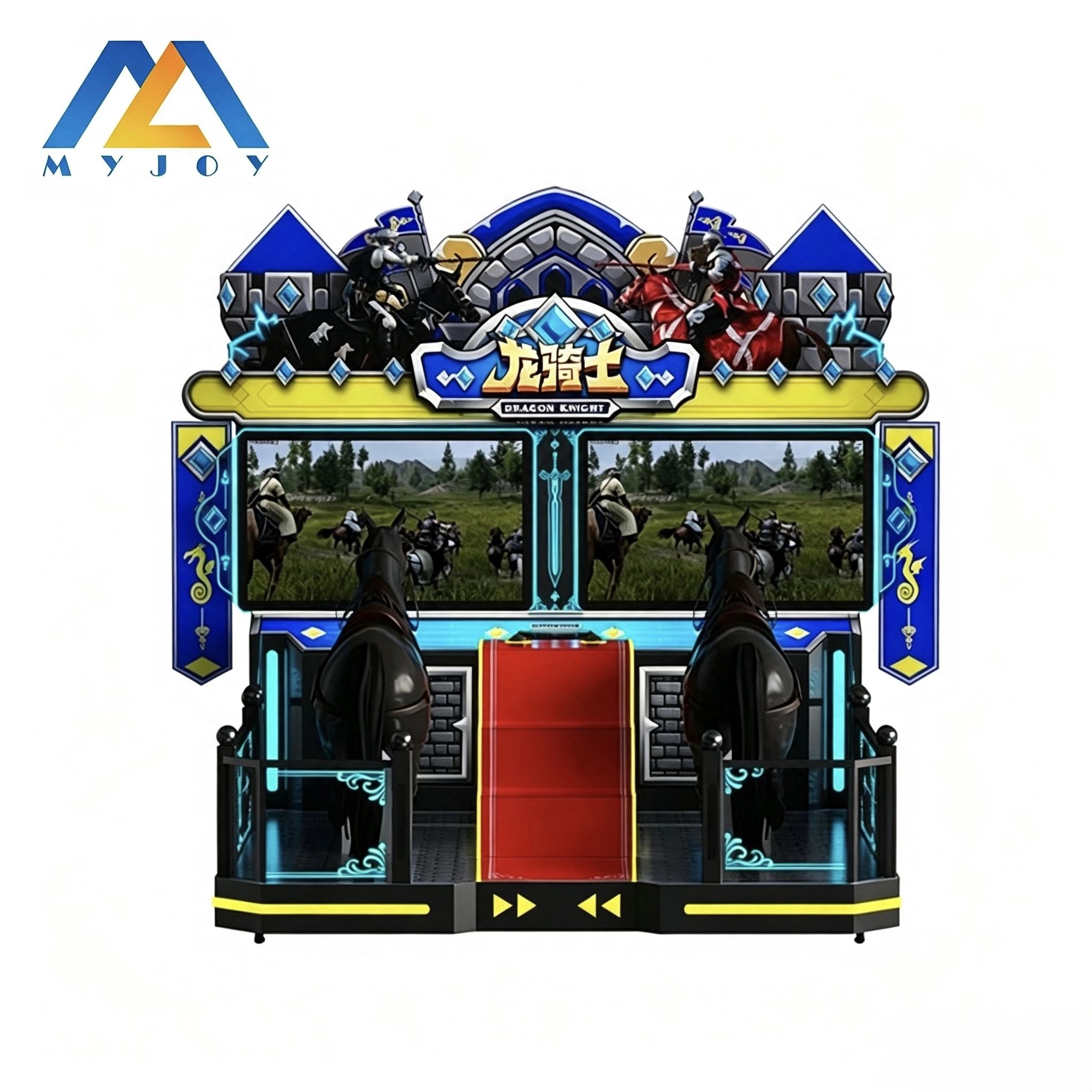
Flying Dragon Knight Horse Racing Simulator is a premium two-player arcade entertainment machine designed for amusement parks, shopping malls, arcades, family entertainment centers and themed attractions. Inspired by medieval knights and fantasy dragon adventures, this simulator combines realistic horse riding motion, interactive racing gameplay and an impressive visual design to create an unforgettable entertainment experience.
Featuring two realistic horse models, dual HD displays, dynamic motion control, vibration feedback and immersive sound effects, players can experience exciting horse racing competitions, adventure challenges and jumping missions. The machine recreates the feeling of real horseback riding through synchronized movement and responsive control systems.
With its eye-catching dragon knight appearance, colorful LED lighting, multiplayer competition mode and safe commercial design, Flying Dragon Knight Horse Racing Simulator is an excellent attraction solution for increasing customer engagement and entertainment value.
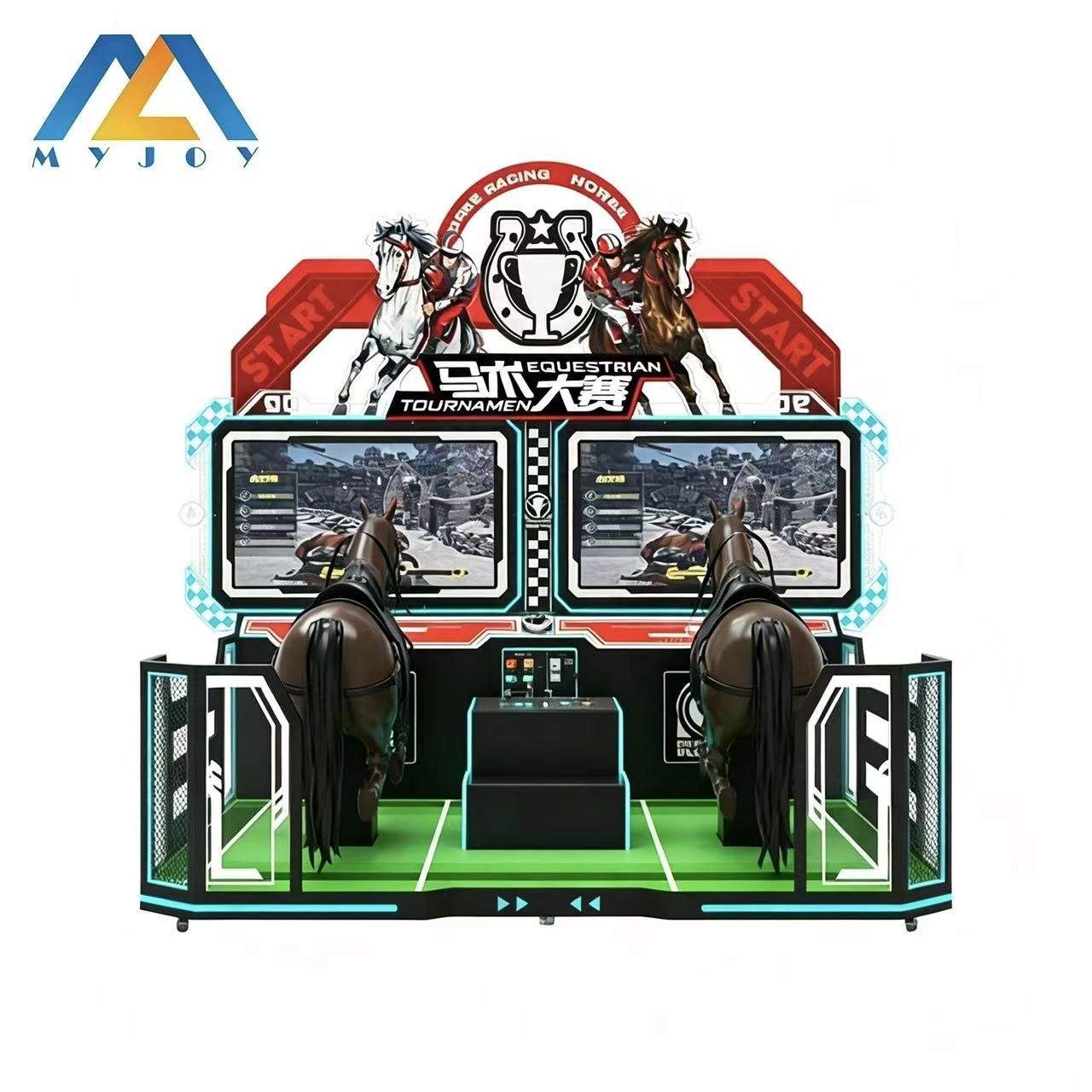
The Horse Racing Championship is a dual-player interactive sports simulator developed by Guangzhou Meiyilian Animation Technology Co., Ltd. It combines simulated horseback riding, competitive racing, physical interaction, and immersive visual effects to create an exciting attraction for players aged 5 to 50.
The machine features two realistic horse models equipped with comfortable saddles and reins. Players control their horses through riding movements and compete on two HD screens. Multiple racing scenes, difficulty levels, and challenge modes make the experience suitable for beginners and experienced players alike.
With its striking equestrian-themed design, dynamic LED lighting, green racetrack-style platform, and competitive ranking system, the machine easily attracts attention and encourages repeat play. It is ideal for amusement arcades, shopping malls, family entertainment centers, sports venues, theme parks, clubs, and tourist attractions.


No. 3, Wenjian Second Road, Wenbian Village, Shiji Town, Panyu District, Guangzhou City, China
Facebook