

Custom Wild Rider 3 motorcycle racing arcade Manufacturers and Suppliers

Businesses sourcing a custom Wild Rider 3 motorcycle racing arcade need more than a visually attractive cabinet: they need a capable engineering partner that can adapt the player interface, display system, motorcycle controller, software configuration, payment method, branding, safety features, packaging, and after-sales program to the operating requirements of a specific venue or market. MYL ARCADE, established in 2007 in Guangzhou, China, combines nearly two decades of amusement-equipment experience with research and development, production, sales, project planning, after-sales service, and operation support, giving international buyers a practical route from concept and prototype to repeatable commercial deployment.
Why Guangzhou Supports Bespoke Arcade Equipment Sourcing
A mature manufacturing ecosystem
Guangzhou is one of China’s important commercial and manufacturing centers, with established supplier networks for metal fabrication, injection-molded components, electronics, LED displays, audio equipment, control systems, printing, packaging, and export services. For a Wild Rider 3 motorcycle racing arcade project, this concentration can simplify coordination between the cabinet builder and specialized component suppliers. It also makes it easier to review samples, resolve engineering changes, and consolidate finished machines before shipment.
Regional capability should not be judged only by a factory’s location. Buyers should verify whether the supplier controls the critical stages of design, assembly, testing, and documentation. A responsible manufacturer should explain which parts are produced in-house, which are sourced from approved vendors, how incoming components are inspected, and how engineering changes are recorded. This evidence is more useful than a generic claim of being a factory.
Experience with international venue requirements
MYL ARCADE has developed long-term partnerships with more than 2,000 amusement centers, family entertainment centers, digital sports parks, and indoor entertainment venues in China. Its products have also been exported to more than 20 countries and regions, including Japan, the United States, Italy, Spain, Guyana, the Middle East, South America, and Southeast Asia. This background is relevant to buyers who need a motorcycle racing arcade game prepared for different power systems, languages, payment models, venue layouts, and shipping conditions.
International sourcing still requires local verification. The importer remains responsible for checking applicable electrical, fire, electromagnetic compatibility, consumer safety, and commercial-use requirements. Buyers can use recognized frameworks such as ISO 9001 quality-management principles as a reference when assessing process control, while confirming the exact legal requirements in the destination country with a qualified compliance adviser or testing laboratory.
How to Develop a Custom Motorcycle Racing Arcade
Define the commercial and technical brief
A strong project begins with a written specification rather than a product photograph. The brief should identify the intended venue, player age range, daily operating hours, available floor area, ceiling height, entrance dimensions, local voltage and frequency, payment system, preferred language, screen size, sound limits, network requirements, warranty expectations, and target delivery quantity. For the Wild Rider 3 motorcycle racing arcade, buyers should also specify whether the machine is intended for individual play, linked multiplayer operation, tournament use, or a mixed entertainment zone.
Branding requirements deserve equal attention. The supplier should receive approved logos, color references, cabinet artwork, illuminated sign requirements, instruction-panel language, and any restrictions on using third-party characters or game assets. Because the name Wild Rider 3 may refer to a particular game or branded product, purchasers should establish ownership, distribution rights, software authorization, and permitted territories before asking a manufacturer to reproduce or modify a commercial design. A manufacturer can build hardware to an approved brief, but it should not represent unlicensed intellectual property as its own.
Engineer the cabinet, controls, and player experience
Customization may involve cabinet dimensions, motorcycle seat geometry, handlebar reach, foot-rest position, steering resistance, vibration effects, display angle, speaker placement, cooling airflow, service doors, and cable routing. These details affect accessibility, durability, maintenance time, and player comfort. A professional supplier should review the design for stability, pinch-point risks, sharp edges, exposed wiring, heat accumulation, and the practical replacement of high-wear parts.
The display and control architecture should be documented clearly. Buyers should request information about screen technology, resolution, refresh rate, computer or game-board specifications, operating system, software recovery method, audio output, controller calibration, and error diagnostics. If a Wild Rider 3 motorcycle racing arcade is connected to other units, the quotation should define the network topology, synchronization method, maximum linked units, router requirements, and what happens if one station loses communication.
Prototype, test, and approve before production
A prototype is not merely a marketing sample; it is a risk-control stage. The prototype should confirm cabinet appearance, rider ergonomics, visual performance, sound levels, steering response, game stability, payment operation, access for technicians, and packaging dimensions. Buyers should request a documented approval process covering artwork, sample materials, software settings, control feel, and any deviations from the original brief.
Testing should include extended operation, repeated steering and button use, power cycling, thermal observation, transportation simulation where appropriate, and inspection after assembly. Ask for photographs or videos of test procedures, serial-number records, a spare-parts list, and a final inspection report. A clear distinction should be made between factory acceptance testing and destination-site commissioning, because installation conditions can affect network operation, ventilation, and power quality.
Comparing Custom and Standard Arcade Procurement
| Procurement factor | Standard off-the-shelf machine | Custom Wild Rider 3 motorcycle racing arcade solution |
|---|---|---|
| Cabinet and branding | Fixed exterior, artwork, and dimensions | Adaptable cabinet, graphics, lighting, and venue identity |
| Player interface | Predefined seat, handlebars, controls, and display layout | Can be reviewed for ergonomics, accessibility, and operating intensity |
| Payment and software | Usually limited to the supplier’s standard configuration | May be planned around approved payment, language, network, and venue requirements |
| Engineering risk | Lower customization risk but less differentiation | Requires specification control, prototype approval, and change management |
| After-sales preparation | Generic manuals and standard spare parts | Can include project-specific drawings, parts lists, training, and service procedures |
| Commercial fit | Fast purchase for common layouts | Better suited to branded zones, multi-site rollouts, or unusual space constraints |
Custom manufacturing does not automatically mean better economics. It is most valuable when the buyer needs a distinctive experience, a specific footprint, a multi-unit deployment, or integration with a broader family entertainment center. A disciplined supplier should separate one-time engineering costs from per-unit production costs and explain minimum order quantities, tooling charges, sample charges, software fees, packaging, and replacement-part pricing.
Quality Assurance, Export Logistics, and Long-Term Support
Use measurable quality gates
Quality assurance should be divided into incoming inspection, in-process control, assembly inspection, functional testing, and pre-shipment approval. For a motorcycle racing arcade game, practical checkpoints include frame alignment, cabinet finish, display uniformity, sound output, control calibration, grounding, cable protection, cooling performance, software loading, payment response, and emergency access for maintenance. Photographic records and serial-number tracking help connect the delivered unit to its inspection history.
Buyers should request a bill of materials or at least a critical-components list, warranty terms, recommended maintenance intervals, consumable specifications, and a troubleshooting guide. They should also clarify whether replacement boards, displays, power supplies, controllers, and cosmetic panels will remain available for the expected operating life. A supplier that provides structured technical documentation is easier to manage than one that relies only on informal messaging.
Plan packaging and international transportation
Before placing an order, confirm the packed dimensions, gross weight, number of cartons or crates, loading quantity, incoterm, port of loading, insurance responsibility, and destination delivery scope. Guangzhou’s export connectivity can support consolidated or full-container shipments, but the correct choice depends on order volume, delivery urgency, and the buyer’s customs capabilities. The buyer should appoint a freight forwarder or customs professional to validate tariff classification, import documents, taxes, and destination restrictions rather than relying on an assumed duty rate.
Arcade cabinets should be protected against abrasion, moisture, impact, and movement inside the package. Request corner protection, reinforced bases, shock-resistant internal supports, moisture control where needed, and carton or crate markings that match the packing list. For large cabinets, the purchase order should state whether the unit is shipped assembled or in sections and whether doors, lifts, elevators, or narrow corridors at the destination venue have been considered.
Protect the investment after installation
After-sales support should be agreed before payment. The contract should define response times, remote diagnosis, replacement-part responsibility, labor coverage, exclusions, software update policy, and escalation procedures. For multi-site operators, a spare-parts package and technician training can reduce downtime more effectively than shipping individual components after a failure.
MYL ARCADE’s broader capabilities cover arcade game machines, redemption machines, sports arcade games, interactive digital sports equipment, VR attractions, prize machines, children’s amusement machines, and family entertainment solutions. This range can help a buyer coordinate a complete entertainment zone instead of treating the Wild Rider 3 motorcycle racing arcade as an isolated purchase. Venue planning and operation support may also help align machine placement, customer flow, prize or payment strategy, signage, and maintenance access.
For supplier due diligence, buyers may compare the manufacturer’s procedures with internationally recognized guidance such as the ISO 12100 principles for machinery safety risk assessment, review electrical and electromagnetic requirements applicable to the destination, and consult the U.S. Consumer Product Safety Commission business guidance when importing into the United States. These references do not replace local certification, but they encourage a documented approach to hazards, testing, labeling, and traceability.
Build a contract that controls changes
The final agreement should attach the approved drawings, artwork, technical specification, software version, quantity, delivery schedule, inspection standard, packing list, warranty, payment milestones, and acceptance criteria. It should explain how changes are requested and priced after prototype approval. Intellectual-property ownership, confidentiality, territory, exclusivity, non-disclosure obligations, and rights to use photographs should also be addressed where custom artwork, software configuration, or branded cabinets are involved.
A sensible payment structure links milestones to evidence: specification confirmation, prototype approval, production completion, inspection, and shipment. Buyers should avoid evaluating a quote only on unit price. Total landed cost includes engineering, tooling, packaging, inland transport, ocean or air freight, insurance, customs charges, installation, spare parts, payment fees, and downtime risk. The most competitive supplier is usually the one that delivers predictable performance and support across the machine’s operating life.
Contact MYL ARCADE in Guangzhou to discuss your custom Wild Rider 3 motorcycle racing arcade requirements, from engineering and prototyping through production, export delivery, venue planning, and long-term after-sales support.
Frequently Asked Questions
Can MYL ARCADE customize the cabinet design for a Wild Rider 3 motorcycle racing arcade?
MYL ARCADE can review requirements for cabinet dimensions, artwork, lighting, display position, motorcycle controls, payment configuration, language, and venue integration, subject to the approved technical brief and any necessary intellectual-property authorization.
What information should buyers provide before requesting a quotation?
Buyers should provide the intended venue, quantity, floor area, entrance dimensions, local voltage and frequency, screen and control preferences, payment method, language, branding requirements, delivery destination, target schedule, and any networking or multiplayer requirements.
How does MYL ARCADE manage prototype approval?
A prototype can be used to confirm cabinet appearance, player ergonomics, display performance, sound, control response, software stability, payment operation, service access, and packaging dimensions before repeat production begins.
What quality checks should be expected for a motorcycle racing arcade game?
Relevant checks include incoming-component inspection, frame and cabinet inspection, display and audio testing, controller calibration, grounding and cable protection, cooling performance, software loading, payment response, extended operation, and final pre-shipment inspection with serial-number records.
Can MYL ARCADE support international delivery?
MYL ARCADE has exported products to more than 20 countries and regions and can coordinate production and export preparation, while the buyer or its appointed customs and logistics professionals should verify destination tariffs, taxes, import documents, certifications, and delivery requirements.
What should an after-sales agreement include?
The agreement should define warranty coverage, response times, remote diagnosis, replacement-part responsibility, software update policy, service exclusions, escalation procedures, spare-parts availability, and technician training where required.
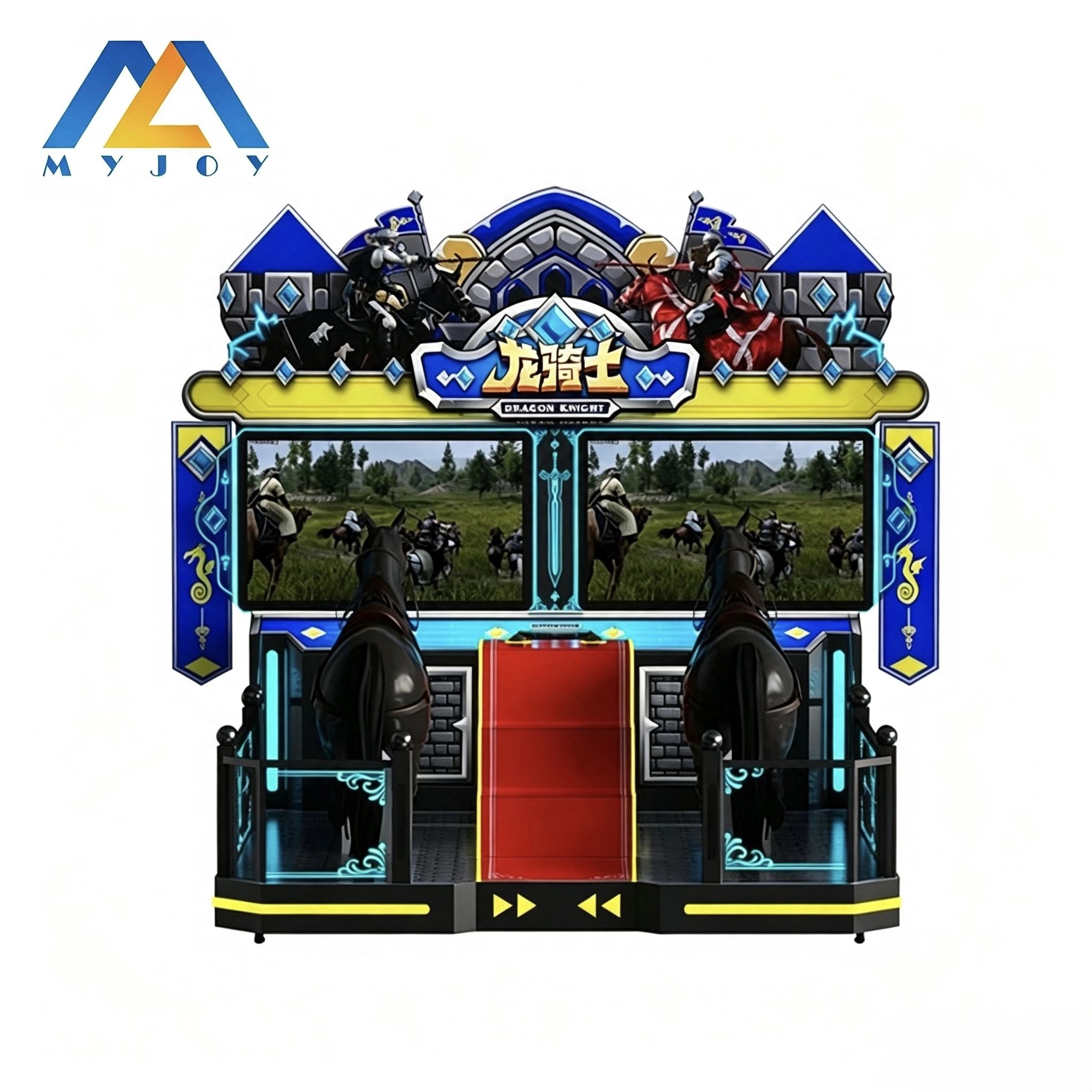
Flying Dragon Knight Horse Racing Simulator is a premium two-player arcade entertainment machine designed for amusement parks, shopping malls, arcades, family entertainment centers and themed attractions. Inspired by medieval knights and fantasy dragon adventures, this simulator combines realistic horse riding motion, interactive racing gameplay and an impressive visual design to create an unforgettable entertainment experience.
Featuring two realistic horse models, dual HD displays, dynamic motion control, vibration feedback and immersive sound effects, players can experience exciting horse racing competitions, adventure challenges and jumping missions. The machine recreates the feeling of real horseback riding through synchronized movement and responsive control systems.
With its eye-catching dragon knight appearance, colorful LED lighting, multiplayer competition mode and safe commercial design, Flying Dragon Knight Horse Racing Simulator is an excellent attraction solution for increasing customer engagement and entertainment value.
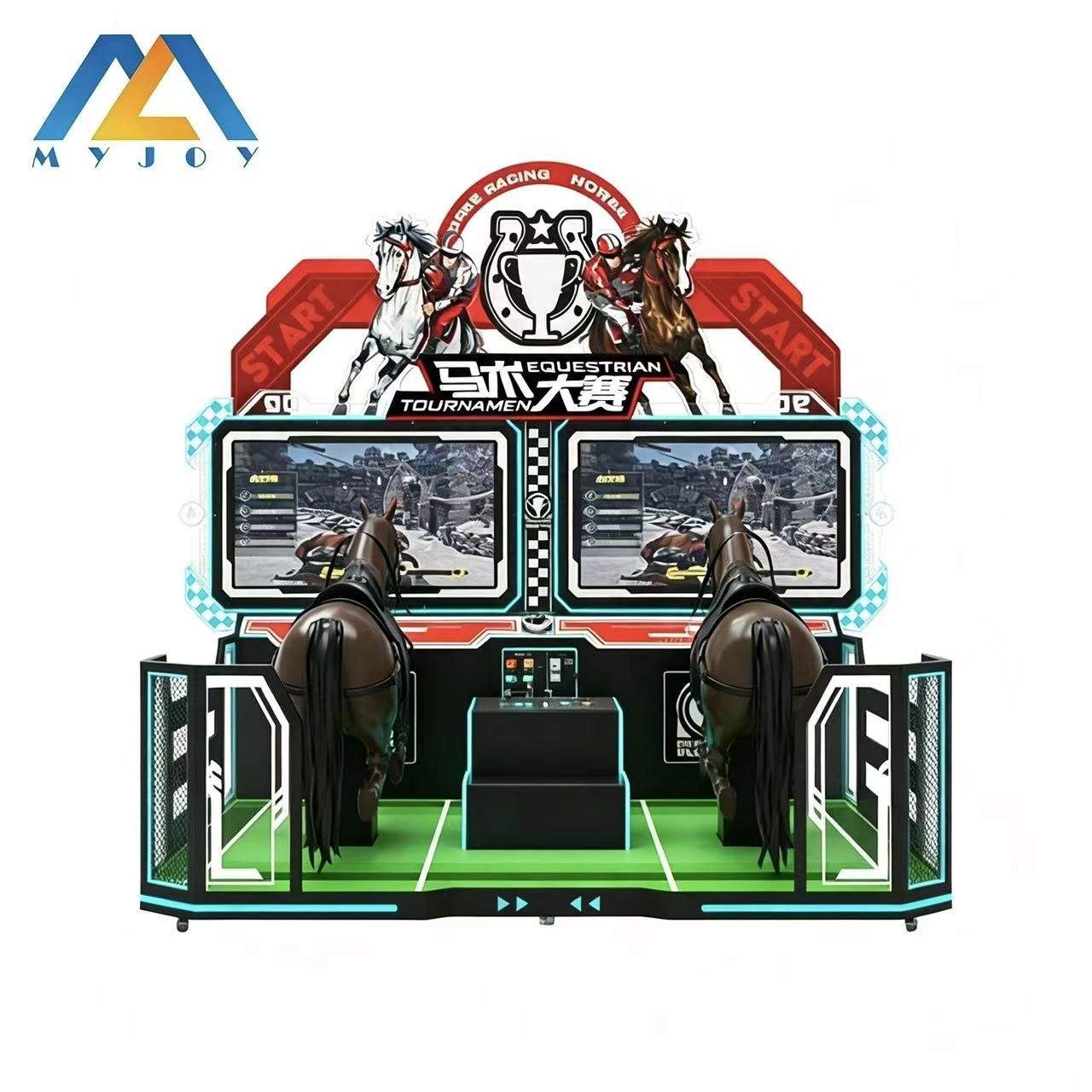
The Horse Racing Championship is a dual-player interactive sports simulator developed by Guangzhou Meiyilian Animation Technology Co., Ltd. It combines simulated horseback riding, competitive racing, physical interaction, and immersive visual effects to create an exciting attraction for players aged 5 to 50.
The machine features two realistic horse models equipped with comfortable saddles and reins. Players control their horses through riding movements and compete on two HD screens. Multiple racing scenes, difficulty levels, and challenge modes make the experience suitable for beginners and experienced players alike.
With its striking equestrian-themed design, dynamic LED lighting, green racetrack-style platform, and competitive ranking system, the machine easily attracts attention and encourages repeat play. It is ideal for amusement arcades, shopping malls, family entertainment centers, sports venues, theme parks, clubs, and tourist attractions.
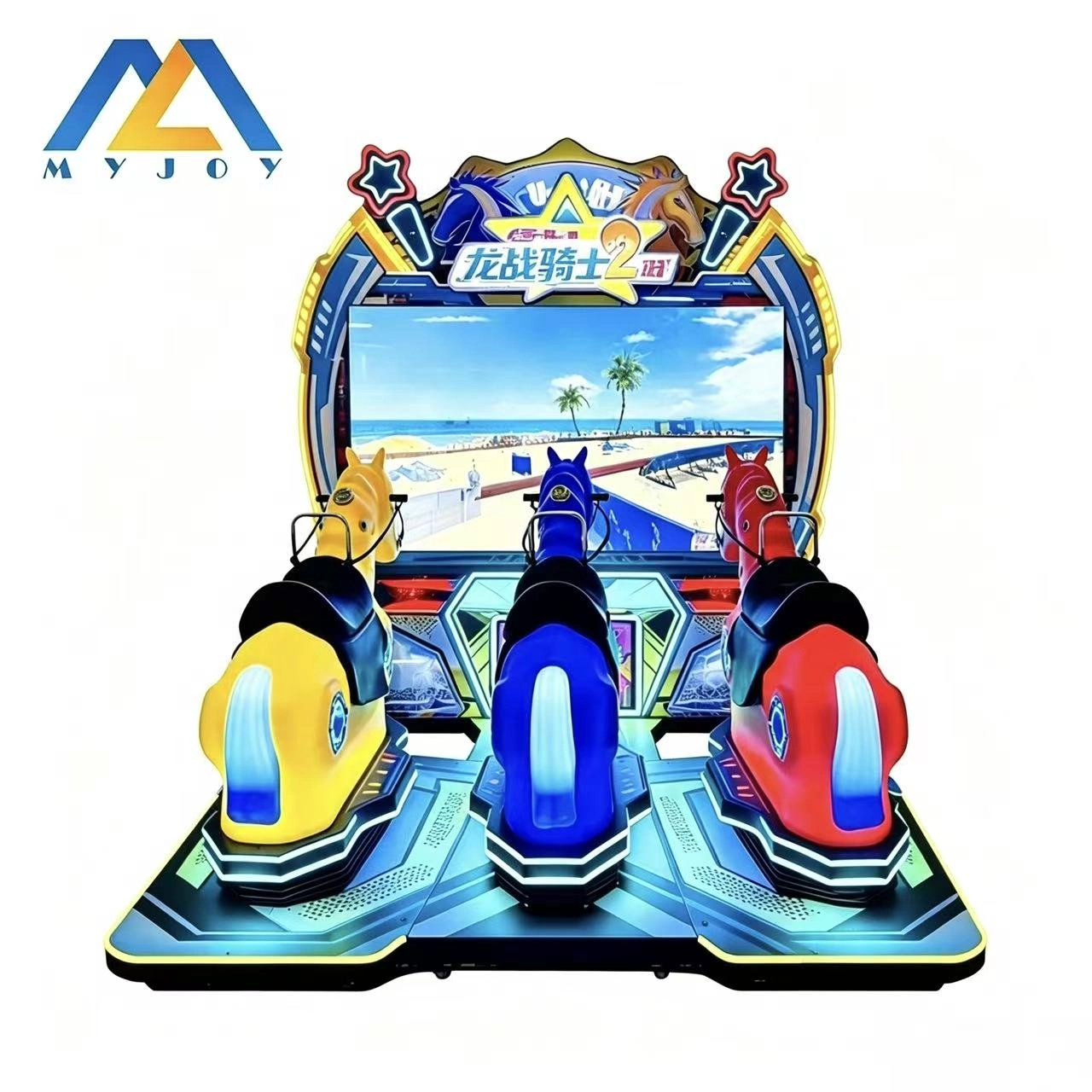
Dragon Warrior Knight 2 – Bring Real Horse Racing Excitement to Indoor Entertainment Venues
Dragon Warrior Knight 2 is an immersive interactive horse riding arcade machine designed around horse racing, obstacle challenges, and multiplayer competition. Featuring a cute and colorful horse design, large HD display, dynamic lighting effects, surround sound system, and realistic rein-control operation, this simulator creates an exciting horse racing experience for children, teenagers, and families.
Players can experience the feeling of riding a racing horse by controlling the reins to accelerate, change direction, and jump over obstacles. The realistic riding movements and interactive gameplay provide strong immersion and encourage repeat play.
The machine supports single-player challenge mode and 3-player competitive racing mode, allowing players to compete with friends, family members, or teammates. It is an ideal attraction for children's playgrounds, arcades, shopping malls, amusement parks, and family entertainment centers.
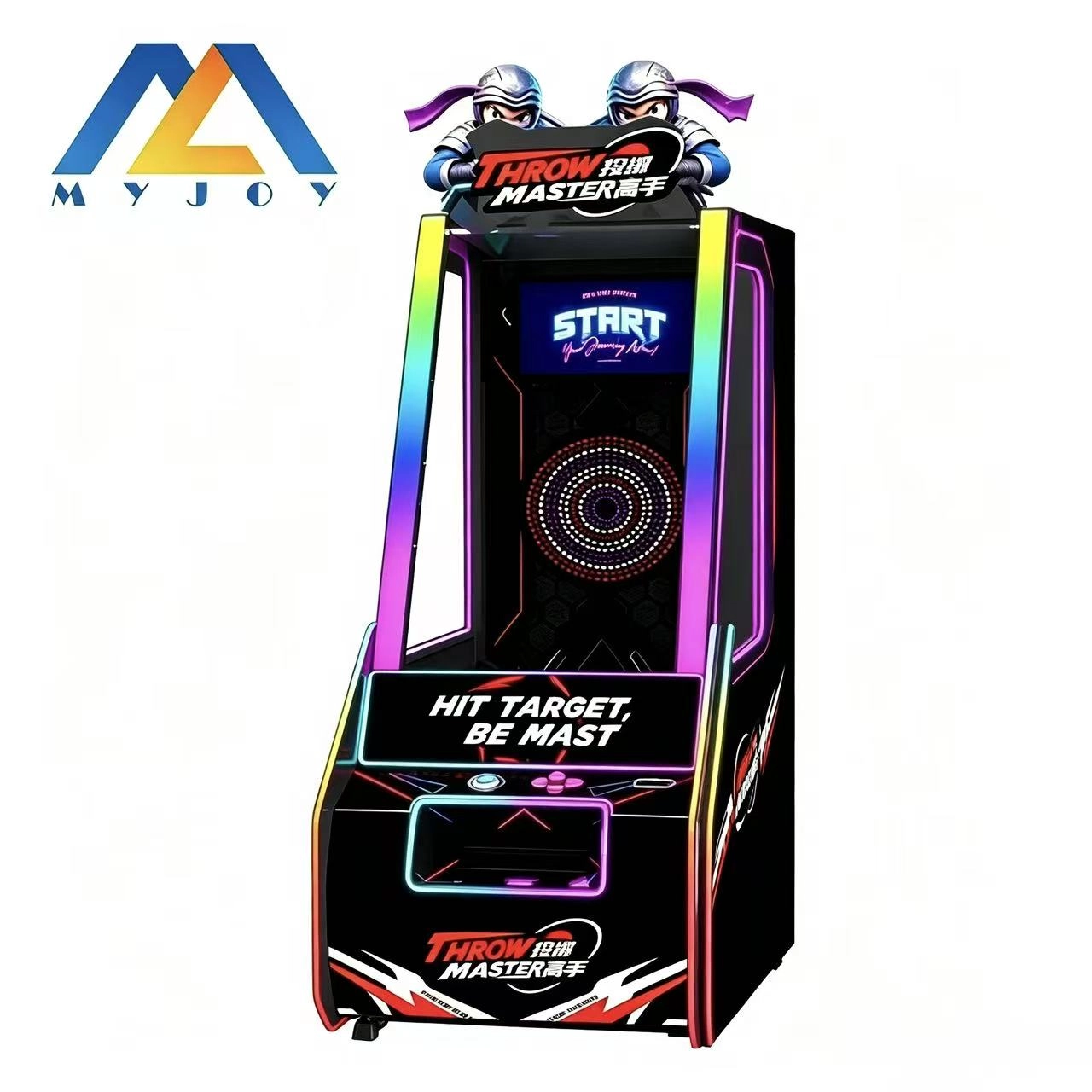
THROW MASTER is a commercial interactive dart throwing arcade machine that combines physical throwing action with an electronic target, digital scoring, on-screen interaction, and camera-based hit detection.
Designed for arcades, family entertainment centers (FECs), indoor amusement venues, shopping malls, and competitive entertainment spaces, THROW MASTER delivers an engaging mix of casual fun and skill-based competition.
Players insert coins, select their player and game mode, and throw darts at the large colorful electronic target. The system detects each result and displays scores, objectives, remaining throws, and game progress on the screen.
With Standard Mode for score-based challenges and Skill Mode for precision target challenges, the machine is suitable for both casual players and those looking for a more competitive experience. Leaderboards, adjustable game settings, and optional ticket rewards also make it well suited for commercial arcade operation.
Its large upright cabinet, colorful circular target, and vibrant RGB-style lighting create a futuristic arcade appearance that helps attract attention in busy entertainment venues.


No. 3, Wenjian Second Road, Wenbian Village, Shiji Town, Panyu District, Guangzhou City, China
Facebook