


How to Choose the coin operated machine manufacturer and supplier ?

Choosing a coin operated machine manufacturer requires more than comparing unit prices: buyers should verify the machine’s intended use and operating environment, coin validation and payment compatibility, safety and electrical documentation, production quality controls, spare-parts support, and the supplier’s ability to meet delivery and export requirements. Request traceable test records and samples, confirm that certificates and declarations apply to the exact model and destination market, audit production capability, and compare total landed cost—including tooling, packaging, freight, duties, installation, and warranty exposure—before committing to a purchase.
What the operating environment means for your sourcing decision
Start with the application, not the catalogue
A coin operated machine can serve very different purposes, from vending and amusement to laundry, car-wash, access-control, and pay-per-use equipment. Those applications impose different requirements for transaction volume, enclosure strength, user interface, payment logic, and maintenance access. Before approaching manufacturers, write a product brief that specifies the intended environment, expected daily transactions, operating hours, user profile, installation location, and consequences of downtime. A unit installed indoors in a staffed venue is not automatically suitable for unattended outdoor use, where moisture, temperature variation, vandalism, and limited service access may be significant concerns.
Define what the machine must do at the system level. Document the accepted coin denominations and currencies, whether tokens are used, the vend or service sequence, change-return requirements, audit data, and any integration with card, contactless, or remote-management systems. A coin acceptor may validate a coin but does not necessarily provide the full payment, accounting, or anti-fraud functions a buyer expects. Ask the supplier to identify which functions are built into the machine, which depend on third-party components, and which require custom software or an external controller.
Translate local operating needs into verifiable specifications
When sourcing across borders, specify the destination market and installation conditions early. Confirm rated voltage and frequency, plug and wiring requirements, language and currency settings, labeling, packaging, and any locally required safety or import documentation. Do not assume that a product configured for one country can be deployed unchanged in another. If the machine connects to a network or processes payment data through another system, define the interfaces and security responsibilities with the relevant technology providers; a mechanical supplier’s general statement of compatibility is not a substitute for system-level testing.
Ask for a model-specific bill of materials or at least a controlled component list for critical items such as the coin mechanism, controller, power supply, display, locks, and dispensing or actuation components. Clarify which components may be substituted and what approval process applies. This protects buyers from receiving a revised production configuration that differs materially from the approved sample. Where custom branding or firmware is involved, agree ownership, version control, change approval, and access to configuration files before tooling or production begins.
How to vet product quality, compliance, and factory capability
Check technical evidence against the exact machine configuration
Request the current technical datasheet, operating and service manuals, wiring diagrams where appropriate, parts list, warranty terms, and inspection or test records. Confirm the model number and revision shown in those documents match the quotation and sample. For electrical products placed on markets that require conformity marking, ask for the applicable declaration and supporting evidence rather than relying on a logo in a brochure. The European Commission explains the scope and responsibilities associated with CE marking in the European Economic Area; buyers should verify which legislation applies to their particular product and intended market.
An ISO certificate is evidence of a management-system certification within its stated scope, not proof that every individual machine meets every buyer specification. Check the certificate holder’s legal name, covered manufacturing location, scope, validity, and issuing certification body. The ISO 9001 quality management overview describes the standard’s focus on quality management systems; use it as context, then ask the supplier for the processes that control incoming materials, assembly, inspection, corrective action, and traceability. For electrical or electronic equipment, determine the relevant product safety standards with a qualified compliance specialist. The International Electrotechnical Commission standards catalogue is a reference point, but a listing alone does not establish that a specific model has been tested or complies.
Ask how the supplier tests coin recognition across the agreed currency set, including accepted coins, rejected foreign objects, worn or damaged coins, and tolerance for real-world variation. Request sample test results and clarify the test conditions. For a complete machine, check functional sequences, repeated-use endurance, electrical safety, grounding, emergency or fault behavior, and access for routine cleaning and service. Test criteria should reflect the buyer’s use case and be agreed in writing; avoid accepting vague claims such as “100% tested” without a definition of the test, sampling method, and record retention.
Assess the supplier’s actual manufacturing and quality controls
Distinguish a factory from a trading company, while recognizing that either can be a valid supply partner if responsibilities and controls are transparent. Ask who owns the design, where each production stage takes place, which operations are subcontracted, and who performs final inspection. During a factory audit—on-site or through a qualified independent auditor—review the production flow, calibration and maintenance records, work instructions, incoming inspection, nonconformance handling, and segregation of rejected materials. A clean showroom is not evidence of controlled production; focus on records and repeatable processes.
Verify capacity against the order you plan to place. Discuss current production loading, realistic monthly output, peak-season constraints, minimum order quantities, tooling lead time, and the production slot reserved for your project. Ask for evidence of previous products with similar mechanical, electrical, or payment complexity, while respecting customer confidentiality. Establish how engineering changes are documented and how a change to a coin acceptor, supplier, firmware revision, or enclosure material is communicated. A robust supplier will be able to explain its change-control process rather than promising that no changes will ever occur.
Use a documented evaluation checklist
Score suppliers using consistent evidence rather than presentation quality or price alone. The following checklist can be adapted to the product risk, order size, and destination requirements. “Standard requirement” means a practical baseline for due diligence, not a universal legal rule; applicable regulations and contract terms must be checked for each market.
| Criteria | Standard requirement | Importance |
|---|---|---|
| Product specification | Model-specific datasheet, agreed configuration, interfaces, and change-control terms | Prevents specification gaps and unapproved substitutions |
| Payment performance | Coin, token, and currency test plan with documented acceptance and rejection criteria | Reduces failed transactions, fraud exposure, and avoidable service calls |
| Quality management | Defined incoming, in-process, and final inspection with retained records | Shows whether production controls are repeatable and traceable |
| Compliance evidence | Applicable declarations and test evidence tied to the exact model and destination | Helps manage market-access and product-safety risk |
| Factory capability | Verified site, process ownership, capacity, subcontractor disclosure, and audit access | Tests whether the supplier can deliver the promised order consistently |
| Service and parts | Warranty process, spare-parts list, response route, and support period stated in writing | Limits downtime and lifecycle cost after delivery |
| Commercial and logistics terms | Clear lead time, packaging, inspection rights, delivery terms, and payment milestones | Reduces disputes and unexpected landed-cost exposure |
Compare commercial terms, delivery risk, and long-term support
Compare supplier types and total cost, not just quotations
Different supplier models provide different trade-offs. A specialist manufacturer may have stronger product knowledge and direct engineering access, while a trading company may coordinate multiple factories or offer a broader range. An integrator may be best suited to projects requiring custom software, payment-system integration, or installation coordination, but buyers should identify who is accountable for the complete system. The right choice depends on project complexity and service needs; the key is to make responsibility explicit in the contract.
| Supplier type | Potential advantages | Due diligence focus |
|---|---|---|
| Direct manufacturer | Direct access to production and engineering decisions | Confirm factory ownership, export capability, and service resources |
| Trading company or distributor | May consolidate products, communication, and logistics | Identify the actual factory, document accountability, and confirm warranty handling |
| System integrator | Can coordinate machine, software, and payment components | Define interface ownership, end-to-end testing, and responsibility for failures |
Compare quotations on a like-for-like basis. A lower unit price may omit custom tooling, coin mechanism configuration, branded panels, software work, spare parts, export packaging, or pre-shipment inspection. Build a total-cost comparison that includes sample charges, development fees, payment terms, freight, insurance, duties and taxes where applicable, installation, maintenance, and likely replacement parts. State whether the price covers engineering changes and what happens if a sample fails acceptance testing. This makes commercial evaluation more meaningful than ranking headline prices.
Make lead times, inspection, and delivery commitments measurable
Ask suppliers to separate engineering, sample approval, material procurement, production, inspection, and transit time. A single quoted lead time can obscure long-lead components or customs and shipping uncertainty. Put milestone dates and buyer approval points into the project plan, and define the event that starts the production clock—for example, approval of the final drawing and receipt of the agreed deposit. Confirm packaging specifications, palletization, moisture protection where relevant, shipping marks, and the documents required by your freight forwarder and importing jurisdiction.
Agree inspection rights before production begins. A sensible plan may include sample approval, in-process checks for higher-risk custom work, and final inspection against written acceptance criteria. Specify defect classifications, sampling approach, corrective-action expectations, and who pays for reinspection or rework when agreed requirements are not met. For delivery terms, name the precise place and agreed Incoterms rule and version rather than using informal phrases such as “shipping included.” The International Chamber of Commerce Incoterms rules resource provides official information on the rules; buyers should ensure their purchase contract clearly assigns transport, insurance, export, and import responsibilities.
Evaluate after-sales support as part of the product
A coin operated machine is a service asset, so support arrangements matter beyond the warranty headline. Ask which parts are considered consumables, how long critical spares will be available, how warranty claims are submitted, and what diagnostic information the supplier needs. Request a recommended spare-parts kit based on the expected installed base and operating intensity. Confirm whether troubleshooting is available in the buyer’s time zone and language, and whether the supplier provides repair instructions, firmware updates, or remote support. If repairs require returning equipment internationally, estimate the time and cost before choosing that model.
For a first order, reduce uncertainty with staged commitments: qualify the supplier, approve a representative sample, place a controlled pilot order, evaluate performance in the real operating environment, and scale only after agreed acceptance criteria are met. Keep a record of serial numbers, configuration revisions, inspection results, reported failures, and resolution times. This evidence helps distinguish a one-off issue from a recurring quality trend and gives both buyer and supplier a factual basis for corrective action. The most dependable partner is not necessarily the one making the strongest promise; it is the one that can demonstrate capability, communicate risk early, and resolve problems through documented processes.
Contact us with your target market, application, payment requirements, and expected order volume to discuss a coin operated machine sourcing plan tailored to your project.
Frequently Asked Questions
What should I request before choosing a coin operated machine supplier?
Request a model-specific datasheet, operating and service manuals, configuration details, inspection or test records, warranty terms, and applicable compliance documentation. Confirm that the documents match the quoted model and intended destination market, and ask how coin validation, quality controls, changes, and after-sales support are handled.
How can I verify that a supplier is a manufacturer rather than a trading company?
Ask who owns the design, where production takes place, which stages are subcontracted, and who performs final inspection. Verify the production site and review process records during an on-site or qualified independent audit. A trading company can still be a suitable partner if the factory relationship, responsibilities, and warranty arrangements are transparent.
Does an ISO 9001 certificate prove that a coin operated machine meets my requirements?
No. An ISO 9001 certificate relates to a quality management system within the stated scope; it does not prove that every machine meets your specification or all destination-market requirements. Check the certificate’s holder, site, scope, validity, and issuing body, then review model-specific test and compliance evidence.
What should I check about CE marking when sourcing for Europe?
Determine which European Union legislation applies to the exact product and intended use. Request the applicable declaration and supporting technical evidence for the model and configuration, and verify that the economic operator has fulfilled its responsibilities. A CE logo in a brochure alone does not establish that the product is compliant.
How do I compare quotations from different coin operated machine manufacturers?
Compare equivalent configurations and calculate total landed and lifecycle cost, including development, tooling, payment components, inspection, packaging, freight, duties, installation, spare parts, and warranty support. Clarify lead-time milestones, acceptance criteria, payment terms, and responsibility for rework or failed inspections.
Should I place a large order with a new supplier immediately?
Where practical, qualify the supplier, approve a representative sample, and run a controlled pilot order before scaling. Evaluate performance in the intended operating environment against written acceptance criteria, and retain records of configuration, inspection results, failures, and corrective actions.
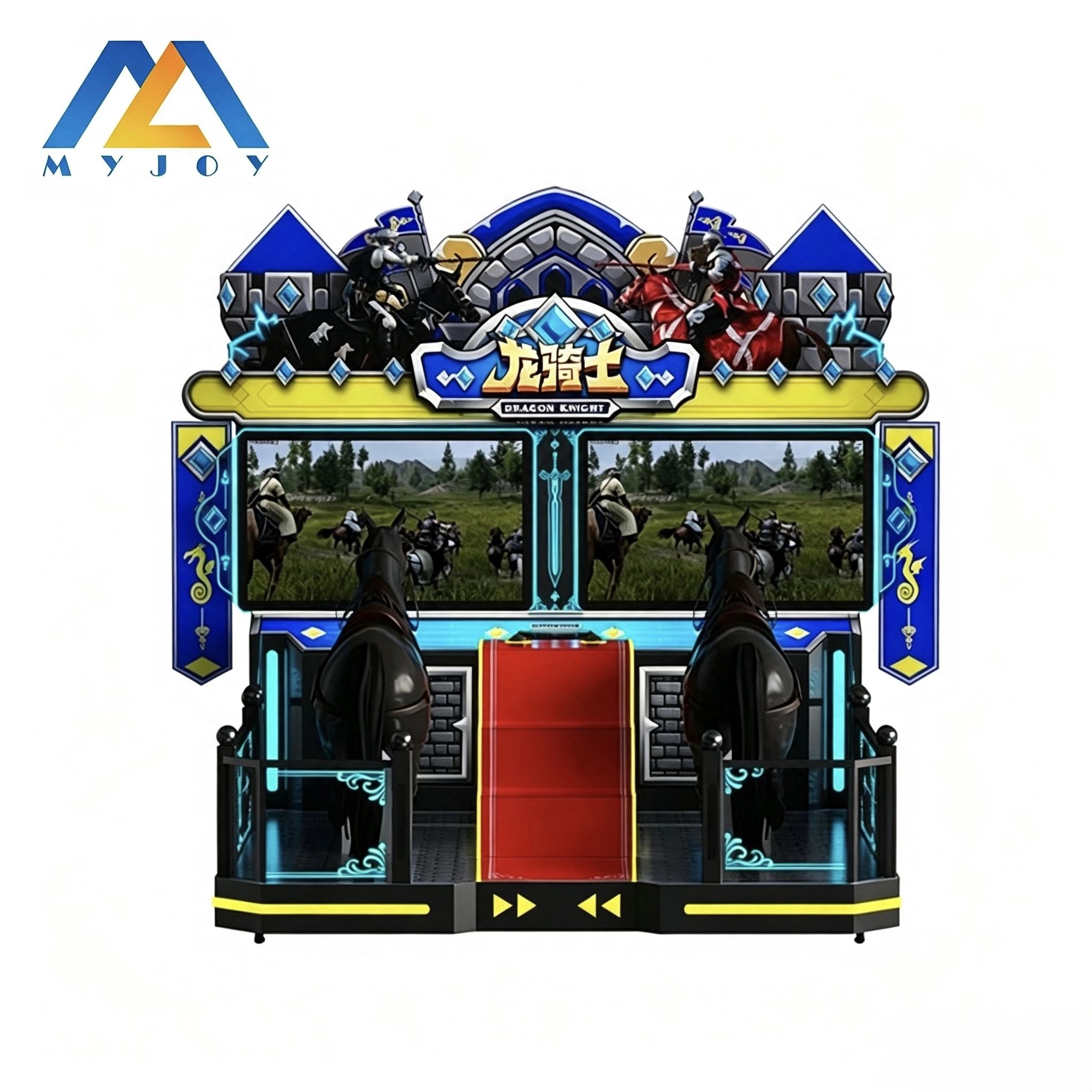
Flying Dragon Knight Horse Racing Simulator is a premium two-player arcade entertainment machine designed for amusement parks, shopping malls, arcades, family entertainment centers and themed attractions. Inspired by medieval knights and fantasy dragon adventures, this simulator combines realistic horse riding motion, interactive racing gameplay and an impressive visual design to create an unforgettable entertainment experience.
Featuring two realistic horse models, dual HD displays, dynamic motion control, vibration feedback and immersive sound effects, players can experience exciting horse racing competitions, adventure challenges and jumping missions. The machine recreates the feeling of real horseback riding through synchronized movement and responsive control systems.
With its eye-catching dragon knight appearance, colorful LED lighting, multiplayer competition mode and safe commercial design, Flying Dragon Knight Horse Racing Simulator is an excellent attraction solution for increasing customer engagement and entertainment value.
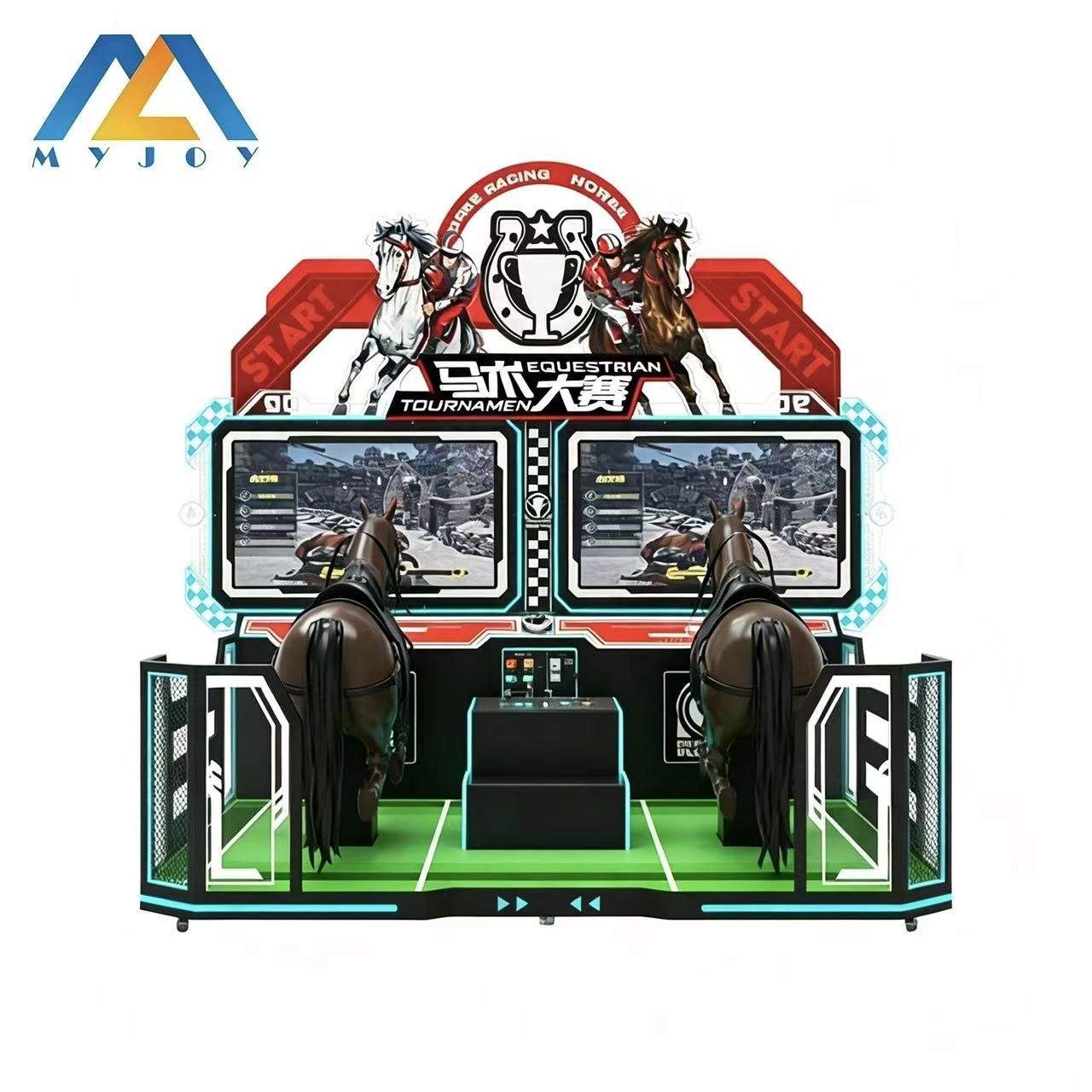
The Horse Racing Championship is a dual-player interactive sports simulator developed by Guangzhou Meiyilian Animation Technology Co., Ltd. It combines simulated horseback riding, competitive racing, physical interaction, and immersive visual effects to create an exciting attraction for players aged 5 to 50.
The machine features two realistic horse models equipped with comfortable saddles and reins. Players control their horses through riding movements and compete on two HD screens. Multiple racing scenes, difficulty levels, and challenge modes make the experience suitable for beginners and experienced players alike.
With its striking equestrian-themed design, dynamic LED lighting, green racetrack-style platform, and competitive ranking system, the machine easily attracts attention and encourages repeat play. It is ideal for amusement arcades, shopping malls, family entertainment centers, sports venues, theme parks, clubs, and tourist attractions.
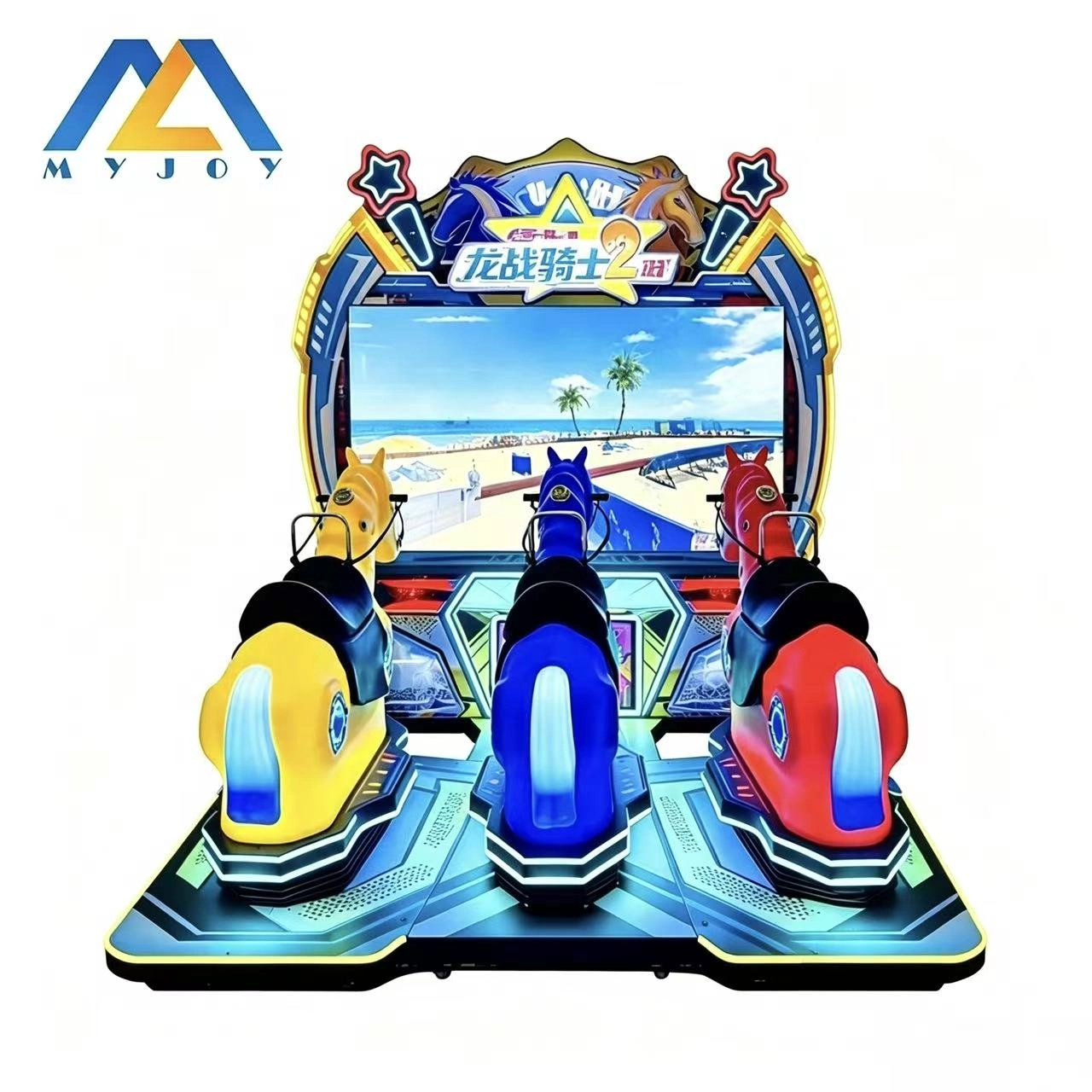
Dragon Warrior Knight 2 – Bring Real Horse Racing Excitement to Indoor Entertainment Venues
Dragon Warrior Knight 2 is an immersive interactive horse riding arcade machine designed around horse racing, obstacle challenges, and multiplayer competition. Featuring a cute and colorful horse design, large HD display, dynamic lighting effects, surround sound system, and realistic rein-control operation, this simulator creates an exciting horse racing experience for children, teenagers, and families.
Players can experience the feeling of riding a racing horse by controlling the reins to accelerate, change direction, and jump over obstacles. The realistic riding movements and interactive gameplay provide strong immersion and encourage repeat play.
The machine supports single-player challenge mode and 3-player competitive racing mode, allowing players to compete with friends, family members, or teammates. It is an ideal attraction for children's playgrounds, arcades, shopping malls, amusement parks, and family entertainment centers.
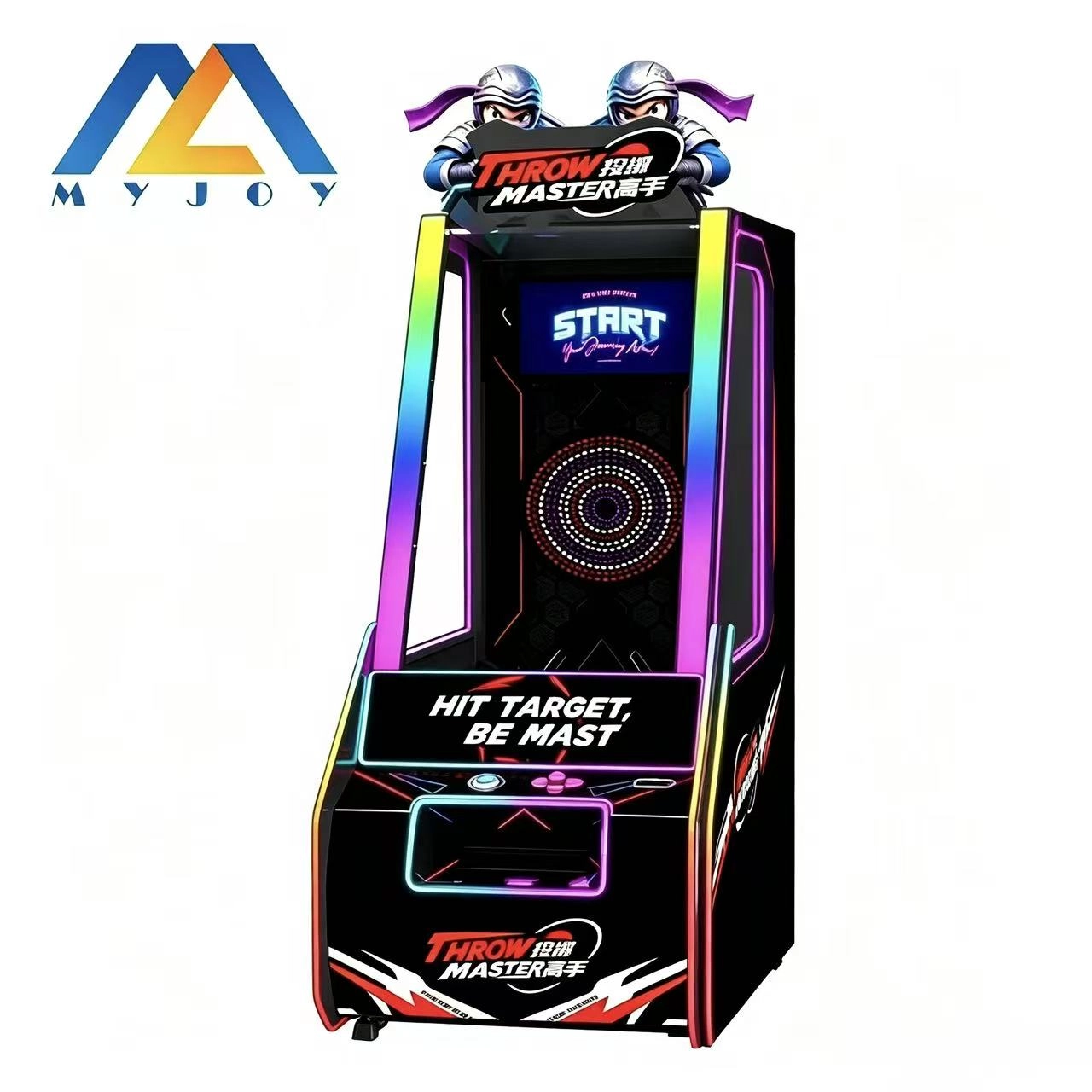
THROW MASTER is a commercial interactive dart throwing arcade machine that combines physical throwing action with an electronic target, digital scoring, on-screen interaction, and camera-based hit detection.
Designed for arcades, family entertainment centers (FECs), indoor amusement venues, shopping malls, and competitive entertainment spaces, THROW MASTER delivers an engaging mix of casual fun and skill-based competition.
Players insert coins, select their player and game mode, and throw darts at the large colorful electronic target. The system detects each result and displays scores, objectives, remaining throws, and game progress on the screen.
With Standard Mode for score-based challenges and Skill Mode for precision target challenges, the machine is suitable for both casual players and those looking for a more competitive experience. Leaderboards, adjustable game settings, and optional ticket rewards also make it well suited for commercial arcade operation.
Its large upright cabinet, colorful circular target, and vibrant RGB-style lighting create a futuristic arcade appearance that helps attract attention in busy entertainment venues.


No. 3, Wenjian Second Road, Wenbian Village, Shiji Town, Panyu District, Guangzhou City, China
Facebook