

Tips for buy coin operated game machine from China
Buying a coin operated game machine directly from China can give operators and distributors access to a broad manufacturing base, configurable designs, and competitive production costs. A safe purchase depends on verifying the supplier, documenting the machine’s technical and commercial requirements, testing a representative unit, agreeing on inspection and payment milestones, and choosing shipping terms that clearly allocate cost and risk. Plan import duties, electrical and product-safety requirements, spare parts, and after-sales support before production begins—not after the machine is on the water.
Understand the China sourcing landscape before requesting a quote
Distinguish a factory from a trading company
China has specialist amusement-equipment factories, exporters that coordinate production, and trading companies that source from several workshops. Each model can be suitable, but the right choice depends on your order size, technical complexity, and need for control. A direct manufacturer may provide faster access to engineering and production information; a trading company may consolidate products from different suppliers or offer broader export support. Neither label alone guarantees quality or reliability.
Ask the supplier for its registered Chinese Guangzhou Myjoy Animation Technology Co., Ltd., business licence, registered address, legal representative, and the name of the entity that will appear on the contract and invoice. Confirm that the business scope and address are consistent with its claims, and check the company through official or reputable business-information sources where available. Request a live video tour of the production and testing areas, with the supplier showing its name or identifying signage. If the seller claims to own a factory, ask to see relevant workstations, assembly records, and quality procedures rather than relying on showroom footage.
Confirm whether the quotation is issued by the manufacturer or another legal entity, and make sure the payment beneficiary matches the contracted entity. If a different company will receive funds, request a written explanation and supporting documents, then have your finance or legal team assess the arrangement. Do not treat a polished website, marketplace profile, or certificate image as a substitute for identity and payment checks.
| Point to compare | Direct manufacturer | Trading company or export intermediary |
|---|---|---|
| Product engineering contact | May provide direct access to production and technical staff; verify who will support your project. | May coordinate communication but depend on an upstream factory for technical answers. |
| Product range | Often strongest in its own equipment categories and configurations. | May offer a wider range by sourcing from multiple factories. |
| Quality visibility | Factory access can make production checks easier, subject to cooperation and location. | Ask which factory makes the machine and whether you can inspect it. |
| Commercial evaluation | Compare total price, engineering support, and warranty terms. | Compare the service provided and confirm who is responsible for defects and claims. |
Assess the order size and the supplier’s actual capability
Ask for the minimum order quantity (MOQ) for the standard model and for any customized version. A supplier may accept one unit for a sample or pilot order while requiring a larger batch for custom artwork, cabinet dimensions, payment systems, or software changes. Get each MOQ and its price effect in writing. Request a cost breakdown that identifies the machine configuration, included accessories, packaging, customization charges, and any optional items, such as a card reader or additional spare parts.
Before paying a deposit, request evidence that the supplier can build the exact configuration you plan to sell or operate. This may include a current production video, technical drawings, wiring diagrams, a list of major components, and photographs of the control panel and coin mechanism. Ask which components are standard and which may be substituted. A supplier should not be expected to disclose another customer’s confidential information, but it should be able to explain its own product and acceptance process clearly.
Define specifications and verify quality before shipment
Turn the product brief into an acceptance specification
Descriptions such as “arcade game,” “standard voltage,” or “coin operated” are too vague to control a cross-border order. Provide a written specification for the coin operated game machine, including model, cabinet dimensions, weight, display type and size, game content, controls, sound, lighting, power input, plug type, and required accessories. Identify the intended market and venue, such as a family entertainment center, arcade, or unattended location, because operating conditions and payment needs may differ.
Specify how the machine accepts payment: coin denomination and currency, coin mechanism model, token compatibility, bill acceptor, card reader, or other payment interface. Confirm whether the equipment is designed for the destination currency and whether the payment system can be adjusted locally. Ask for the software language, menu options, update method, and any licensing or connectivity requirements. If the machine connects to a network or uses a remote management platform, clarify who supplies the service, what data is transmitted, and whether ongoing fees apply.
Record measurable acceptance criteria. Examples include the machine’s external dimensions within an agreed tolerance, correct startup and game operation, functioning controls and audio, no visible cabinet damage, and successful payment validation using specified coins or tokens. Agree on which items are inspected, how test results will be documented, and how nonconformities will be corrected. Attach approved drawings, artwork, and a configuration sheet to the purchase contract or purchase order.
Evaluate samples, components, and compliance claims
For a new model or supplier, consider a paid sample or pilot unit before committing to a larger run. Test the coin operated game machine in conditions similar to its intended use: repeated play cycles, payment acceptance, button or joystick response, sound and display performance, and operation after power cycling. Keep a dated record of test results and photographs, and identify the approved sample by model, revision, and configuration. A sample does not guarantee that every production unit will match, so the order should still include a production inspection plan.
Ask for the names and specifications of key electrical and payment components, including the power supply, wiring, connectors, and coin mechanism. Confirm that replacement parts will remain available and request a recommended spare-parts list with prices and lead times. Any claims about certifications should identify the exact model or component covered, the issuing or testing organization, the applicable standard, and the certificate’s validity and scope. A certificate for one component or model does not automatically establish compliance for a different finished machine.
Identify destination-market requirements before production. The rules that apply can depend on the country, product design, intended use, and whether the machine includes radio, payment, or network functions. For the European market, consult the European Commission’s guidance on CE marking and determine which legislation and conformity steps apply to the specific equipment. Ask the supplier for supporting technical documentation, but have a qualified importer or compliance professional confirm the obligations in the market where the product will be sold or operated.
Use staged quality control and a written defect process
Agree on quality checks at appropriate stages: review of materials or components where practical, an in-process check for customized work, and a final inspection before shipment. A pre-shipment inspection can verify quantity, model and configuration, workmanship, basic operation, packaging, labels, and the agreed payment test. Provide the inspector with the signed specification and acceptance criteria. Where the order or risk level warrants it, use an independent inspection firm, and make clear that inspection costs, timing, and access must be coordinated with the factory.
Ask the supplier to provide a test report, serial-number list, photographs, and packing details before the balance payment is due. Specify how defects will be handled: repair, replacement, spare parts, credit, or another agreed remedy, along with the process for reporting a problem and the evidence required. Define the warranty period, when it begins, what it covers, and whether labor, shipping, or on-site service is excluded. A warranty that does not explain who pays international freight may be difficult to use in practice.
Quality management systems can provide useful context but should not be mistaken for product approval. For example, ISO 9001 quality management system information explains a system standard; ask whether any certificate is current, issued to the actual manufacturing entity, and relevant to the site producing your order. Treat the certificate as one verification point, alongside technical review, inspection, and test evidence.
Control payment, shipping, and delivery risks
Agree on payment milestones and contract details
Use a written purchase contract or detailed purchase order that identifies the buyer and seller entities, machine model, configuration, quantity, price, currency, production lead time, packaging, inspection rights, shipment deadline, warranty, and remedies for nonconforming goods. Include approved artwork and technical documents as controlled attachments. Specify the governing language and how changes must be approved; informal messages can help manage the project, but critical changes should be confirmed in the contract record.
Payment structures vary with order size and supplier policy. A deposit followed by a balance after agreed production and inspection milestones is common, but terms should be negotiated based on the parties and transaction risk. Do not send the entire amount simply because a supplier says production is urgent. Before transferring funds, verify bank details independently using a known contact channel, especially if you receive a last-minute account-change request. Never rely solely on a new email or messaging account to confirm altered payment instructions.
Choose an Incoterm that matches your shipping capability
Incoterms clarify certain delivery responsibilities, costs, and risk-transfer points between buyer and seller; they do not replace a full sales contract or determine every issue, such as ownership transfer or payment. Name the chosen rule, the precise place or port, and the version in the contract. The International Chamber of Commerce’s Incoterms rules is the authoritative reference for the rules and their scope. The following comparison is a practical starting point, not a substitute for confirming the exact rule and route with your forwarder.
| Term | Typical allocation for a sea shipment | Buyer considerations |
|---|---|---|
| FOB, named port of shipment | Seller handles export clearance and delivery onto the vessel at the named port; the buyer arranges main carriage and import clearance. | Generally used for sea or inland waterway transport. Agree who manages origin handling and confirm the named port and shipment point. |
| CIF, named destination port | Seller pays the cost and freight and obtains the required insurance to the named destination port; risk generally transfers when goods are loaded aboard at the shipment port. | Do not assume seller-paid freight means seller retains transit risk until arrival. Confirm insurance terms, coverage, and destination charges. |
| DDP, named place of destination | Seller takes responsibility for delivery to the named place, including import clearance and applicable duties under the rule. | Confirm the seller can legally and practically act as importer or arrange import clearance in your country, and define unloading responsibility. |
For machines moving in a container, ask your freight forwarder whether a container-appropriate rule such as FCA would better match the handover. Under any term, clarify who books the carrier, pays origin and destination handling charges, arranges cargo insurance, and handles customs documents. Ask for the named location in full; “FOB China” or “CIF Europe” is not precise enough to avoid disputes.
Prepare packaging, customs documents, and after-arrival support
Confirm packaging suitable for the transport mode and the machine’s weight and fragility. Request internal protection for screens, controls, and moving parts, plus external packing that resists handling and moisture during transit. If wood packaging is used in international trade, ask the supplier and forwarder to confirm applicable import requirements, including whether treatment and marking under the relevant rules are required for the destination. Photograph the packed equipment and shipping marks before dispatch.
Before shipment, have the commercial invoice, packing list, transport document, and any certificates or declarations required for the destination checked for consistent product descriptions, quantities, values, and consignee details. Confirm the tariff classification and estimate duties and taxes with a customs broker or the destination customs authority rather than relying on an unverified code supplied by a seller. The World Customs Organization’s explanation of the Harmonized System provides background on the international goods-classification framework, but national tariff codes and rates must be checked locally.
Ask for the shipping schedule, estimated transit time, tracking details, and the party responsible for customs clearance. Transit estimates are not guarantees: port congestion, inspections, routing changes, and local delivery arrangements can affect arrival. Plan for destination charges, unloading equipment, site access, installation, and electrical connection before the machine arrives. Obtain installation instructions, troubleshooting guidance, wiring information, and a named support contact in advance, and keep records of serial numbers and any damage observed at delivery.
Contact us to discuss a transparent, direct-from-factory sourcing process for your coin operated game machine, including specifications, inspection planning, and shipping coordination.
Frequently Asked Questions
How can I verify that a Chinese coin operated game machine supplier is a real manufacturer?
Check the supplier’s registered company name, business licence, address, and contracting entity. Request a live video tour of the production and testing areas, and verify that the payment beneficiary matches the entity named in the contract. Confirming whether the seller is a factory or intermediary is more useful than relying on a website or marketplace profile alone.
Should I order a sample before placing a bulk order?
For a new model or supplier, consider a paid sample or pilot unit. Test payment acceptance, game operation, controls, display, sound, and repeated-use performance, and record the approved model and configuration. A sample does not replace production inspection, so include a separate pre-shipment quality plan in the order.
What should I include in the technical specification?
Document the model, dimensions, weight, display, game content, controls, sound, lighting, power input, plug type, payment method, coin or token compatibility, language, software, accessories, and destination market. Add measurable acceptance criteria and attach approved drawings or artwork to the purchase order.
Which Incoterm should I use when importing from China?
The best term depends on your transport mode and logistics capability. FOB and CIF are generally sea or inland-waterway terms; under CIF, risk generally transfers when the goods are loaded aboard at the shipment port even though the seller pays freight and obtains insurance to the destination port. Compare FCA or other applicable terms with your forwarder, specify the named place, and confirm who handles insurance, customs, and destination charges.
How do I reduce the risk of receiving a defective machine?
Agree on a written specification and acceptance criteria, arrange inspections at appropriate production stages, and consider an independent pre-shipment inspection. Require documented operating and payment tests, photographs, and a serial-number list. Set out the defect-reporting process, warranty scope, remedies, and responsibility for shipping costs in the contract.
What documents and import costs should I plan for?
Common shipping records include a commercial invoice, packing list, and transport document, with additional declarations or certificates depending on the product and destination. Confirm tariff classification, duties, taxes, customs clearance, cargo insurance, port or terminal charges, unloading, and local delivery costs with a qualified customs broker or forwarder before shipment.
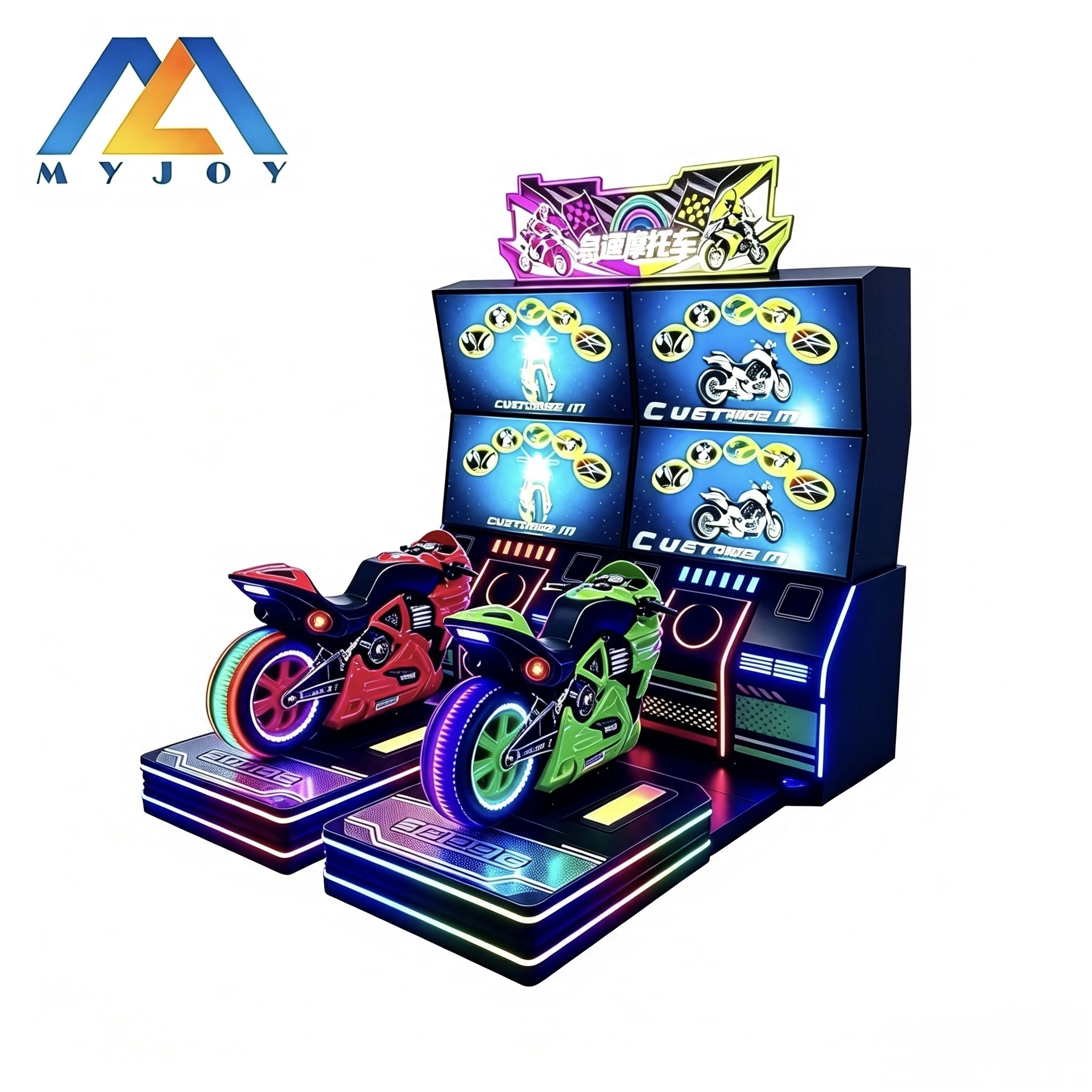
Motorcycle Racing Arcade Machine is a dual-player competitive interactive racing machine designed with a realistic motorcycle body and control system. Players control steering by leaning their body left or right, combined with a motion platform and dynamic racing visuals to deliver a highly immersive riding experience. It supports head-to-head multiplayer competition and is suitable for arcades and various trendy entertainment venues.
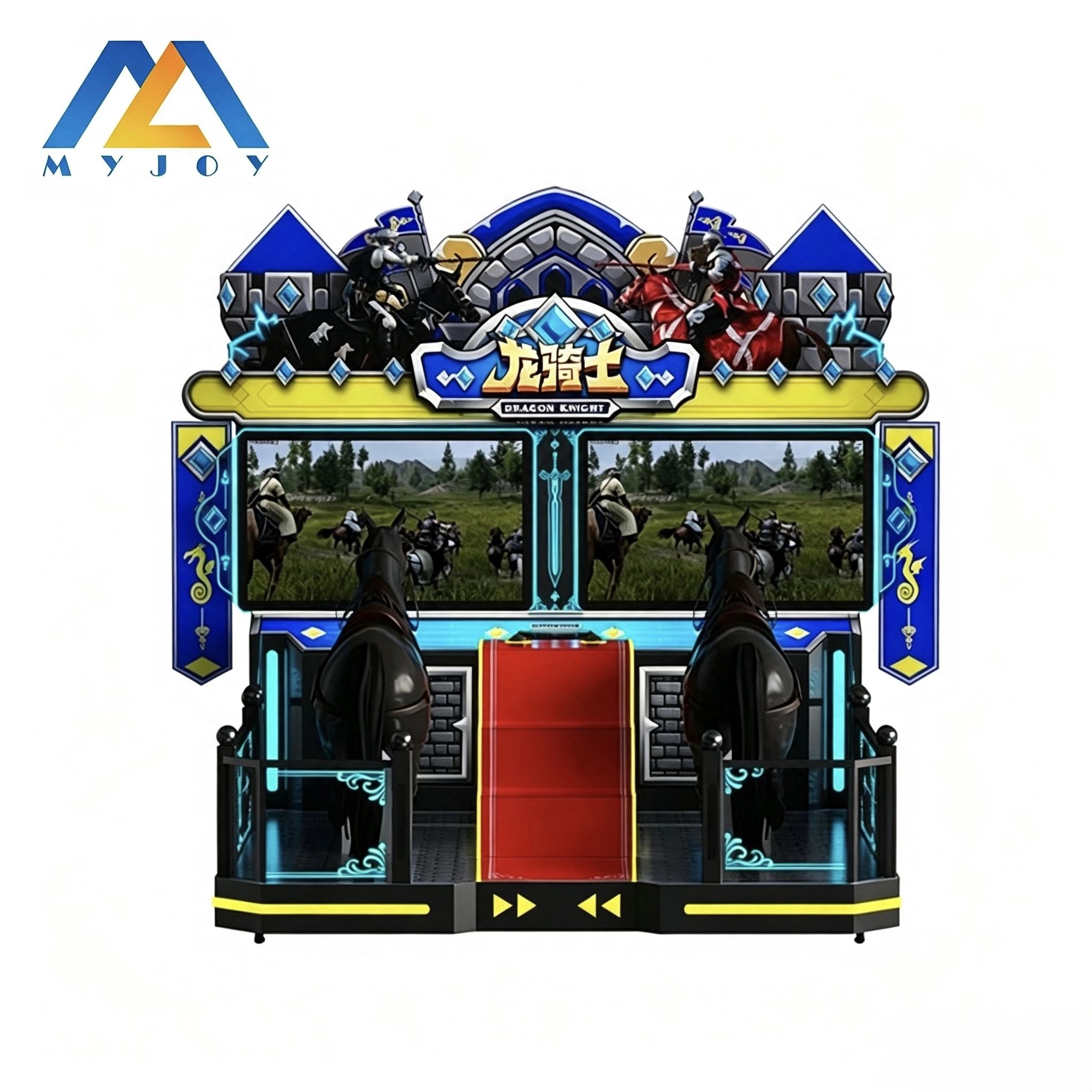
Flying Dragon Knight Horse Racing Simulator is a premium two-player arcade entertainment machine designed for amusement parks, shopping malls, arcades, family entertainment centers and themed attractions. Inspired by medieval knights and fantasy dragon adventures, this simulator combines realistic horse riding motion, interactive racing gameplay and an impressive visual design to create an unforgettable entertainment experience.
Featuring two realistic horse models, dual HD displays, dynamic motion control, vibration feedback and immersive sound effects, players can experience exciting horse racing competitions, adventure challenges and jumping missions. The machine recreates the feeling of real horseback riding through synchronized movement and responsive control systems.
With its eye-catching dragon knight appearance, colorful LED lighting, multiplayer competition mode and safe commercial design, Flying Dragon Knight Horse Racing Simulator is an excellent attraction solution for increasing customer engagement and entertainment value.
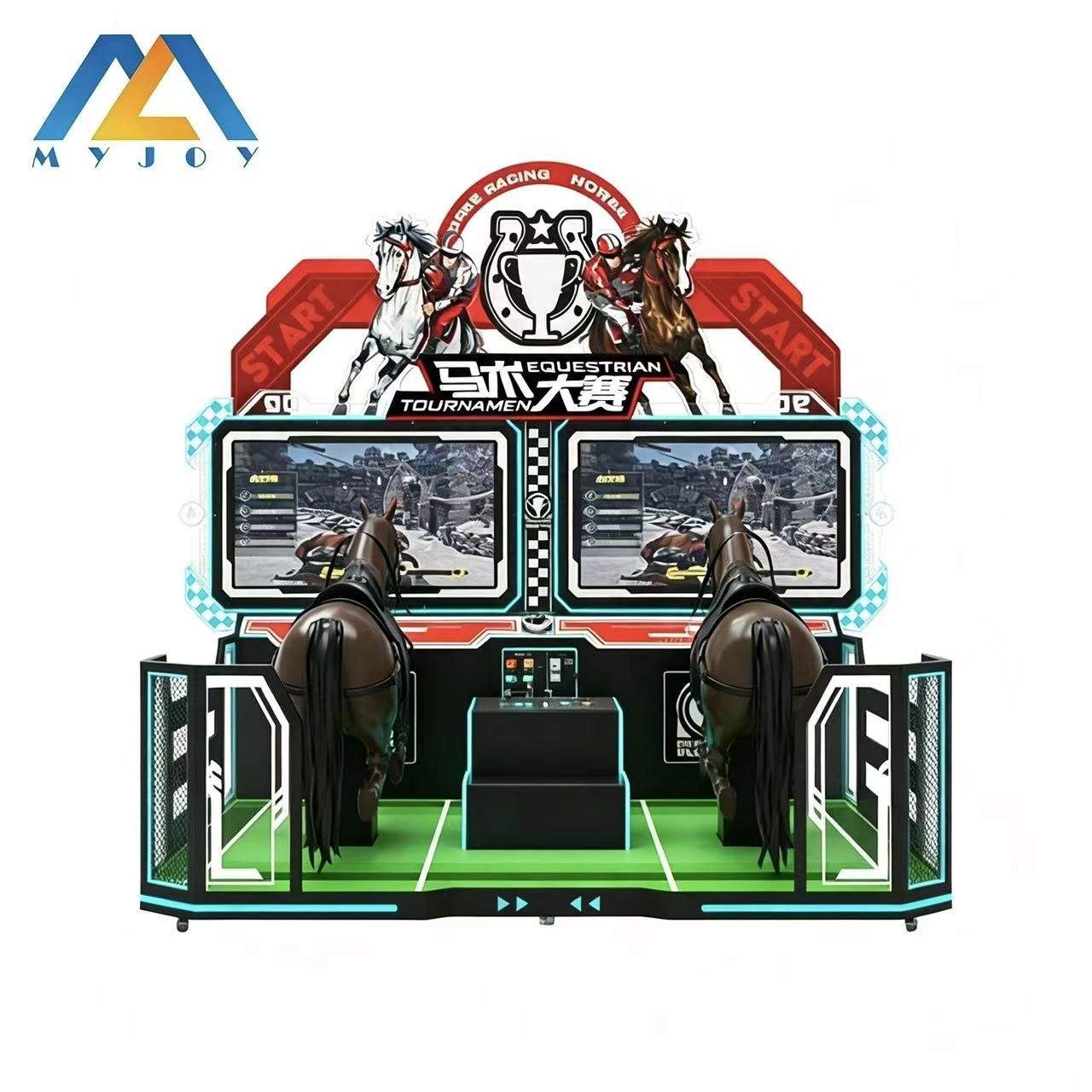
The Horse Racing Championship is a dual-player interactive sports simulator developed by Guangzhou Meiyilian Animation Technology Co., Ltd. It combines simulated horseback riding, competitive racing, physical interaction, and immersive visual effects to create an exciting attraction for players aged 5 to 50.
The machine features two realistic horse models equipped with comfortable saddles and reins. Players control their horses through riding movements and compete on two HD screens. Multiple racing scenes, difficulty levels, and challenge modes make the experience suitable for beginners and experienced players alike.
With its striking equestrian-themed design, dynamic LED lighting, green racetrack-style platform, and competitive ranking system, the machine easily attracts attention and encourages repeat play. It is ideal for amusement arcades, shopping malls, family entertainment centers, sports venues, theme parks, clubs, and tourist attractions.
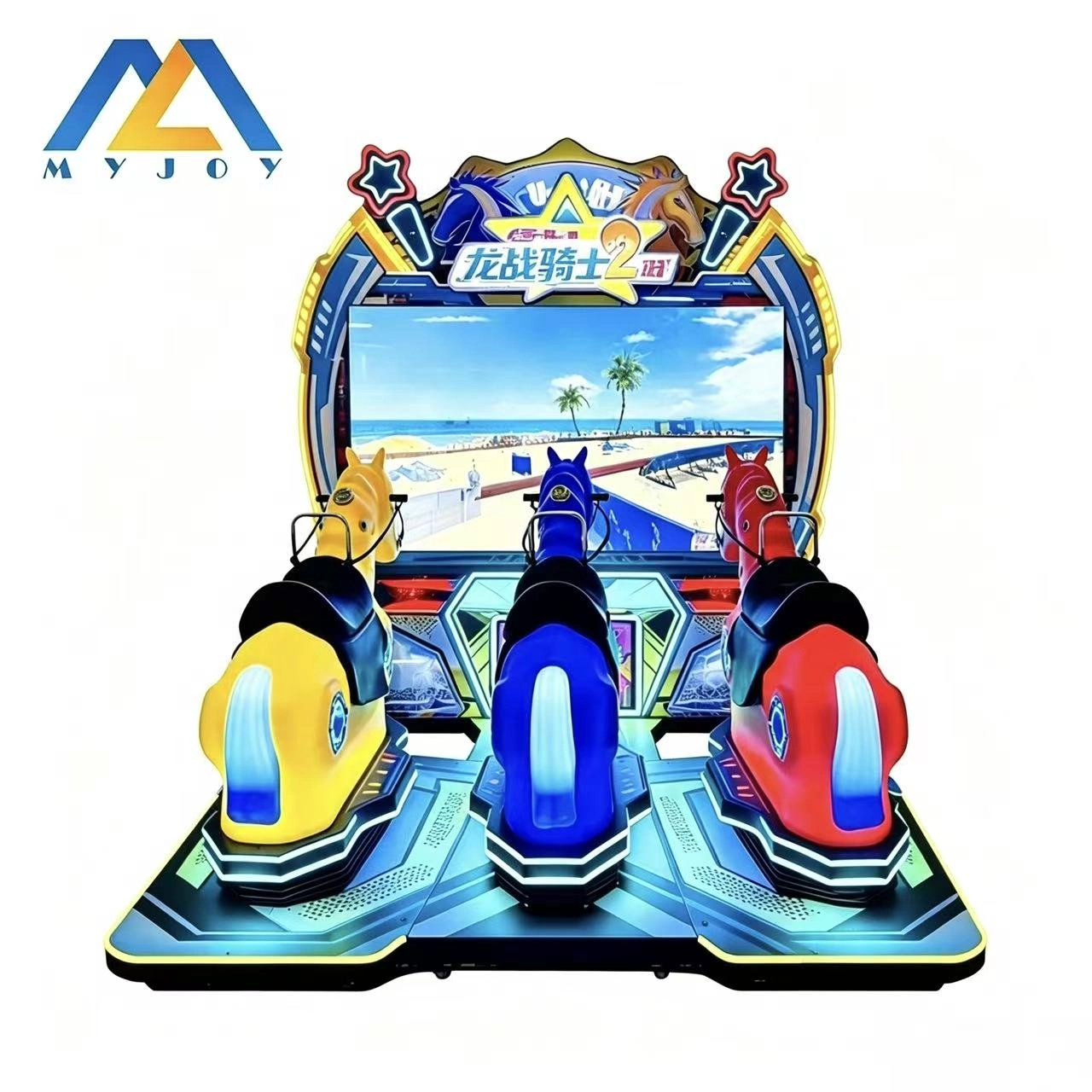
Dragon Warrior Knight 2 – Bring Real Horse Racing Excitement to Indoor Entertainment Venues
Dragon Warrior Knight 2 is an immersive interactive horse riding arcade machine designed around horse racing, obstacle challenges, and multiplayer competition. Featuring a cute and colorful horse design, large HD display, dynamic lighting effects, surround sound system, and realistic rein-control operation, this simulator creates an exciting horse racing experience for children, teenagers, and families.
Players can experience the feeling of riding a racing horse by controlling the reins to accelerate, change direction, and jump over obstacles. The realistic riding movements and interactive gameplay provide strong immersion and encourage repeat play.
The machine supports single-player challenge mode and 3-player competitive racing mode, allowing players to compete with friends, family members, or teammates. It is an ideal attraction for children's playgrounds, arcades, shopping malls, amusement parks, and family entertainment centers.


No. 3, Wenjian Second Road, Wenbian Village, Shiji Town, Panyu District, Guangzhou City, China
Facebook